Pesola Arto J, Laukkanen Arto, Heikkinen Risto, Sipilä Sarianna, Sääkslahti Arja, Finni Taija
Neuromuscular Research Center, Faculty of Sport and Health Sciences, University of Jyväskylä, Jyväskylä, Finland.
Faculty of Sport and Health Sciences, University of Jyväskylä, Jyväskylä, Finland.
PLoS One. 2017 Aug 24;12(8):e0183299. doi: 10.1371/journal.pone.0183299. eCollection 2017.
It is unknown whether reducing sedentary time at work and during leisure time is possible and effective during one year.
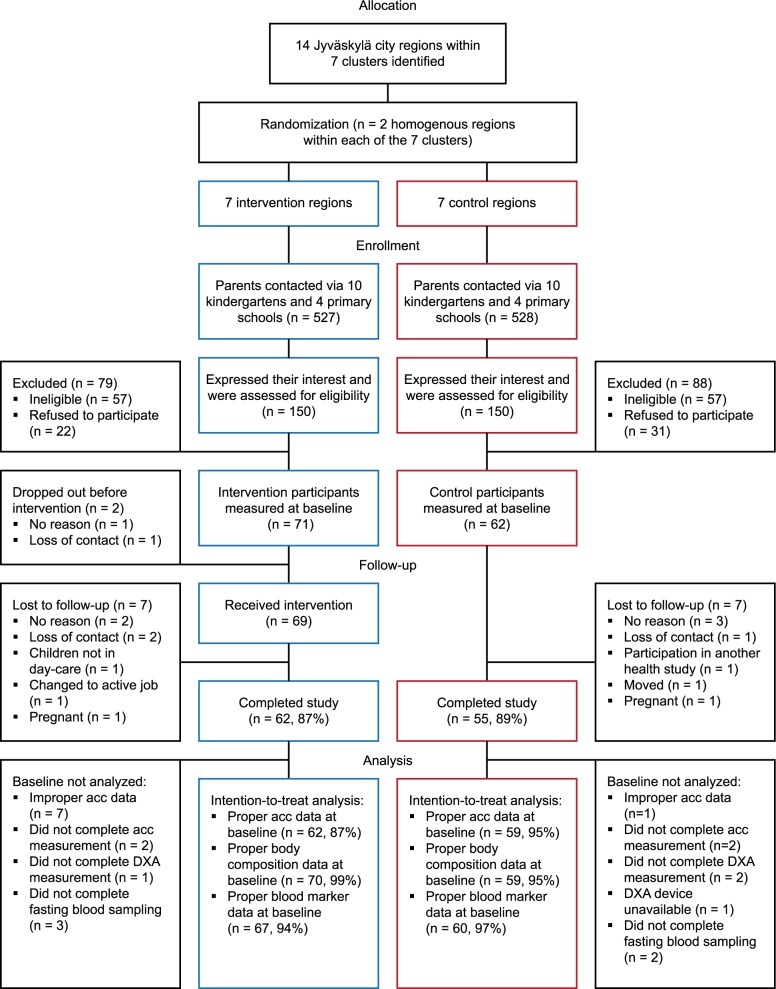
Office workers with young children were recruited for this one-year cluster-randomized controlled trial through kindergartens and primary schools from 7 clusters in the city of Jyväskylä, Finland. After a lecture, face-to-face tailored counseling was used to set contractually binding goals regarding reducing and breaking up sitting periods and increasing light intensity physical activity during work and leisure time. Primary outcomes of total, work and leisure sedentary time (<100 counts/min, cpm), light activity time (<2020 cpm), moderate-to-vigorous activity time (MVPA) and breaks/sedentary hour were assessed with a waist-worn Alive -accelerometer for 7 days, 5 times during the year. Anthropometrics (DXA), fasting biomarkers and self-reported diet were assessed as secondary outcomes. Data were collected between 2011-2013 and analyzed between 2013-2016 with a linear mixed-effects model fit by REML using likelihood ratio test and intention-to-treat-principle.
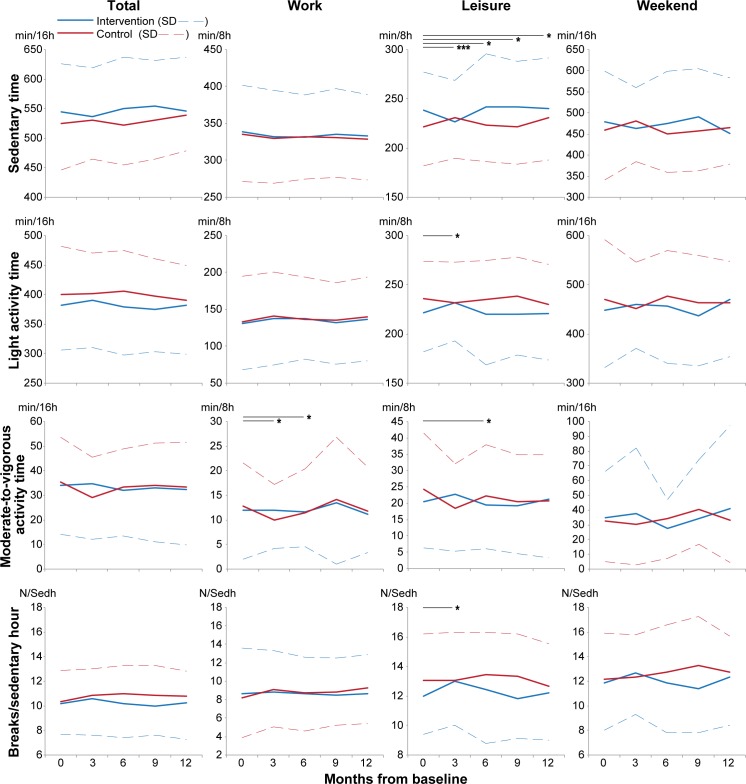
Participants from intervention (N = 71) and control (N = 62) regions were assessed at baseline and 117 completed the study. Sedentary leisure time decreased [-21.2 (95% CI -37.3 to -5.1) min/8 hours, likelihood ratio P<0.001] and light activity time [13.4 (-2.2 to 29.0) min/8 hours, P = 0.008] and breaks per sedentary hour [1.0 (-0.2 to 2.2), P = 0.010] increased in the intervention group as compared to controls at 3 months. The decrease in sedentary leisure time was maintained throughout the year [-7.9 (-24.0 to 8.3) min/8 hours, P = 0.029]. Small decreases in the control group's work and leisure MVPA were observed mostly at 3 months. Small favorable intervention effects were observed for fasting plasma glucose at 3 months and for leg lean mass and apoB/apoA-1 ratio at 12 months, with no changes in other outcomes.
Behavioral counseling induced a small decline in sedentary leisure time throughout one year in parents with a sedentary occupation and young children. Small concurrent changes in different biomarkers suggest that reducing sedentary leisure time during one year may be beneficial.
ISRCTN28668090, registered 30 November 2011.
尚不清楚在一年时间内减少工作和休闲时的久坐时间是否可行且有效。
通过芬兰于韦斯屈莱市7个社区的幼儿园和小学招募有年幼子女的上班族参与这项为期一年的整群随机对照试验。在一次讲座后,采用面对面的个性化咨询来设定具有合同约束力的目标,即减少和打破久坐时段,并增加工作和休闲时的轻度体力活动。使用腰部佩戴的Alive加速度计在一年中的5个时间段内连续7天评估总久坐时间、工作和休闲久坐时间(<100计数/分钟,cpm)、轻度活动时间(<2020 cpm)、中度至剧烈活动时间(MVPA)以及每久坐小时的休息次数等主要结局指标。将人体测量学指标(双能X线吸收法)、空腹生物标志物和自我报告的饮食作为次要结局指标进行评估。数据收集于2011年至2013年期间,并于2013年至2016年期间使用通过限制最大似然法拟合的线性混合效应模型,采用似然比检验和意向性分析原则进行分析。
对干预组(N = 71)和对照组(N = 62)的参与者在基线时进行了评估,共有117人完成了研究。与对照组相比,干预组在3个月时久坐休闲时间减少了[-21.2(95%置信区间 -37.3至 -5.1)分钟/8小时,似然比P<0.001],轻度活动时间增加了[13.4(-2.2至29.0)分钟/8小时,P = 0.008],每久坐小时的休息次数增加了[1.0(-0.2至2.2),P = 0.010]。久坐休闲时间的减少在全年中得以维持[-7.9(-24.0至8.3)分钟/8小时,P = 0.029]。对照组的工作和休闲MVPA在3个月时大多出现小幅下降。在3个月时观察到空腹血糖有小幅度的有利干预效果,在12个月时观察到腿部瘦体重和载脂蛋白B/载脂蛋白A-1比值有小幅度的有利干预效果,其他结局指标无变化。
行为咨询使从事久坐职业且有年幼子女的父母的久坐休闲时间在一整年中出现了小幅下降。不同生物标志物同时出现的小幅度变化表明,在一年中减少久坐休闲时间可能是有益的。
ISRCTN28668090,于2011年11月30日注册。