Hadgraft Nyssa T, Winkler Elisabeth, Climie Rachel E, Grace Megan S, Romero Lorena, Owen Neville, Dunstan David, Healy Genevieve, Dempsey Paddy C
Centre for Urban Transitions, Swinburne University of Technology, Melbourne, VIC, Australia.
Baker Heart and Diabetes Institute, Melbourne, VIC, Australia.
Br J Sports Med. 2021 Feb;55(3):144-154. doi: 10.1136/bjsports-2019-101154. Epub 2020 Apr 8.
CONTEXT/PURPOSE: Observational and acute laboratory intervention research has shown that excessive sedentary time is associated adversely with cardiometabolic biomarkers. This systematic review with meta-analyses synthesises results from free living interventions targeting reductions in sedentary behaviour alone or combined with increases in physical activity.
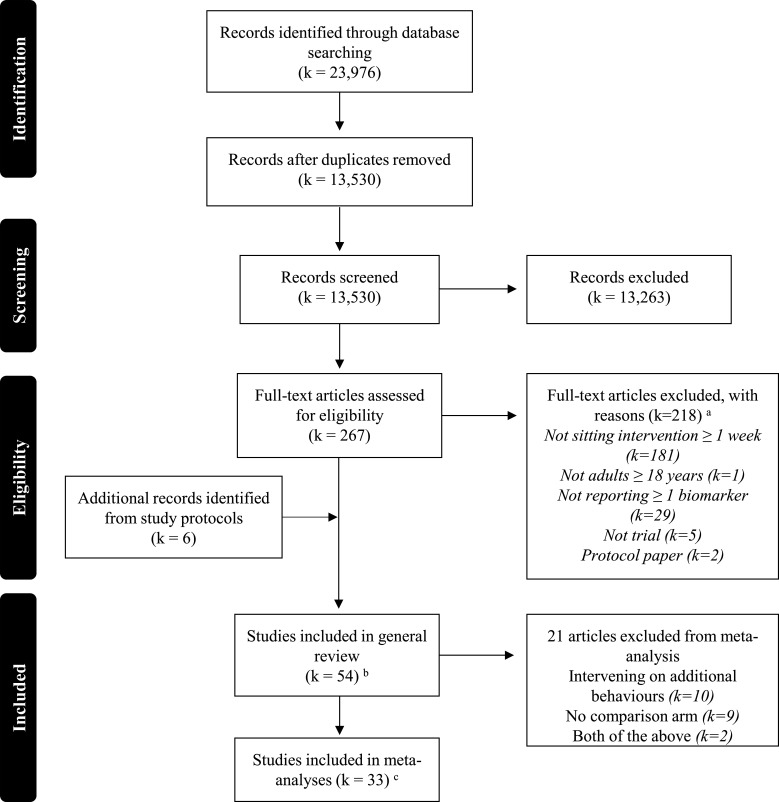
Six electronic databases were searched up to August 2019 for sedentary behaviour interventions in adults lasting for ≥7 days publishing cardiometabolic biomarker outcomes covering body anthropometry, blood pressure, glucose and lipid metabolism, and inflammation (54 studies). The pooled effectiveness of intervention net of control on 15 biomarker outcomes was evaluated using random effects meta-analyses in the studies with control groups not providing other relevant interventions (33 studies; 6-25 interventions analysed).
Interventions between 2 weeks and <6 months in non-clinical populations from North America, Europe and Australia comprised much of the evidence base. Pooled effects revealed small, significant (p<0.05) beneficial effects on weight (≈ -0.6 kg), waist circumference (≈ -0.7 cm), percentage body fat (≈ -0.3 %), systolic blood pressure (≈ -1.1 mm Hg), insulin (≈ -1.4 pM) and high-density lipoprotein cholesterol (≈ 0.04 mM). Pooled effects on the other biomarkers (p>0.05) were also small, and beneficial in direction except for fat-free mass (≈ 0.0 kg). Heterogeneity ranged widely (I=0.0-72.9).
Our review of interventions targeting sedentary behaviour reductions alone, or combined with increases in physical activity, found evidence of effectiveness for improving some cardiometabolic risk biomarkers to a small degree. There was insufficient evidence to evaluate inflammation or vascular function. Key limitations to the underlying evidence base include a paucity of high-quality studies, interventions lasting for ≥12 months, sensitive biomarkers and clinical study populations (eg, type 2 diabetes).
CRD42016041742.
背景/目的:观察性研究和急性实验室干预研究表明,久坐时间过长与心血管代谢生物标志物存在不良关联。本系统评价及荟萃分析综合了旨在单独减少久坐行为或同时增加身体活动的自由生活干预研究结果。
检索了6个电子数据库,截至2019年8月,查找针对成年人且持续时间≥7天的久坐行为干预研究,这些研究发表了涵盖身体测量、血压、血糖和脂质代谢以及炎症的心血管代谢生物标志物结果(54项研究)。在未提供其他相关干预措施的对照组研究中(33项研究;分析了6 - 25项干预措施),使用随机效应荟萃分析评估干预措施相对于对照组对15种生物标志物结果的综合有效性。
来自北美、欧洲和澳大利亚的非临床人群中,为期2周且<6个月的干预措施构成了大部分证据基础。综合效应显示,对体重(约 -0.6千克)、腰围(约 -0.7厘米)、体脂百分比(约 -0.3%)、收缩压(约 -1.1毫米汞柱)、胰岛素(约 -1.4皮摩尔)和高密度脂蛋白胆固醇(约0.04毫摩尔)有小的、显著的(p<0.05)有益影响。对其他生物标志物的综合效应(p>0.05)也较小,除去脂体重(约0.0千克)外,方向上均有益。异质性范围广泛(I=0.0 - 72.9)。
我们对单独针对减少久坐行为或同时增加身体活动的干预措施的综述发现,有证据表明这些措施在一定程度上能有效改善一些心血管代谢风险生物标志物。但评估炎症或血管功能的证据不足。基础证据的关键局限性包括高质量研究较少、干预持续时间≥12个月、敏感生物标志物以及临床研究人群(如2型糖尿病患者)缺乏。
CRD42016041742。