Division of Developmental and Behavioral Medicine, Department of Pediatrics, Stanford University School of Medicine, 1265 Welch Road X119, Stanford, CA 94305, USA.
The Gonda Multidisciplinary Brain Research Center, Bar Ilan University, Ramat Gan 5290002, Israel.
Neuroimage Clin. 2017 Aug 8;16:268-275. doi: 10.1016/j.nicl.2017.08.005. eCollection 2017.
We previously observed a complex pattern of differences in white matter (WM) microstructure between preterm-born (PT) and full-term-born (FT) children and adolescents age 9-17 years. The aim of this study was to determine if the same differences exist as early as age 6 years.
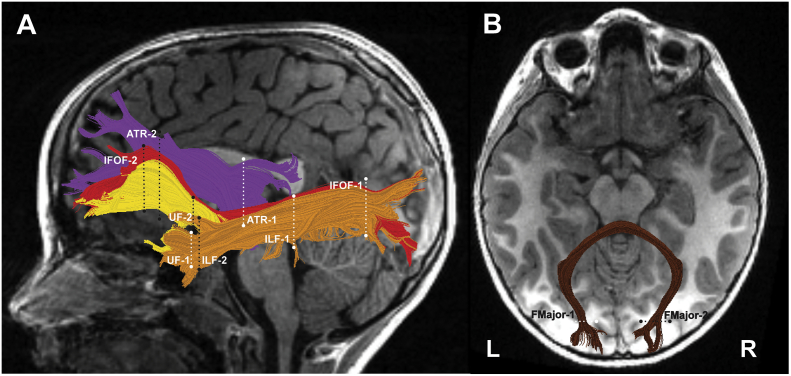
We obtained diffusion MRI (dMRI) scans in children born PT at age 6 years ( = 20; 11 males) and FT ( = 38; 14 males), using two scanning protocols: 30 diffusion directions (b = 1000 s/mm) and 96 diffusion directions (b = 2500 s/mm). We used deterministic tractography and analyzed fractional anisotropy (FA) along bilateral cerebral WM pathways that demonstrated differences in the older sample.
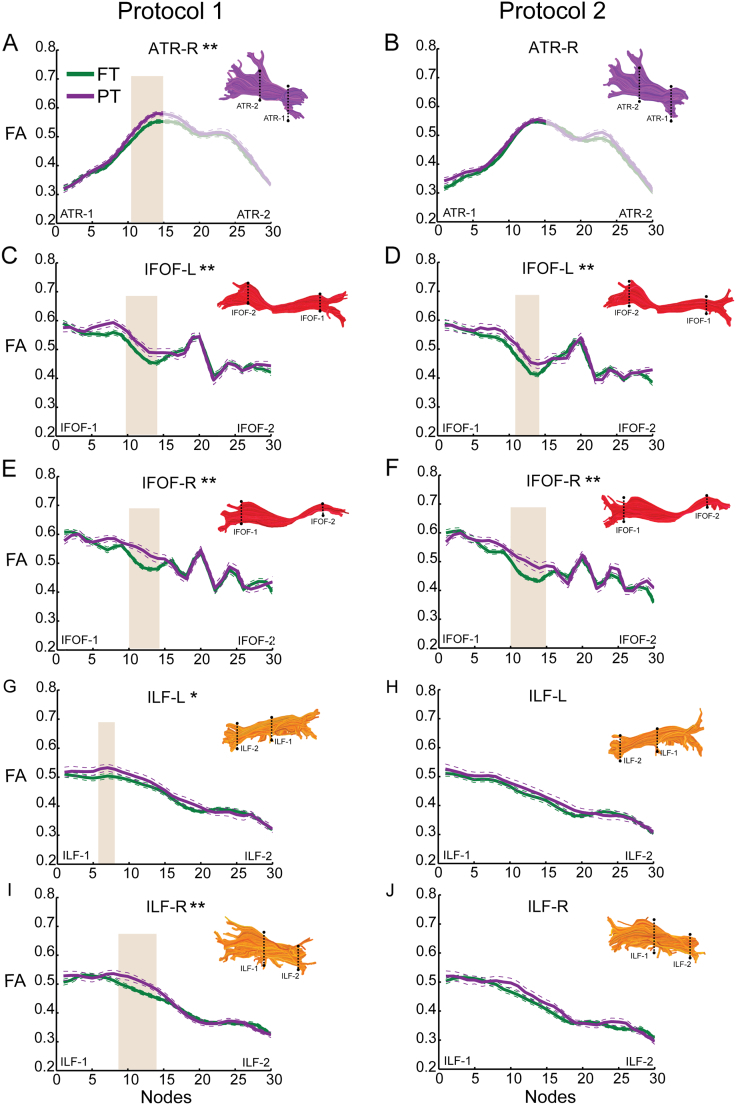
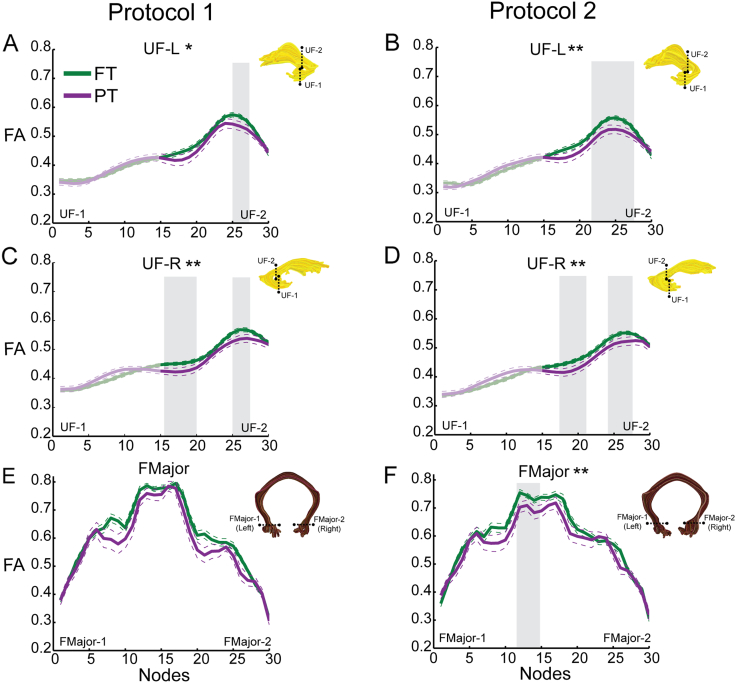
Compared to the FT group, the PT group showed (1) significantly decreased FA in the uncinate fasciculi and forceps major and (2) significantly increased FA in the right anterior thalamic radiation, inferior fronto-occipital fasciculi, and inferior longitudinal fasciculi. This pattern of group differences resembles findings in the previous study of older PT and FT participants. Group differences were similar across dMRI acquisition protocols.
The underlying neurobiology driving the pattern of PT-FT differences in FA is present as early as age 6 years. Generalization across dMRI acquisition protocols demonstrates the robustness of group differences in FA. Future studies will use quantitative neuroimaging techniques to understand the tissue properties that give rise to this consistent pattern of WM differences after PT birth.
我们之前观察到早产儿(PT)和足月儿(FT)儿童和青少年 9-17 岁之间的大脑白质(WM)微观结构存在复杂差异模式。本研究旨在确定这种差异是否早在 6 岁时就存在。
我们对 6 岁时出生的 PT 儿童(n=20;男 11 人)和 FT 儿童(n=38;男 14 人)进行了弥散磁共振成像(dMRI)扫描,使用了两种扫描方案:30 个扩散方向(b=1000 s/mm)和 96 个扩散方向(b=2500 s/mm)。我们使用确定性追踪技术,分析了双侧大脑 WM 通路的各向异性分数(FA),这些通路在年龄较大的样本中存在差异。
与 FT 组相比,PT 组的(1)钩束和内囊脚的 FA 显著降低,(2)右侧前丘脑辐射、下额枕束和下纵束的 FA 显著增加。这种组间差异模式类似于之前对年龄较大的 PT 和 FT 参与者的研究结果。不同的 dMRI 采集方案得到的组间差异相似。
导致 FA 中 PT-FT 差异的神经生物学基础在 6 岁时就存在。dMRI 采集方案的广泛应用证明了 FA 组间差异的稳健性。未来的研究将使用定量神经影像学技术来了解 PT 出生后 WM 差异的这种一致模式背后的组织特性。