Rose Michael, Crawford Dennis
Department of Orthopaedic Surgery and Rehabilitation, Oregon Health and Science University, Portland, Oregon, USA.
Orthop J Sports Med. 2017 Aug 7;5(8):2325967117719695. doi: 10.1177/2325967117719695. eCollection 2017 Aug.
Allograft healing (ligamentization) after reconstruction of the anterior cruciate ligament (ACL) is dependent on multiple factors, including tissue processing, host biologic environment, and biomechanical stressors. Magnetic resonance imaging (MRI) can be used to assess graft maturation after ACL reconstruction.
A significant difference will exist in the MRI analysis between 2 distinct allograft constructs. Specifically, the MRI signal-to-noise quotient (SNQ) value will be smaller in quadrupled hamstring tendon (HT) allografts compared with doubled tibialis anterior (TA) allografts due to the difference in graft geometry (surface area-to-volume ratio).
Cohort study; Level of evidence, 2.
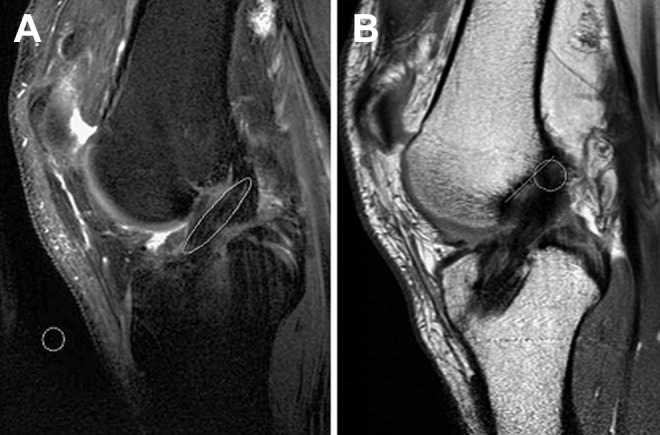
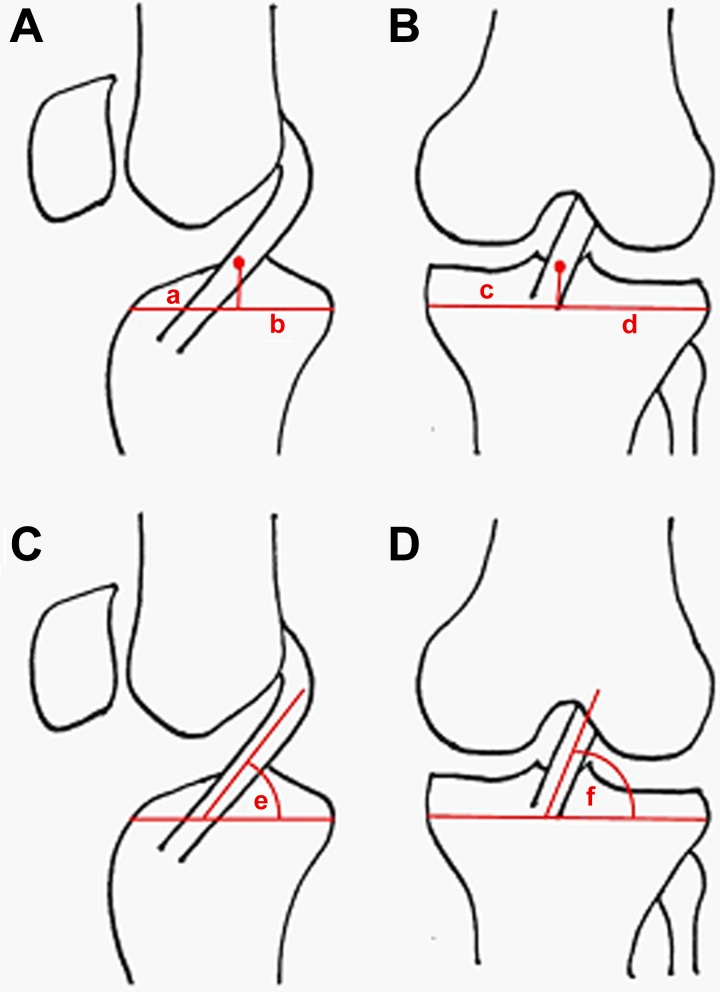
Prospectively collected data from a subset of patients who participated in a randomized controlled trial at a single center from July 2010 to April 2012 were reviewed. Patients underwent ACL reconstruction using either HT or TA allografts. Six months postoperatively, 32 patients underwent noncontrast MRI to assess ligamentization. The SNQ was calculated for the allograft using sagittal noncontrast T2-weighted MRI as follows: = ( - )/ . Graft properties including sagittal and coronal angle as well as tibial and femoral tunnel location were measured. All participants completed validated patient-reported outcome measures preoperatively and at 2 years postoperatively.
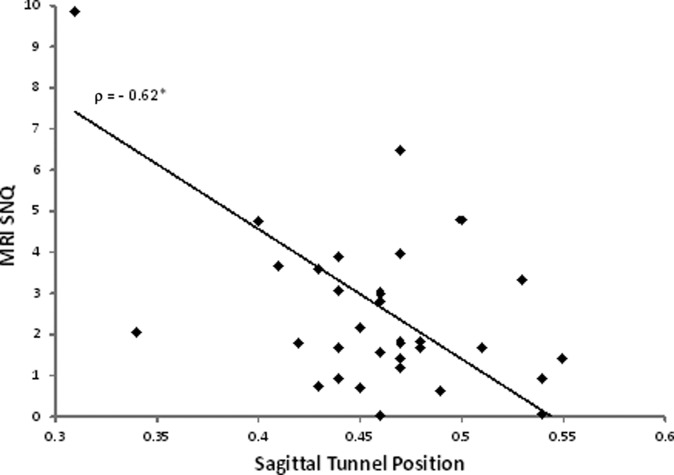
The mean MRI SNQ for the HT and TA allografts was 2.56 ± 2.41 and 3.15 ± 3.38, respectively ( = .57). For the entire group, there was a significant correlation between MRI SNQ and both sagittal graft angle ( = .02) and sagittal tibial tunnel position ( < .001). We did not find a significant correlation between the tibial tunnel location in the coronal plane, coronal graft angle, or location of the femoral tunnel and the MRI SNQ.
Allograft ligamentization 6 months postoperatively, as assessed by MRI, is dependent on position of the tibial tunnel in the sagittal plane as well as sagittal graft orientation. We did not detect a difference in graft maturation at 6 months between the tibialis anterior and hamstring tendon allografts. This is the only study to our knowledge that directly compares quadrupled HT allografts and doubled TA allografts using postoperative MRI.
前交叉韧带(ACL)重建术后同种异体移植物的愈合(韧带化)取决于多种因素,包括组织处理、宿主生物环境和生物力学应激源。磁共振成像(MRI)可用于评估ACL重建术后移植物的成熟情况。
两种不同的同种异体移植物构建物在MRI分析中会存在显著差异。具体而言,由于移植物几何形状(表面积与体积比)的差异,与双股胫骨前肌(TA)同种异体移植物相比,四股腘绳肌腱(HT)同种异体移植物的MRI信噪比(SNQ)值会更小。
队列研究;证据等级,2级。
回顾性分析2010年7月至2012年4月在单一中心参与一项随机对照试验的部分患者的前瞻性收集数据。患者接受使用HT或TA同种异体移植物的ACL重建。术后6个月,32例患者接受非增强MRI检查以评估韧带化情况。使用矢状面非增强T2加权MRI计算同种异体移植物的SNQ,公式如下:SNQ =(S - N)/ N。测量移植物特性,包括矢状面和冠状面角度以及胫骨和股骨隧道位置。所有参与者在术前和术后2年完成经过验证的患者报告结局指标评估。
HT和TA同种异体移植物的平均MRI SNQ分别为2.56±2.41和3.15±3.38(P = 0.57)。对于整个组,MRI SNQ与矢状面移植物角度(P = 0.02)和矢状面胫骨隧道位置(P < 0.001)均存在显著相关性。我们未发现冠状面胫骨隧道位置、冠状面移植物角度或股骨隧道位置与MRI SNQ之间存在显著相关性。
通过MRI评估,术后6个月同种异体移植物的韧带化取决于矢状面胫骨隧道的位置以及矢状面移植物的方向。我们未检测到胫骨前肌和腘绳肌腱同种异体移植物在6个月时移植物成熟度的差异。据我们所知,这是唯一一项使用术后MRI直接比较四股HT同种异体移植物和双股TA同种异体移植物的研究。