Schilaty Nathan D, Nagelli Christopher, Bates Nathaniel A, Sanders Thomas L, Krych Aaron J, Stuart Michael J, Hewett Timothy E
Department of Orthopedic Surgery, Mayo Clinic, Rochester, Minnesota, USA.
Biomechanics Laboratory and Sports Medicine Center, Mayo Clinic, Rochester, Minnesota, USA.
Orthop J Sports Med. 2017 Aug 18;5(8):2325967117724196. doi: 10.1177/2325967117724196. eCollection 2017 Aug.
The reported rate of second anterior cruciate ligament (ACL) injuries (20%-30%), including graft failure and contralateral ACL tears, after ACL reconstruction (ACLR) or nonoperative therapy indicates that multiple factors may predispose patients to subsequent ACL injuries.
To determine the incidence of second ACL injuries in a population-based cohort over a 10-year observation period (2001-2010) and to identify factors that contribute to the risk of second injuries.
Descriptive epidemiological study.
International Classification of Diseases, 9th Revision (ICD-9) codes relevant to the diagnosis of an ACL tear and the procedure code for ACLR were utilized to search the Rochester Epidemiology Project, a multidisciplinary county database, between the years of 2001 and 2010. The complete medical records for all cases were reviewed to confirm diagnosis and treatment details. A total of 914 unique patients with 1019 acute, isolated ACL tears were identified. These patients were stratified by primary and secondary tears, sex, age, activity level, side of injury, sex × side of injury, and graft type of reconstruction.
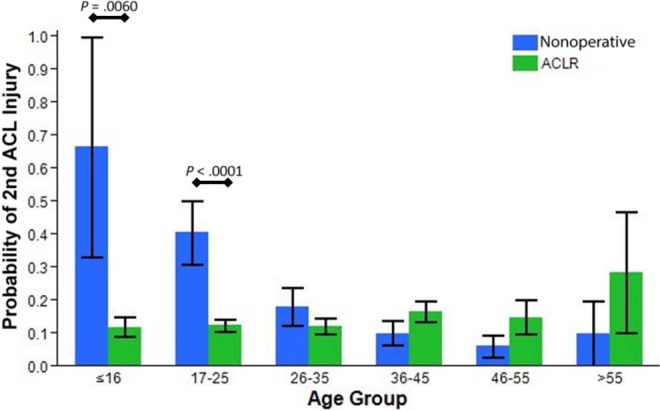
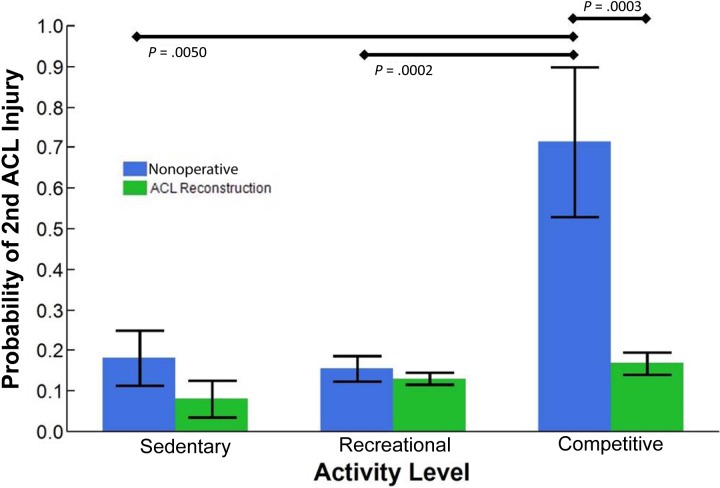
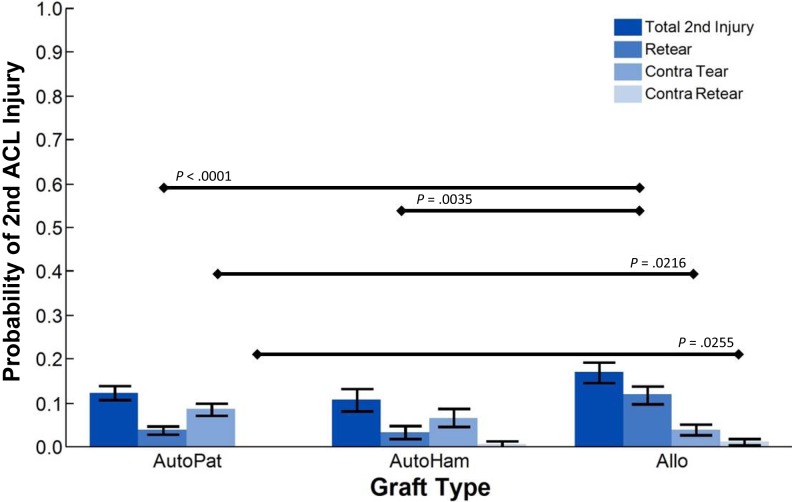
Second ACL tears were recorded in 141 (13.8%) of the 914 patients diagnosed with an ACL tear in Olmsted County, Minnesota, USA, from 2001 to 2010; 50.4% of these occurred in the contralateral knee. A noncontact mechanism was responsible for 76.4% of all ACL injuries. A second ACL injury was influenced by factors of sex × age group, treatment type × age group, and treatment type × activity level. Nonparametric analysis of graft disruption × graft type demonstrated that a higher prevalence of second ACL tears occurred with allografts compared with hamstring autografts ( = .0054) and patellar tendon autografts ( = .0001).
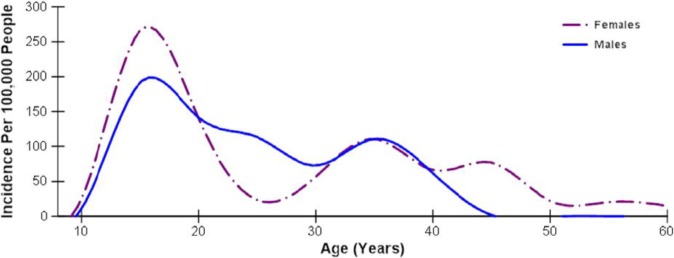
The incidence of second ACL tears in this population-based cohort was 13.8%, and half occurred to the ACL of the contralateral knee. Statistically, second ACL injuries differed by sex, occurring in female patients younger than 25 years and male patients aged 26 to 45 years. Allografts continued to be associated with a greater risk of second ACL injuries compared with hamstring and patellar tendon autografts. Nonoperative treatment carried more risk of contralateral tears than ACLR.
据报道,前交叉韧带(ACL)重建术(ACLR)或非手术治疗后,第二次ACL损伤(包括移植物失败和对侧ACL撕裂)的发生率为20%-30%,这表明多种因素可能使患者易发生后续ACL损伤。
确定在10年观察期(2001-2010年)内以人群为基础的队列中第二次ACL损伤的发生率,并确定导致二次损伤风险的因素。
描述性流行病学研究。
利用国际疾病分类第九版(ICD-9)中与ACL撕裂诊断相关的编码以及ACLR的手术编码,在罗切斯特流行病学项目(一个多学科的县级数据库)中检索2001年至2010年期间的数据。对所有病例的完整病历进行审查,以确认诊断和治疗细节。共确定了914例独特患者,他们有1019例急性、孤立性ACL撕裂。这些患者按初次和二次撕裂、性别、年龄、活动水平、损伤侧、性别×损伤侧以及重建的移植物类型进行分层。
2001年至2010年期间,在美国明尼苏达州奥尔姆斯特德县被诊断为ACL撕裂的914例患者中,有141例(13.8%)记录到第二次ACL撕裂;其中50.4%发生在对侧膝关节。76.4%的ACL损伤是由非接触机制导致的。第二次ACL损伤受性别×年龄组、治疗类型×年龄组以及治疗类型×活动水平等因素影响。对移植物断裂×移植物类型的非参数分析表明,与腘绳肌自体移植物(P = .0054)和髌腱自体移植物(P = .0001)相比,同种异体移植物发生第二次ACL撕裂的患病率更高。
在这个以人群为基础的队列中,第二次ACL撕裂的发生率为13.8%,其中一半发生在对侧膝关节的ACL。从统计学上看,第二次ACL损伤在性别上存在差异,发生在25岁以下的女性患者和26至45岁的男性患者中。与腘绳肌和髌腱自体移植物相比,同种异体移植物发生第二次ACL损伤的风险仍然更高。非手术治疗比对侧ACL重建术发生对侧撕裂的风险更高。