Key Laboratory of the Ministry of Education for Coastal and Wetland Ecosystem, College of the Environment and Ecology, Xiamen University, Xiamen, 361102, China.
State Key Laboratory of Marine Environmental Science, Institute of Marine Microbes and Ecospheres, College of Ocean and Earth Sciences, University, Xiamen, 361102, China.
Sci Rep. 2017 Aug 25;7(1):9494. doi: 10.1038/s41598-017-10308-y.
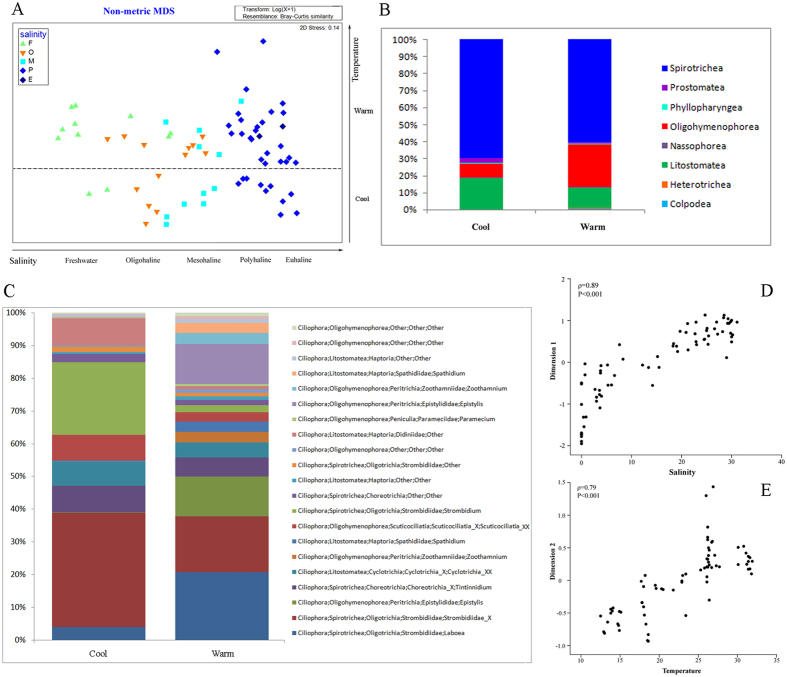
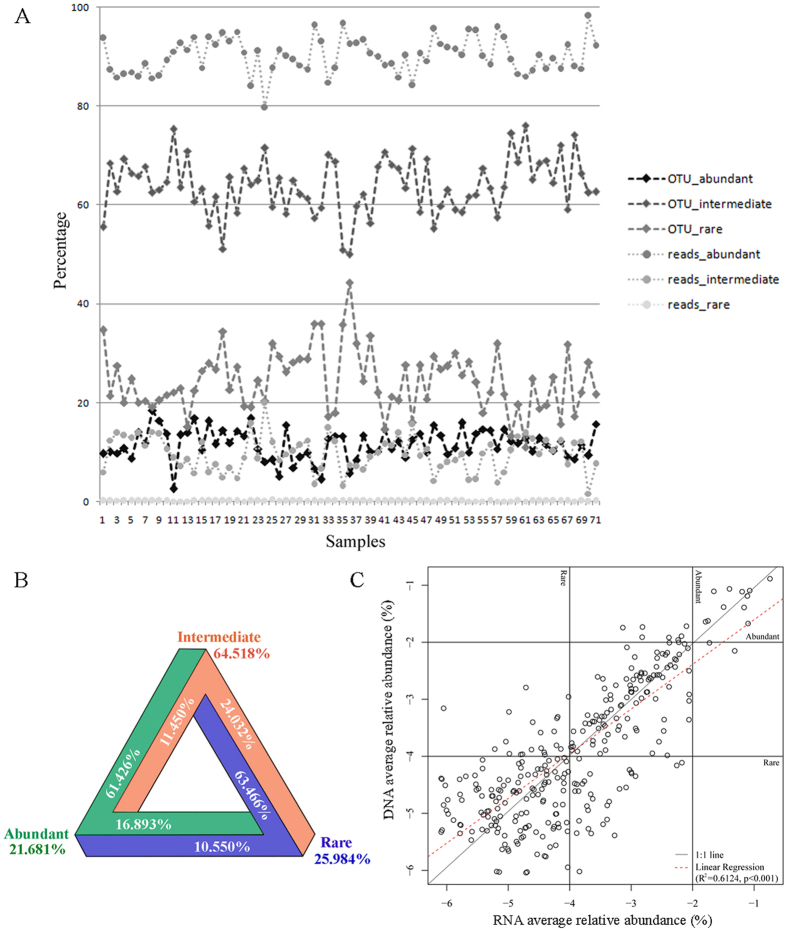
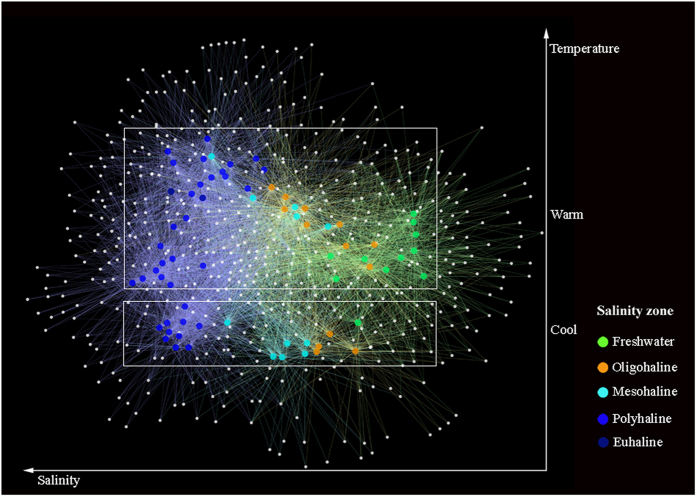
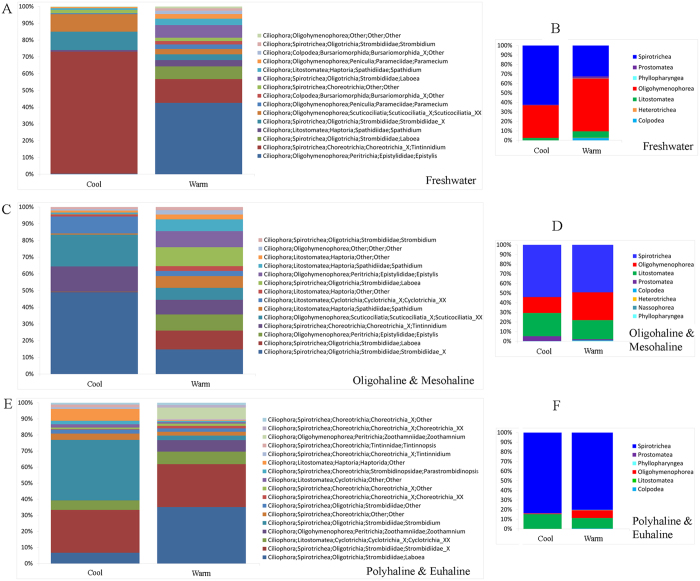
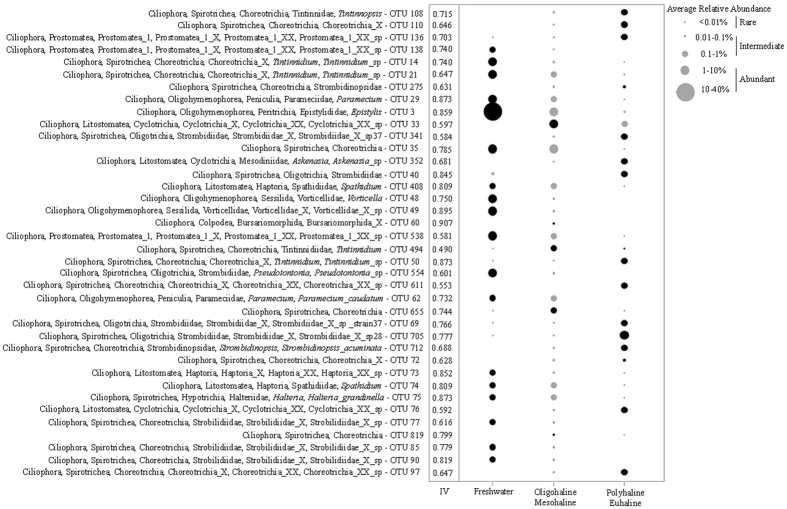
We examined the spatial and temporal variability of ciliate community in a subtropical estuary by rRNA and rDNA-based high throughput sequencing of 97 samples collected along the entire salinity gradient at two-month intervals in 2014. Community divided statistically into three groups: freshwater (salinity < 0.5‰), oligohaline and mesohaline (0.5‰ < salinity < 18‰), and polyhaline and euhaline (18‰ < salinity < 40‰). Across all three groups, salinity explained most of the community variability. Within each group, seasonal shifts in community formed cool (spring and winter) and warm (summer and autumn) subgroups, indicating that spatial variability overrode seasonal changes in determining community composition. Cool and warm groups showed opposite associations with temperature and prey proxies, suggesting distinct seasonal niche separation. The community reassembly of cool and warm groups was essentially due to transitions between intermediate (with relative abundance of 0.01-1%) and abundant (with relative abundance > 1%) OTUs. Further analyses demonstrated that the intermediate group not only encompassed comparable OTU richness to that of the total community and maintained high metabolic activity but also had the highest proportion in transition, either to abundance or rarity, thus offering a first view on how it varies across space and time and revealing the essential role it played in maintaining stability and functionality within the community.
我们通过高通量 rRNA 和 rDNA 测序技术,对 2014 年每隔两个月在整个盐度梯度上采集的 97 个样本进行了研究,以研究亚热带河口纤毛群落的时空变异性。群落根据统计学分为三组:淡水(盐度<0.5‰)、寡盐和中盐(0.5‰<盐度<18‰)和多盐和广盐(18‰<盐度<40‰)。在所有三组中,盐度解释了群落变化的大部分原因。在每组内,群落的季节性变化形成了凉爽(春季和冬季)和温暖(夏季和秋季)亚群,表明空间变异性在决定群落组成方面超过了季节性变化。凉爽和温暖的群体与温度和猎物指标呈相反的关系,表明它们的季节性生态位存在明显的分离。凉爽和温暖群体的群落再组装主要是由于中间(相对丰度为 0.01-1%)和丰富(相对丰度>1%)OTUs 的转变。进一步的分析表明,中间群体不仅包含与整个群落相当的 OTU 丰富度,并且保持着较高的代谢活性,而且在向丰度或稀有度的转变中比例最高,从而首次揭示了它在空间和时间上的变化方式,并揭示了它在维持群落稳定性和功能方面的重要作用。