Soni Priyanka, Qayoom Sumaira, Husain Nuzhat, Kumar Praveen, Chandra Anil, Ojha Bal Krishan, Gupta Rakesh Kumar
Department of Pathology, Ram Manohar Lohia Institute of Medical Sciences, Lucknow, Uttar Pradesh, India. Email:
Asian Pac J Cancer Prev. 2017 Aug 27;18(8):2215-2219. doi: 10.22034/APJCP.2017.18.8.2215.
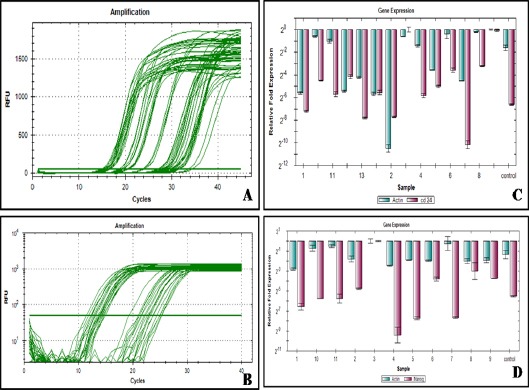
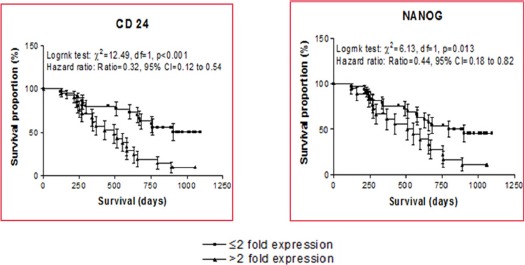
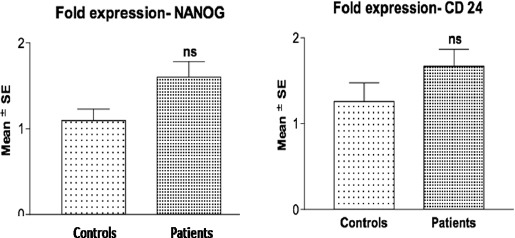
Background and aim: Glioblastoma (GBM) is one of the most common and aggressive brain tumors with a median survival of 12-14 months. The aim of present study was to evaluate the gene expression profile of stem cell markers Nanog and CD24 in GBM and to determine its relationship to outcome in terms of treatment response and overall survival. Material and methods: This was a retrospective as well as retrospective study which included 51 histologically confirmed cases of GBM. Expression of CD24, and Nanog was evaluated by RT-PCR. Control tissue included debrided brain tissue from open head injury cases. All cases of GBM underwent total surgical resection and subsequently chemotherapy. Immediate treatment response was evaluated at 3 months using Response Evaluation Criteria In Solid Tumors (RECIST) guidelines and overall survival was measured at 36 months. Result: As compared to control gene, expression of CD24 and Nanog was seen to be unregulated to 24.5% and 31.7% respectively. However, the difference in mean expression of cases and controls was not statistically significant. Correlation between expressions of these two markers was also not statistically significant. On univariate cox regression analysis, cases with >2 fold expression of CD24 and Nanog had significantly poor survival as compared to those with <2 fold expression. On multivariate analysis > 2 fold CD24 expression had a statistically significant correlation with poor survival. Conclusion: An overexpression of CD24 by more than two fold was associated with poor overall survival in GBM. Poor survival may be related to increased “stemness” of tumour cells. Targeted therapy inclusive of drugs targeting stem cells directly or indirectly may be a promising therapeutic option.
胶质母细胞瘤(GBM)是最常见且侵袭性最强的脑肿瘤之一,中位生存期为12 - 14个月。本研究的目的是评估干细胞标志物Nanog和CD24在GBM中的基因表达谱,并确定其与治疗反应和总生存期方面的预后关系。材料与方法:这是一项回顾性研究,纳入了51例经组织学确诊的GBM病例。通过RT-PCR评估CD24和Nanog的表达。对照组织包括开放性颅脑损伤病例的清创脑组织。所有GBM病例均接受了全手术切除,随后进行化疗。使用实体瘤疗效评价标准(RECIST)指南在3个月时评估即时治疗反应,并在36个月时测量总生存期。结果:与对照基因相比,CD24和Nanog的表达分别失调至24.5%和31.7%。然而,病例组和对照组的平均表达差异无统计学意义。这两种标志物表达之间的相关性也无统计学意义。单因素Cox回归分析显示,CD24和Nanog表达>2倍的病例与<2倍表达的病例相比,生存期显著较差。多因素分析显示,CD24表达>2倍与生存期差具有统计学显著相关性。结论:GBM中CD24过表达超过两倍与总生存期差相关。生存期差可能与肿瘤细胞“干性”增加有关。包括直接或间接靶向干细胞的药物在内的靶向治疗可能是一种有前景的治疗选择。