Byrling Johannes, Andersson Roland, Sasor Agata, Lindell Gert, Ansari Daniel, Nilsson Johan, Andersson Bodil
Department of Surgery, Clinical Sciences Lund, Lund University, and Skåne University Hospital (Johannes Byrling, Roland Andersson, Gert Lindell, Daniel Ansari, Bodil Andersson), Sweden.
Department of Pathology, Clinical Sciences Lund, Lund University and Skane University Hospital (Agata Sasor), Sweden.
Ann Gastroenterol. 2017;30(5):571-577. doi: 10.20524/aog.2017.0169. Epub 2017 Jun 20.
The aim of the present study was to examine the outcomes and prognostic factors after surgery with curative intent for distal cholangiocarcinoma during a modern timespan, in a Swedish tertiary referral center.
All patients who underwent pancreaticoduodenectomy for distal cholangiocarcinoma between April 2008 and December 2015 were identified. Survival was estimated using the Kaplan-Meier analysis. Demographic, clinical, laboratory and histopathological data were evaluated for prognostic factors relating to mortality, using univariable and multivariable statistical analysis.
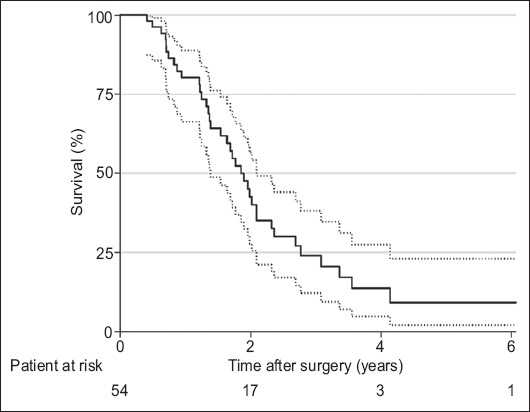
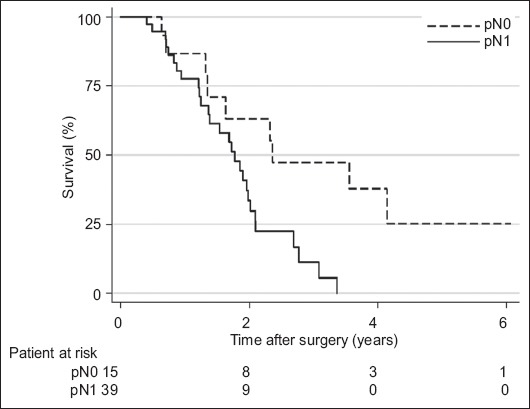
Fifty-four patients were included. The mean age was 68±8 years and 21 (39%) of the patients were female. Jaundice was present at diagnosis in 73% of the patients. There was no 90-day mortality. Complications graded as Clavien-Dindo ≥3 occurred in 10 (19%) of the patients. Twenty-eight (52%) received adjuvant therapy. Overall survival rates at 1, 3, and 5 years were 80%, 21%, and 9.2%, respectively. Median survival was 22.2 months. The presence of lymph node metastases was found to be the only independent predictor of survival (hazard ratio 2.88, 95% confidence interval 1.22-6.84; P=0.016). The total number of lymph node metastases, lymph node ratio or total number of resected nodes did not improve the prediction.
We found that the recurrence rate was higher and the survival poorer after surgery for distal cholangiocarcinoma than has previously been reported. Lymph node status at the time of resection was the most important prognostic factor for survival in the current material.
本研究的目的是在瑞典一家三级转诊中心,对现代时期远端胆管癌根治性手术后的结果和预后因素进行研究。
确定了2008年4月至2015年12月期间所有因远端胆管癌接受胰十二指肠切除术的患者。采用Kaplan-Meier分析估计生存率。使用单变量和多变量统计分析,评估人口统计学、临床、实验室和组织病理学数据与死亡率相关的预后因素。
纳入54例患者。平均年龄为68±8岁,21例(39%)为女性。73%的患者在诊断时出现黄疸。90天内无死亡病例。10例(19%)患者发生Clavien-Dindo≥3级并发症。28例(52%)接受了辅助治疗。1年、3年和5年的总生存率分别为80%、21%和9.2%。中位生存期为22.2个月。发现淋巴结转移是生存的唯一独立预测因素(风险比2.88,95%置信区间1.22 - 6.84;P = 0.016)。淋巴结转移总数、淋巴结比率或切除淋巴结总数均未改善预测效果。
我们发现,远端胆管癌手术后的复发率高于以往报道,生存率较低。在本研究资料中,切除时的淋巴结状态是生存的最重要预后因素。