Zhao Jiangang, Li Jiahui, Schlößer Hans A, Popp Felix, Popp Marie Christine, Alakus Hakan, Jauch Karl-Walter, Bruns Christiane J, Zhao Yue
Department of General, Visceral and Cancer Surgery, University of Cologne, Cologne, Germany.
Department of General, Visceral und Vascular Surgery, Ludwig-Maximilian-University (LMU), Munich, Germany.
Stem Cells Int. 2017;2017:6012810. doi: 10.1155/2017/6012810. Epub 2017 Aug 6.
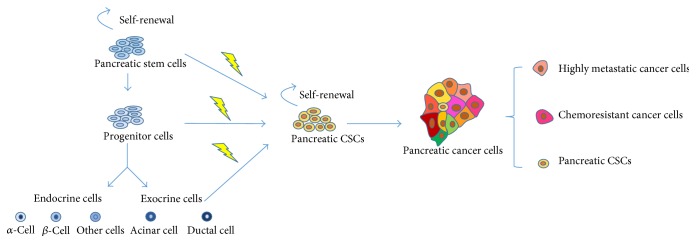
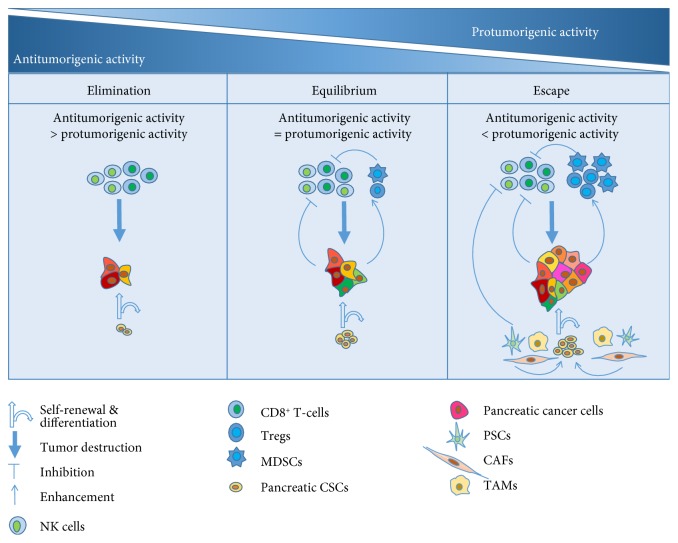
Cancer stem cells (CSCs) have been identified as a subpopulation of stem-like cancer cells with the ability of self-renewal and differentiation in hematological malignancies and solid tumors. Pancreatic cancer is one of the most lethal cancers worldwide. CSCs are thought to be responsible for cancer initiation, progression, metastasis, chemoresistance, and recurrence in pancreatic cancer. In this review, we summarize the characteristics of pancreatic CSCs and discuss the mechanisms involved in resistance to chemotherapy, the interactions with the niche, and the potential role in cancer immunoediting. We propose that immunotherapy targeting pancreatic CSCs, in combination with targeting the niche components, may provide a novel treatment strategy to eradicate pancreatic CSCs and hence improve outcomes in pancreatic cancer.
癌症干细胞(CSCs)已被鉴定为一类具有自我更新和分化能力的干细胞样癌细胞亚群,存在于血液系统恶性肿瘤和实体瘤中。胰腺癌是全球最致命的癌症之一。癌症干细胞被认为与胰腺癌的起始、进展、转移、化疗耐药及复发有关。在本综述中,我们总结了胰腺癌症干细胞的特征,并讨论了其化疗耐药机制、与微环境的相互作用以及在癌症免疫编辑中的潜在作用。我们提出,靶向胰腺癌症干细胞的免疫疗法,联合靶向微环境成分,可能提供一种根除胰腺癌症干细胞从而改善胰腺癌治疗效果的新策略。