Yang Jenq-Lin, Chen Wei-Yu, Chen Shang-Der
Institute for Translation Research in Biomedicine, Kaohsiung Chang Gung Memorial Hospital, 123 Dapi Road, Kaohsiung 83301, Taiwan.
Department of Neurology, Kaohsiung Chang Gung Memorial Hospital, 123 Dapi Road, Kaohsiung 83301, Taiwan.
Int J Mol Sci. 2017 Aug 26;18(9):1861. doi: 10.3390/ijms18091861.
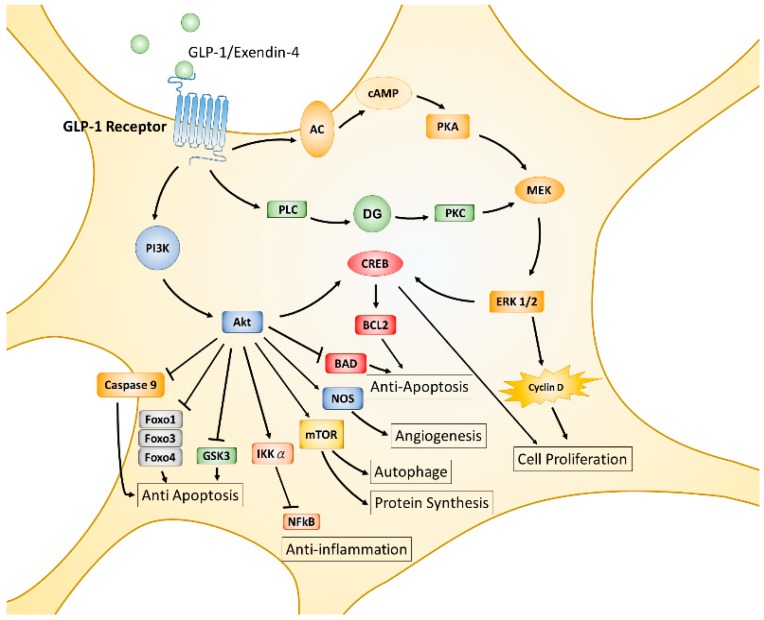
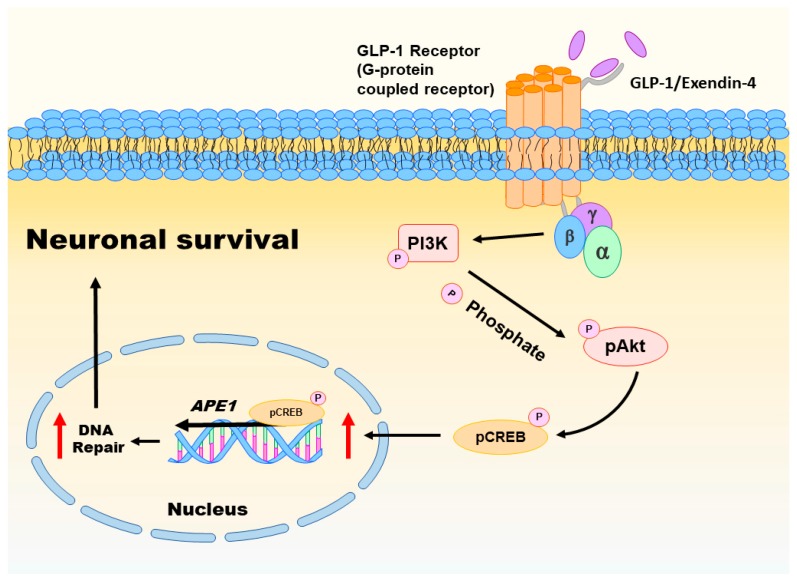
Glucagon-like peptide-1 (GLP-1) is originally found as a metabolic hormone (incretin) that is able to regulate blood-glucose levels via promoting synthesis and secretion of insulin. GLP-1 and many analogues are approved for treatment of type II diabetes. Accumulating results imply that GLP-1 performs multiple functions in various tissues and organs beyond regulation of blood-glucose. The neuroprotective function of GLP-1 has been extensively explored during the past two decades. Three of our previous studies have shown that apurinic/apyrimidinic endonuclease 1 (APE1) is the only protein of the base excision repair (BER) pathway able to be regulated by oxidative stress or exogenous stimulations in rat primary cortical neurons. In this article, we review the role of APE1 in neurodegenerative diseases and its relationship to neuroprotective mechanisms of the activated GLP-1 receptor (GLP-1R) in neurodegenerative disorders. The purpose of this article is to provide new insight, from the aspect of DNA damage and repair, for studying potential treatments in neurodegenerative diseases.
胰高血糖素样肽-1(GLP-1)最初被发现是一种代谢激素(肠促胰岛素),它能够通过促进胰岛素的合成和分泌来调节血糖水平。GLP-1及其许多类似物已被批准用于治疗II型糖尿病。越来越多的研究结果表明,GLP-1在调节血糖之外的各种组织和器官中发挥着多种功能。在过去二十年中,GLP-1的神经保护功能得到了广泛研究。我们之前的三项研究表明,无嘌呤/无嘧啶内切核酸酶1(APE1)是碱基切除修复(BER)途径中唯一能够在大鼠原代皮层神经元中受氧化应激或外源性刺激调控的蛋白质。在本文中,我们综述了APE1在神经退行性疾病中的作用及其与神经退行性疾病中激活的GLP-1受体(GLP-1R)神经保护机制的关系。本文旨在从DNA损伤与修复的角度,为研究神经退行性疾病的潜在治疗方法提供新的见解。