Thanapprapasr Kamolrat, Nartthanarung Adisak, Thanapprapasr Duangmani, Jinawath Artit
Biomedical Engineering Research Unit, National Metal and Materials Technology Center, National Science and Technology Development Agency, Pathumthani, Thailand.
Musculoskeletal Oncology Unit, Department of Orthopaedics, Faculty of Medicine Ramathibodi Hospital, Mahidol University, Bangkok, Thailand.
PLoS One. 2017 Aug 28;12(8):e0182989. doi: 10.1371/journal.pone.0182989. eCollection 2017.
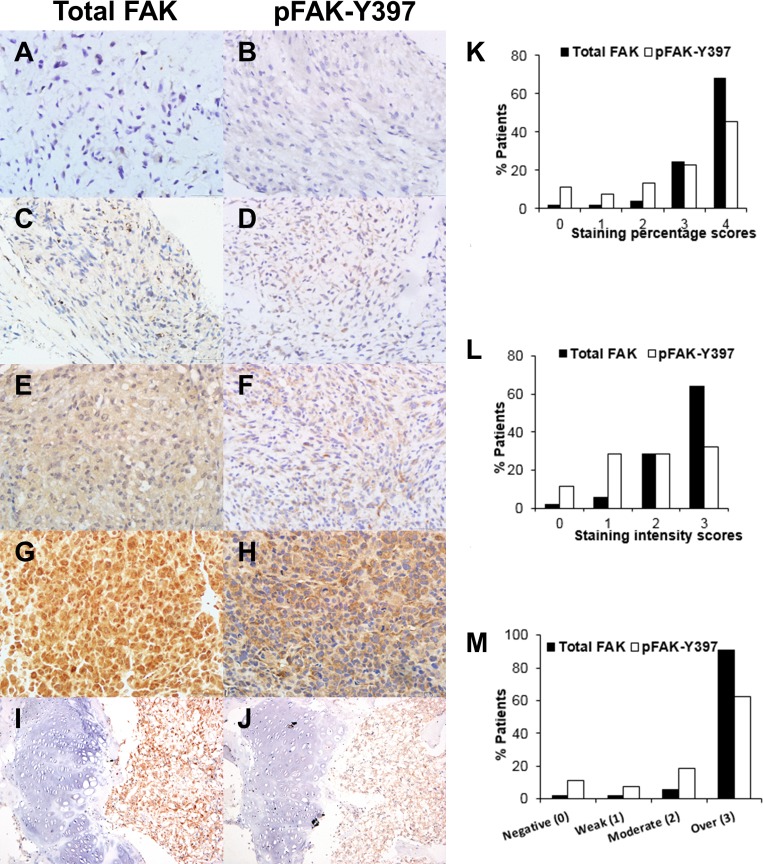
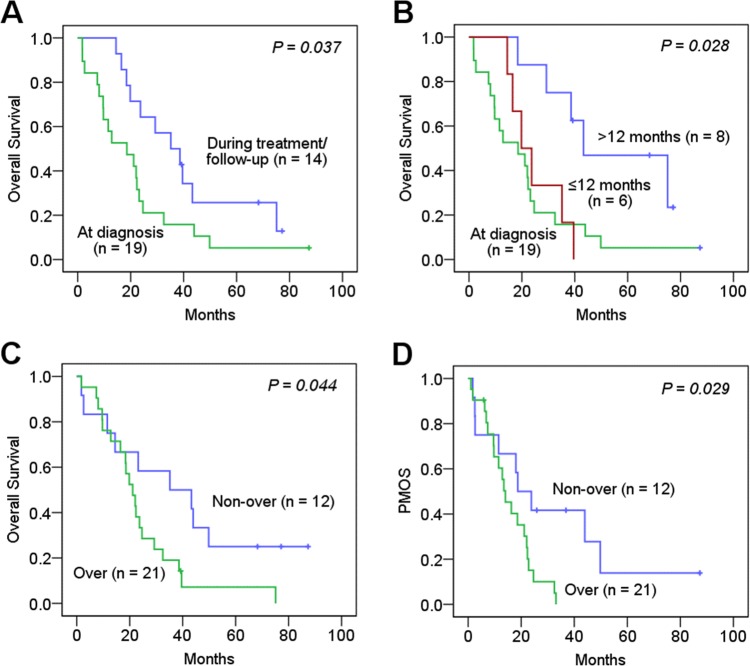
Focal adhesion kinase (FAK) is important for tumor cell survival and metastasis in various cancers. However, its expression and prognostic value in patients with metastatic osteosarcoma remain unknown. We investigated the expression of FAK and its phosphorylated form (pFAK-Y397) in osteosarcoma tissues from 53 patients by immunohistochemistry and evaluated their correlations with clinicopathologic characteristics and outcomes. The prognostic values were assessed using Kaplan-Meier survival and Cox regression analyses. Total FAK and pFAK-Y397 were overexpressed in 48 (90.6%) and 33 (62.3%) cases, respectively. pFAK-Y397 overexpression was correlated with poor histologic response after neoadjuvant chemotherapy in patients with osteosarcoma regardless of the presence of metastasis or not. Kaplan-Meier curve showed that patients with metastatic osteosarcoma with pFAK-Y397 overexpression had significantly worse overall survival (OS) than those with non-overexpression (P = 0.044). Multivariate Cox regression analysis confirmed pFAK-Y397 overexpression as an independent prognostic predictor for OS and post metastases OS (PMOS) (P = 0.017, P = 0.006, respectively). Age at diagnosis was also an independent indicator for PMOS (P = 0.003). However, total FAK expression was not correlated with any clinicopathologic characteristics or OS in patients with metastatic osteosarcoma. In conclusion, our findings identified FAK as a common aberrant protein overexpression in various subtypes of osteosarcoma. pFAK-Y397 overexpression can be used as a prognostic biomarker predicting poor OS for patients with metastatic osteosarcoma, and the expression of pFAK-Y397 differentiated good and poor responders to neoadjuvant chemotherapy.
粘着斑激酶(FAK)在多种癌症的肿瘤细胞存活和转移中起着重要作用。然而,其在转移性骨肉瘤患者中的表达及预后价值仍不清楚。我们通过免疫组织化学研究了53例骨肉瘤组织中FAK及其磷酸化形式(pFAK-Y397)的表达,并评估了它们与临床病理特征及预后的相关性。使用Kaplan-Meier生存分析和Cox回归分析评估预后价值。总FAK和pFAK-Y397分别在48例(90.6%)和33例(62.3%)病例中过表达。无论有无转移,骨肉瘤患者新辅助化疗后pFAK-Y397过表达与组织学反应差相关。Kaplan-Meier曲线显示,pFAK-Y397过表达的转移性骨肉瘤患者的总生存期(OS)明显低于未过表达的患者(P = 0.044)。多变量Cox回归分析证实pFAK-Y397过表达是OS和转移后总生存期(PMOS)的独立预后预测指标(分别为P = 0.017,P = 0.006)。诊断时的年龄也是PMOS的独立指标(P = 0.003)。然而,总FAK表达与转移性骨肉瘤患者的任何临床病理特征或OS均无相关性。总之,我们的研究结果表明FAK是骨肉瘤各亚型中常见的异常蛋白过表达。pFAK-Y397过表达可作为预测转移性骨肉瘤患者OS不良的预后生物标志物,且pFAK-Y397的表达可区分新辅助化疗的良好和不良反应者。