Strauss Michael, George Gavin, Lansdell Emma, Mantell Joanne E, Govender Kaymarlin, Romo Matthew, Odhiambo Jacob, Mwai Eva, Nyaga Eston N, Kelvin Elizabeth A
a Health Economics and HIV and AIDS Research Division (HEARD) , University of KwaZulu-Natal , Durban , South Africa.
b HIV Center for Clinical and Behavioral Studies, Department of Psychiatry, Division of Gender, Sexuality and Health , New York State Psychiatric Institute & Columbia University , New York , NY , USA.
AIDS Care. 2018 Jan;30(1):72-80. doi: 10.1080/09540121.2017.1367086. Epub 2017 Aug 29.
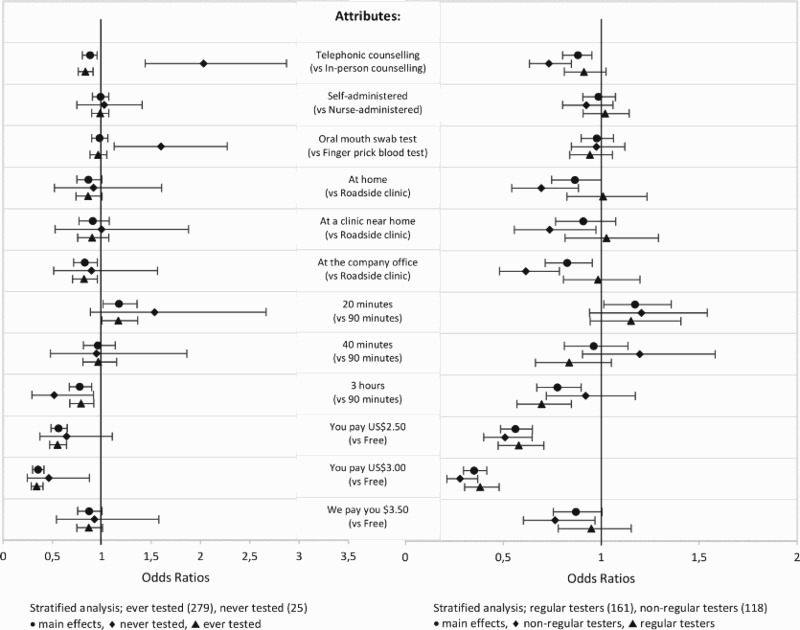
Providing HIV testing services to truck drivers in Africa is crucial but has proven challenging. The introduction of HIV self-testing promises to provide expanded service delivery options for clients, potentially increasing demand for services and expanding coverage - especially important for high-risk and difficult-to-reach populations. This study examines the preferences regarding HIV testing service delivery models, among long distance truck drivers to identify testing services that would appeal to this population. Using a discrete choice experiment, this study examines the drivers of choice regarding HIV counselling and testing among 305 truck drivers recruited from two roadside wellness clinics along major trucking routes in Kenya. Participants made trade-offs between characteristics of HIV testing service delivery models by making hypothetical choices in a series of paired HIV testing scenarios. Conditional logit models were used to identify the HIV testing characteristics driving the selection of preferred scenarios, as well as determine whether preferences interact with individual characteristics - especially HIV testing history. Participants preferred free, provider-administered HIV testing at a roadside clinic, using a finger-prick test, with in-person counselling, undertaken in the shortest possible time. The strongest driver of choice was the cost of the test. Those who had never tested previously preferred oral testing and telephonic counselling, while those who were not regular testers favoured clinic based - over self-testing. The results of this study indicate that for the majority of participants - most of whom had tested before - the existing services offered at roadside clinics were the preferred service delivery model. The introduction of oral self-testing increases the options available to truck drivers and may even improve testing uptake for some, especially among those who have never tested before. However, these findings suggest the impact on HIV testing uptake of introducing oral self-testing may be limited in this population.
在非洲为卡车司机提供艾滋病毒检测服务至关重要,但事实证明颇具挑战性。引入艾滋病毒自我检测有望为客户提供更多样的服务提供选项,可能会增加对服务的需求并扩大覆盖范围——这对高风险和难以接触到的人群尤为重要。本研究调查了长途卡车司机对艾滋病毒检测服务提供模式的偏好,以确定能吸引这一人群的检测服务。通过离散选择实验,本研究调查了从肯尼亚主要卡车运输路线沿线的两家路边健康诊所招募的305名卡车司机在艾滋病毒咨询和检测方面的选择驱动因素。参与者在一系列成对的艾滋病毒检测场景中进行假设选择,从而在艾滋病毒检测服务提供模式的特征之间进行权衡。使用条件逻辑模型来确定驱动首选场景选择的艾滋病毒检测特征,并确定偏好是否与个体特征相互作用——尤其是艾滋病毒检测史。参与者更喜欢在路边诊所进行免费的、由医护人员操作的艾滋病毒检测,采用手指采血检测,进行面对面咨询,并在尽可能短的时间内完成。选择的最主要驱动因素是检测成本。那些以前从未检测过的人更喜欢口腔检测和电话咨询,而那些不是定期检测者的人则更倾向于基于诊所的检测——而不是自我检测。本研究结果表明,对于大多数参与者——其中大多数人以前都接受过检测——路边诊所提供的现有服务是首选的服务提供模式。引入口腔自我检测增加了卡车司机可用的选项,甚至可能提高一些人的检测接受率,尤其是那些从未检测过的人。然而,这些发现表明,在这一人群中引入口腔自我检测对艾滋病毒检测接受率的影响可能有限。