Thorgersen Michael P, Lancaster W Andrew, Ge Xiaoxuan, Zane Grant M, Wetmore Kelly M, Vaccaro Brian J, Poole Farris L, Younkin Adam D, Deutschbauer Adam M, Arkin Adam P, Wall Judy D, Adams Michael W W
Department of Biochemistry and Molecular Biology, University of GeorgiaAthens, GA, United States.
Department of Biochemistry, University of MissouriColumbia, MO, United States.
Front Microbiol. 2017 Aug 10;8:1529. doi: 10.3389/fmicb.2017.01529. eCollection 2017.
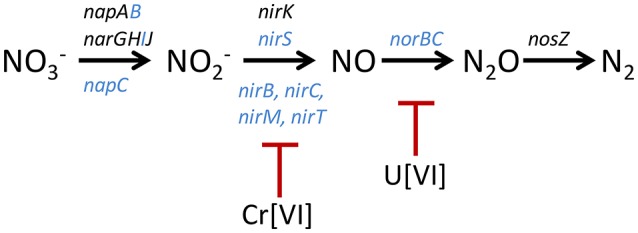
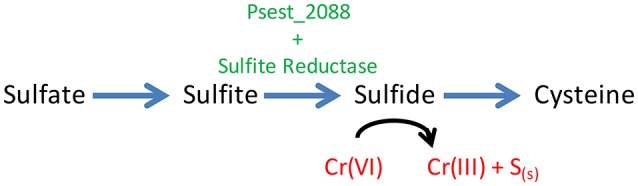
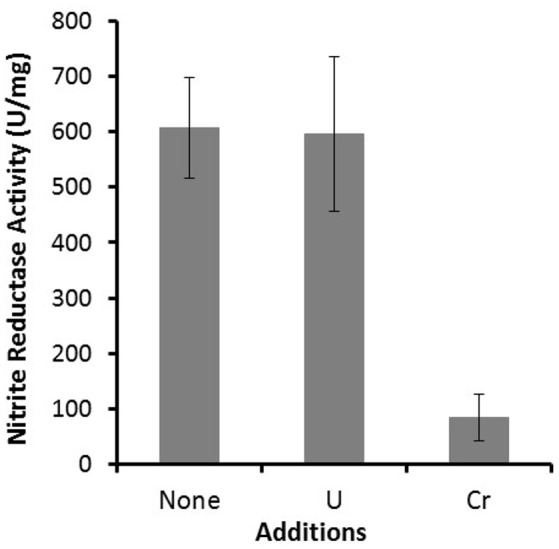
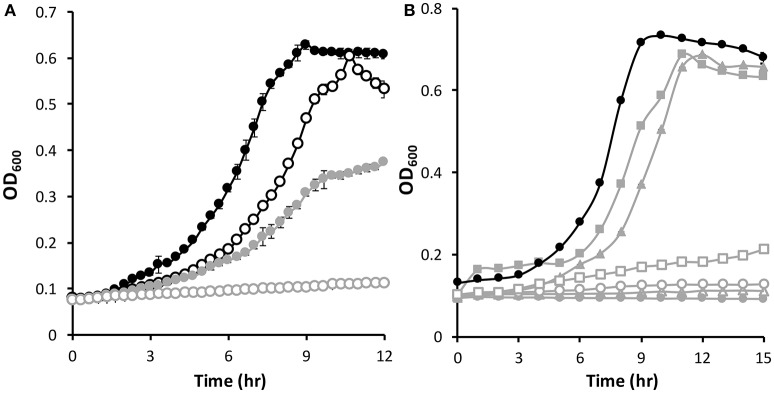
Chromium and uranium are highly toxic metals that contaminate many natural environments. We investigated their mechanisms of toxicity under anaerobic conditions using nitrate-reducing RCH2, which was originally isolated from a chromium-contaminated aquifer. A random barcode transposon site sequencing library of RCH2 was grown in the presence of the chromate oxyanion (Cr[VI][Formula: see text]) or uranyl oxycation (U[VI][Formula: see text]). Strains lacking genes required for a functional nitrate reductase had decreased fitness as both metals interacted with heme-containing enzymes required for the later steps in the denitrification pathway after nitrate is reduced to nitrite. Cr[VI]-resistance also required genes in the homologous recombination and nucleotide excision DNA repair pathways, showing that DNA is a target of Cr[VI] even under anaerobic conditions. The reduced thiol pool was also identified as a target of Cr[VI] toxicity and , a gene of previously unknown function, was shown to have a role in the reduction of sulfite to sulfide. U[VI] resistance mechanisms involved exopolysaccharide synthesis and the universal stress protein UspA. As the first genome-wide fitness analysis of Cr[VI] and U[VI] toxicity under anaerobic conditions, this study provides new insight into the impact of Cr[VI] and U[VI] on an environmental isolate from a chromium contaminated site, as well as into the role of a ubiquitous protein, Psest_2088.
铬和铀是剧毒金属,会污染许多自然环境。我们使用最初从受铬污染的含水层中分离出的硝酸盐还原菌RCH2,研究了它们在厌氧条件下的毒性机制。RCH2的随机条形码转座子位点测序文库在铬酸根阴离子(Cr[VI])或铀酰阳离子(U[VI])存在的情况下生长。缺乏功能性硝酸盐还原酶所需基因的菌株适应性降低,因为这两种金属都与硝酸盐还原为亚硝酸盐后反硝化途径后期步骤所需的含血红素酶相互作用。抗Cr[VI]性还需要同源重组和核苷酸切除DNA修复途径中的基因,这表明即使在厌氧条件下,DNA也是Cr[VI]的靶标。还原型硫醇库也被确定为Cr[VI]毒性的靶标,并且一个功能未知的基因Psest_2088被证明在亚硫酸盐还原为硫化物的过程中起作用。U[VI]抗性机制涉及胞外多糖合成和通用应激蛋白UspA。作为首次在厌氧条件下对Cr[VI]和U[VI]毒性进行的全基因组适应性分析,本研究为Cr[VI]和U[VI]对来自铬污染场地的环境分离株的影响以及普遍存在的蛋白质Psest_2088的作用提供了新的见解。