Braun Jürgen, Baraliakos Xenofon, Hermann Kay-Geert, Landewé Robert, Machado Pedro M, Maksymowych Walter P, Davies Owen, Hoepken Bengt, Nurminen Tommi, Stach Christian, van der Heijde Désirée
Rheumazentrum Ruhrgebiet, Herne, Germany.
Charité Medical School, Berlin, Germany.
RMD Open. 2017 Apr 24;3(1):e000430. doi: 10.1136/rmdopen-2017-000430. eCollection 2017.
To report MRI outcomes and explore the relationship between clinical remission and MRI inflammation in patients with axial spondyloarthritis (axSpA) from the RAPID-axSpA trial, including radiographic (r-)axSpA and non-radiographic (nr-)axSpA.
RAPID-axSpA (NCT01087762) was double-blind and placebo-controlled to week 24, dose-blind to week 48 and open-label to week 204. Patients were randomised to certolizumab pegol (CZP) or placebo. Placebo patients entering dose-blind were rerandomised to CZP. MRIs performed at baseline, weeks 12, 48 and 96 were scored by 2 reviewers independently: Spondyloarthritis Research Consortium of Canada (SPARCC) for sacroiliac (SI) joints; Berlin modification of the Ankylosing Spondylitis spine MRI scoring system for disease activity (Berlin) for spine. Inflammation thresholds: SPARCC≥2; Berlin>2. Remission thresholds: SPARCC<2 (SI joints); Berlin≤2 (spine); Ankylosing Spondylitis Disease Activity Score (ASDAS) inactive disease (<1.3, clinical).
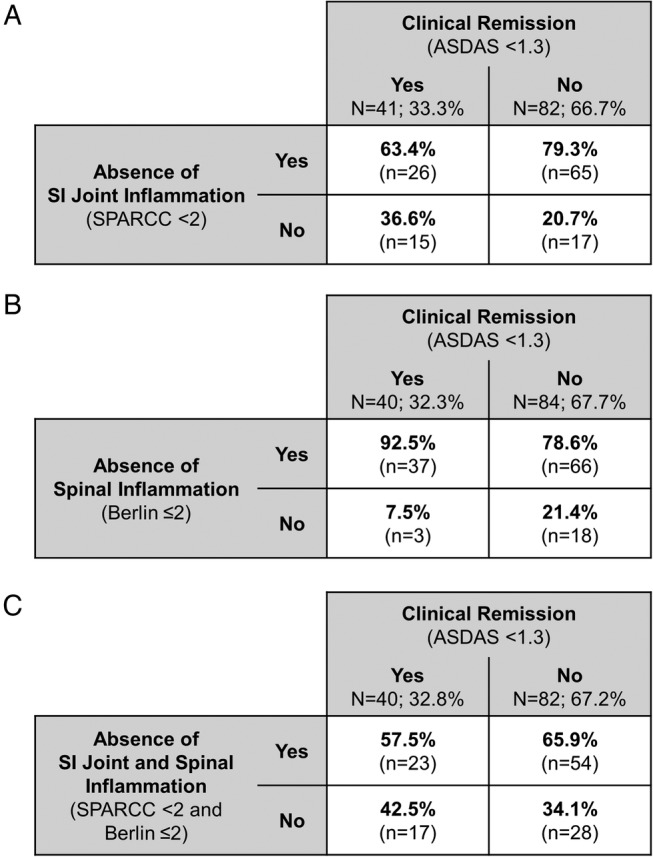
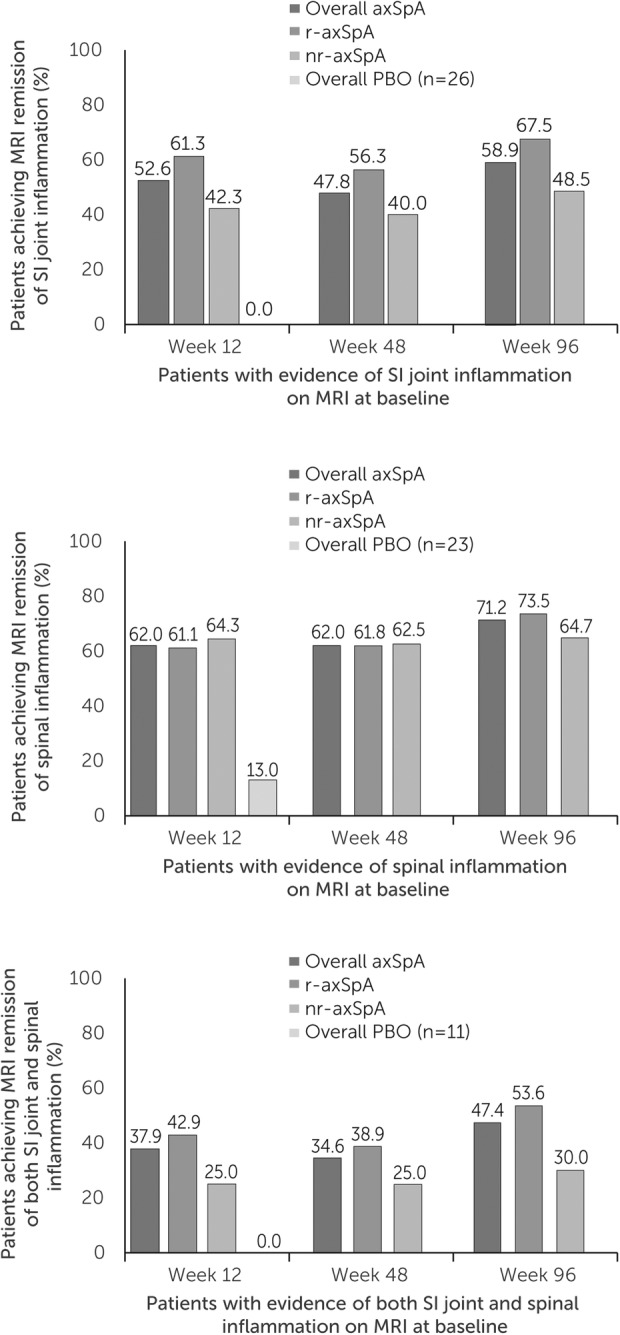
Across 163 patients in the MRI set (109 CZP; 54 placebo), week 12 mean changes from baseline in MRI scores were greater for CZP versus placebo: SPARCC: -4.8 (SD 8.6) vs -1.6 (7.8; p<0.001); Berlin: -2.9 (4.2) vs 0.2 (4.8; p<0.001). Improvements were maintained to week 96. Week 12 MRI remission was achieved by 52.6% of patients with baseline MRI inflammation in SI joints, 62.0% in the spine and 37.9% of patients with both. MRI remission rates were sustained to week 96, with similar trends in r-axSpA and nr-axSpA. At week 96, 57.5% vs 65.9% of patients achieving versus not achieving clinical remission had MRI remission.
CZP reduced inflammation in the spine and SI joints in patients with r-axSpA and nr-axSpA, with improvements maintained over 96 weeks. Substantial proportions of patients achieved MRI remission. Concordance between clinical remission and current definitions of absence of MRI inflammation was limited.
NCT01087762; Post-results.
报告来自RAPID-axSpA试验的中轴型脊柱关节炎(axSpA)患者的MRI结果,并探讨临床缓解与MRI炎症之间的关系,该试验包括放射学阳性(r-)axSpA和非放射学阳性(nr-)axSpA。
RAPID-axSpA(NCT01087762)试验为双盲、安慰剂对照至第24周,剂量盲法至第48周,开放标签至第204周。患者被随机分配至赛妥珠单抗聚乙二醇(CZP)或安慰剂组。进入剂量盲法阶段的安慰剂组患者重新随机分配至CZP组。在基线、第12周、第48周和第96周进行的MRI由2名评估者独立评分:加拿大脊柱关节炎研究联盟(SPARCC)评分系统用于评估骶髂关节;强直性脊柱炎脊柱MRI疾病活动度评分系统的柏林修订版(柏林评分)用于评估脊柱。炎症阈值:SPARCC≥2;柏林评分>2。缓解阈值:SPARCC<2(骶髂关节);柏林评分≤2(脊柱);强直性脊柱炎疾病活动度评分(ASDAS)处于非活动疾病状态(<1.3,临床)。
在MRI队列的163例患者中(109例CZP组;54例安慰剂组),与安慰剂组相比,CZP组在第12周时MRI评分相对于基线的平均变化更大:SPARCC评分:-4.8(标准差8.6)对-1.6(7.8;p<0.001);柏林评分:-2.9(4.2)对0.2(4.8;p<0.001)。这些改善维持至第96周。基线时骶髂关节有MRI炎症的患者中,52.6%在第12周达到MRI缓解,脊柱为62.0%,两者均有的患者为37.9%。MRI缓解率维持至第96周,r-axSpA和nr-axSpA有相似趋势。在第96周时,达到临床缓解的患者中有57.5%实现了MRI缓解,未达到临床缓解的患者中这一比例为65.9%。
CZP可减轻r-axSpA和nr-axSpA患者脊柱和骶髂关节的炎症,改善效果维持超过96周。相当比例的患者实现了MRI缓解。临床缓解与目前MRI无炎症定义之间的一致性有限。
NCT01087762;结果后。