Baraliakos Xenofon, de Jongh Jerney, Poddubnyy Denis, Zwezerijnen Gerben J C, Hemke Robert, Glatt Sophie, Shaw Stevan, Ionescu Lucian, El Baghdady Assem, Mann Joanne, Maguire Ralph Paul, Vaux Tom, de Peyrecave Natasha, Oortgiesen Marga, Baeten Dominique, van der Laken Conny
Rheumazentrum Ruhrgebiet Herne, Ruhr-University Bochum, Herne, Germany.
Department of Rheumatology, Amsterdam Rheumatology and Immunology Center, Amsterdam UMC, Amsterdam, The Netherlands.
Ther Adv Musculoskelet Dis. 2024 Nov 28;16:1759720X241293944. doi: 10.1177/1759720X241293944. eCollection 2024.
The efficacy and safety of bimekizumab (BKZ), an inhibitor of interleukin (IL)-17F in addition to IL-17A, has been established in axial spondyloarthritis (axSpA). Early assessment of new bone formation is possible using F-fluoride positron emission tomography-computerised tomography (PET-CT) imaging to quantitatively monitor osteoblastic activity.
This exploratory study, initiated before phase IIb/III studies, assessed the efficacy and safety of BKZ in patients with radiographic (r-)axSpA and its effect on new bone formation.
Patients were randomised 2:1 to BKZ 160 mg every 2 weeks (Q2W; Weeks 0-10) then 320 mg Q4W (Weeks 12-44), or the reference drug: certolizumab pegol (CZP) 400 mg Q2W (Weeks 0-4), then 200 mg Q2W (Weeks 6-10), 400 mg Q4W (Weeks 12-44).
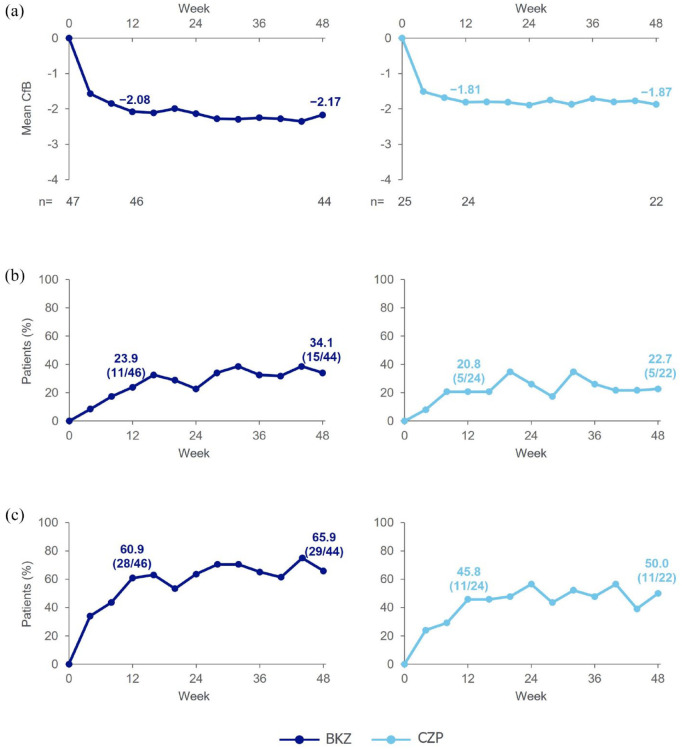
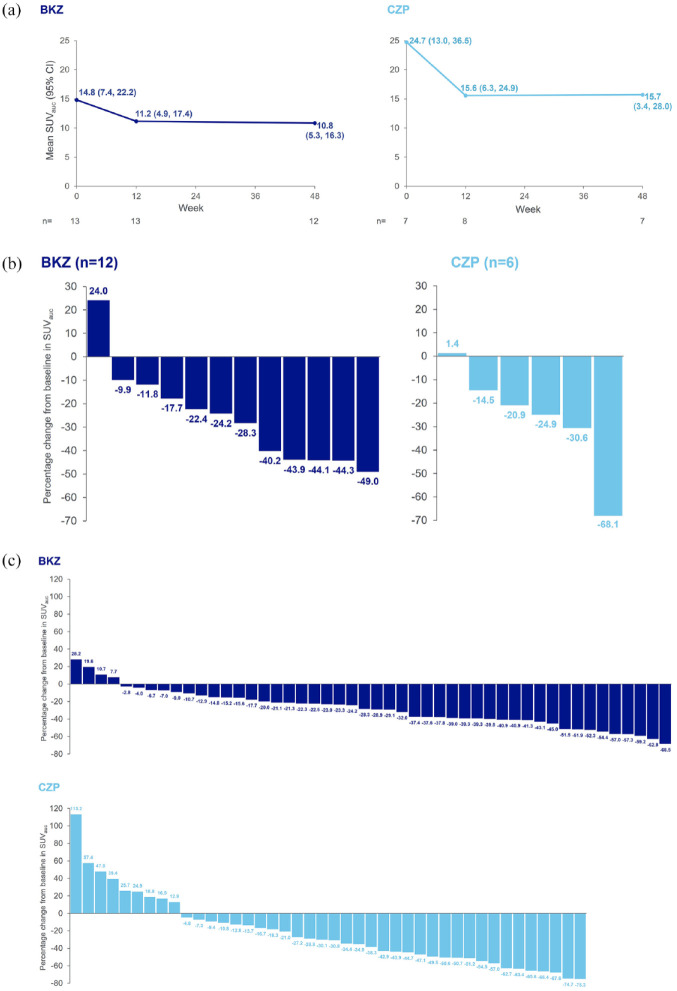
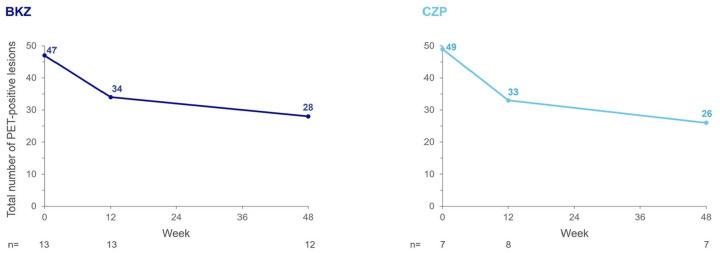
Primary (Axial Spondyloarthritis Disease Activity Score (ASDAS) change from baseline (CfB)) and secondary endpoints (ASDAS-ID, ASDAS-MI) were assessed at Week 12. PET-positive axSpA lesion counts and osteoblastic activity quantification (mean SUV) were performed at baseline and Weeks 12 and 48 in the sacroiliac joints and spine (PET-CT substudy; not powered to evaluate differences).
In total, 76 patients were randomised; 26/76 entered the PET-CT substudy. At Week 12, the mean ASDAS CfB with BKZ was -2.1 (CZP: -1.8); ASDAS-ID and ASDAS-MI were achieved by 23.9% (11/46) (CZP: 20.8% (5/24)) and 60.9% (28/46) (CZP: 45.8% (11/24)) patients. Across treatments, clinical efficacy was maintained or increased further at Week 48. In the PET-CT substudy, the total number of PET-positive axSpA lesions and mean SUV were substantially reduced from baseline at Week 12 with BKZ and CZP, with reductions maintained or further reduced at Week 48. Treatments were well tolerated with no new safety signals.
Dual inhibition of IL-17A and IL-17F with BKZ resulted in improved clinical outcomes and reduced osteoblastic activity in patients with r-axSpA, suggesting the potential of BKZ to reduce disease activity and new bone formation within 12 weeks of treatment. CZP findings were consistent with previous data. No new safety signals were identified.
ClinicalTrials.gov, NCT03215277 (https://clinicaltrials.gov/study/NCT03215277).
除白细胞介素(IL)-17A外,IL-17F抑制剂比美吉珠单抗(BKZ)在轴向性脊柱关节炎(axSpA)中的疗效和安全性已得到确立。利用F-氟化物正电子发射断层扫描-计算机断层扫描(PET-CT)成像对新骨形成进行早期评估,从而定量监测成骨细胞活性是可行的。
这项在IIb/III期研究之前启动的探索性研究评估了BKZ在放射学(r-)axSpA患者中的疗效和安全性及其对新骨形成的影响。
患者按2:1随机分组,分别接受BKZ每2周160mg(第0 - 10周),然后每4周320mg(第12 - 44周),或对照药物:赛妥珠单抗(CZP)每2周400mg(第0 - 4周),然后每2周200mg(第6 - 10周),每4周400mg(第12 - 44周)。
在第12周评估主要终点(轴向性脊柱关节炎疾病活动评分(ASDAS)自基线的变化(CfB))和次要终点(ASDAS-ID、ASDAS-MI)。在基线以及第12周和第48周对骶髂关节和脊柱进行PET阳性axSpA病灶计数和成骨细胞活性定量(平均SUV)(PET-CT子研究;无评估差异的效力)。
总共76例患者被随机分组;26/76例进入PET-CT子研究。在第12周,接受BKZ治疗的患者ASDAS CfB均值为-2.1(CZP为-1.8);达到ASDAS-ID和ASDAS-MI的患者比例分别为23.9%(11/46)(CZP为20.8%(5/24))和60.9%(28/46)(CZP为45.8%(11/24))。在所有治疗组中,第48周时临床疗效得以维持或进一步提高。在PET-CT子研究中,接受BKZ和CZP治疗的患者在第12周时,PET阳性axSpA病灶总数和平均SUV较基线大幅降低,在第48周时降低幅度得以维持或进一步减小。治疗耐受性良好,未发现新的安全信号。
BKZ对IL-17A和IL-17F的双重抑制使r-axSpA患者的临床结局得到改善,成骨细胞活性降低,这表明BKZ在治疗12周内具有降低疾病活动度和新骨形成的潜力。CZP的研究结果与既往数据一致。未发现新的安全信号。
ClinicalTrials.gov,NCT03215277(https://clinicaltrials.gov/study/NCT03215277)