Department of Hepatobiliary Surgery, Affiliated Minda Hospital of Hubei Institute for Nationalities, Enshi, Hubei 445000, P.R. China.
Mol Med Rep. 2017 Oct;16(4):5441-5449. doi: 10.3892/mmr.2017.7219. Epub 2017 Aug 10.
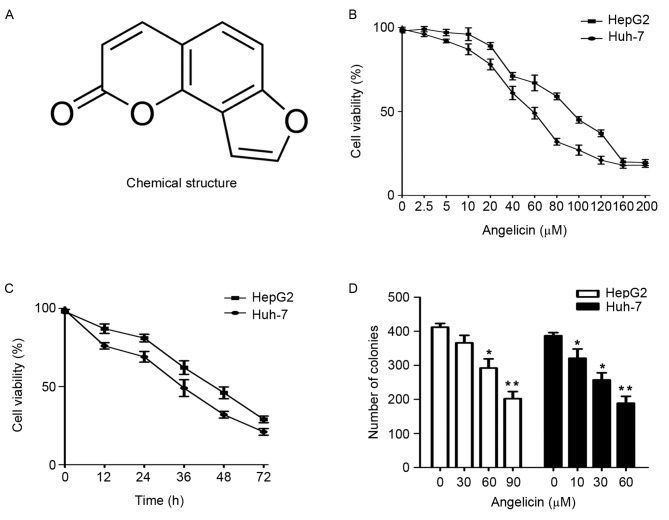
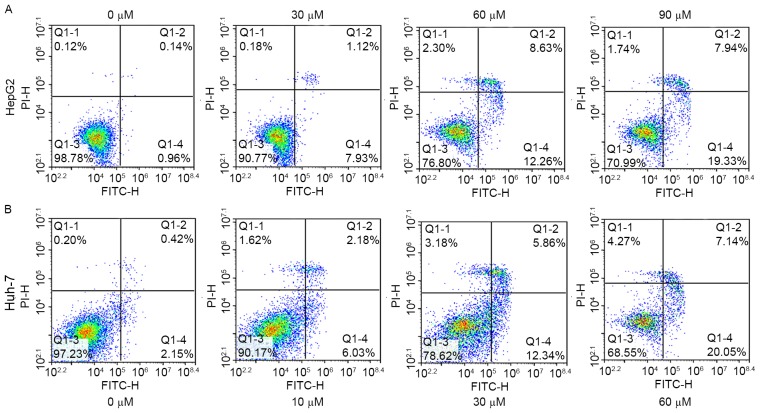
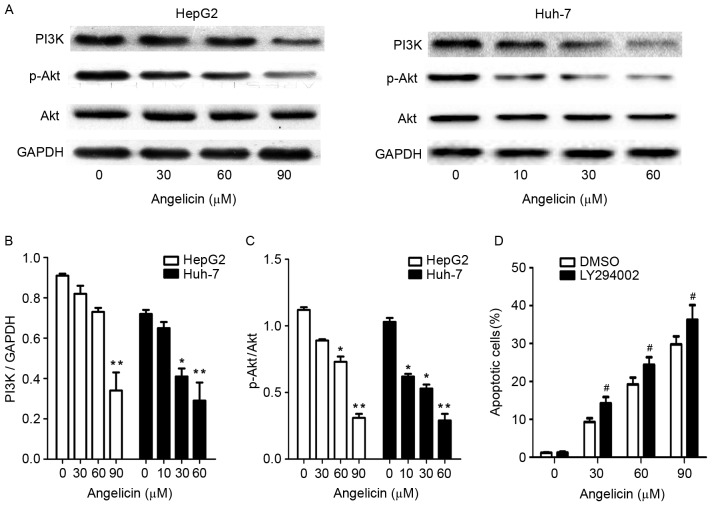
Previous studies have reported that angelicin exerted antiproliferative effects on several types of tumor cell. However, to the best of our knowledge, the effects of angelicin monotherapy on human liver cancer remain to be investigated. In the present study, the antitumor activity of angelicin was evaluated in vitro and in vivo, and the molecular mechanisms underlying its effects were investigated. The present results revealed that angelicin induced apoptosis in liver cancer cells in a dose‑ and time‑dependent manner. Furthermore, in HepG2 and Huh‑7 cells, angelicin‑induced apoptosis was demonstrated to be mitochondria dependent, involving the phosphatidylinositol‑4,5‑bisphosphate 3‑kinase/RAC‑α serine/threonine-protein kinase signaling pathway. In addition, administration of angelicin to mice bearing liver tumor xenografts inhibited tumor growth, without producing significant secondary adverse effects. These results suggested that angelicin may have potential as a novel therapeutic agent for the treatment of patients with liver cancer.
先前的研究报道称,花椒毒素对几种类型的肿瘤细胞具有抗增殖作用。然而,据我们所知,花椒毒素单药治疗对人肝癌的作用仍有待研究。在本研究中,评估了花椒毒素在体外和体内的抗肿瘤活性,并研究了其作用的分子机制。本研究结果显示,花椒毒素呈剂量和时间依赖性诱导肝癌细胞凋亡。此外,在 HepG2 和 Huh-7 细胞中,花椒毒素诱导的凋亡被证明是线粒体依赖性的,涉及磷脂酰肌醇-4,5-二磷酸 3-激酶/RAC-α丝氨酸/苏氨酸蛋白激酶信号通路。此外,给荷有肝癌肿瘤异种移植瘤的小鼠施用花椒毒素抑制了肿瘤生长,而没有产生明显的次要不良反应。这些结果表明,花椒毒素可能具有作为治疗肝癌患者的新型治疗剂的潜力。