Mahendra Camille Keisha, Tan Loh Teng Hern, Lee Wai Leng, Yap Wei Hsum, Pusparajah Priyia, Low Liang Ee, Tang Siah Ying, Chan Kok Gan, Lee Learn Han, Goh Bey Hing
Biofunctional Molecule Exploratory Research Group, School of Pharmacy, Monash University Malaysia, Subang Jaya, Malaysia.
Novel Bacteria and Drug Discovery Research Group, Microbiome and Bioresource Research Strength Jeffrey Cheah School of Medicine and Health Sciences, Monash University, Subang Jaya, Malaysia.
Front Pharmacol. 2020 Apr 16;11:366. doi: 10.3389/fphar.2020.00366. eCollection 2020.
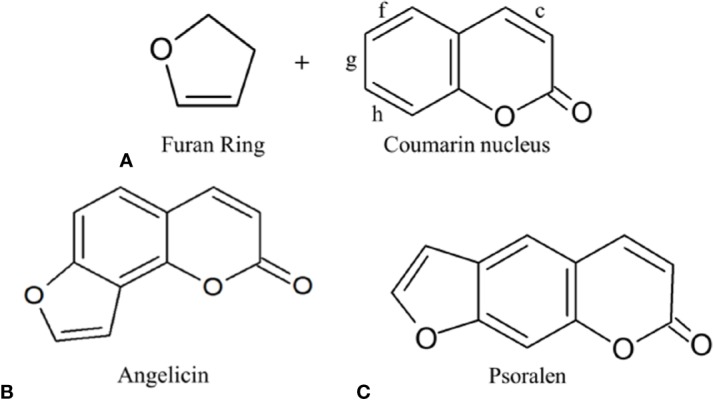
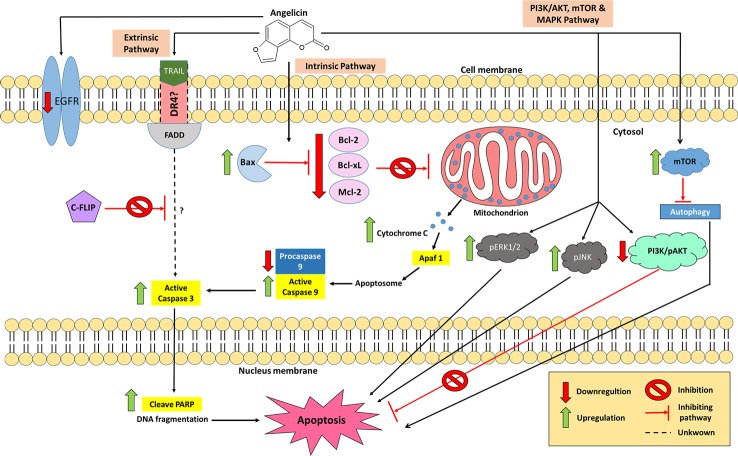
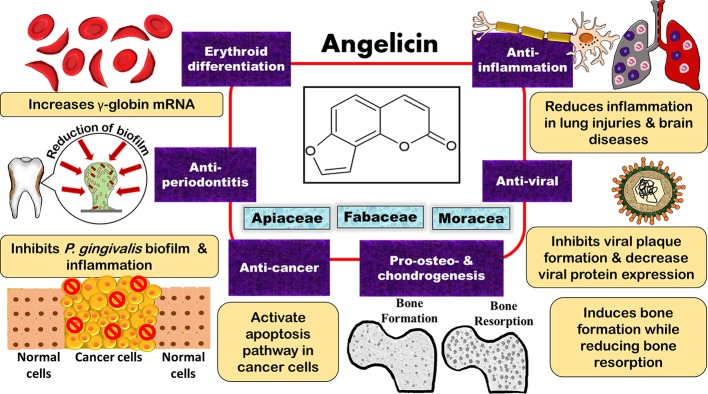
Angelicin, a member of the furocoumarin group, is related to psoralen which is well known for its effectiveness in phototherapy. The furocoumarins as a group have been studied since the 1950s but only recently has angelicin begun to come into its own as the subject of several biological studies. Angelicin has demonstrated anti-cancer properties against multiple cell lines, exerting effects both the intrinsic and extrinsic apoptotic pathways, and also demonstrated an ability to inhibit tubulin polymerization to a higher degree than psoralen. Besides that, angelicin too demonstrated anti-inflammatory activity in inflammatory-related respiratory and neurodegenerative ailments the activation of NF-κB pathway. Angelicin also showed pro-osteogenesis and pro-chondrogenic effects on osteoblasts and pre-chondrocytes respectively. The elevated expression of pro-osteogenic and chondrogenic markers and activation of TGF-β/BMP, Wnt/β-catenin pathway confirms the positive effect of angelicin bone remodeling. Angelicin also increased the expression of estrogen receptor alpha (ERα) in osteogenesis. Other bioactivities, such as anti-viral and erythroid differentiating properties of angelicin, were also reported by several researchers with the latter even displaying an even greater aptitude as compared to the commonly prescribed drug, hydroxyurea, which is currently on the market. Apart from that, recently, a new application for angelicin against periodontitis had been studied, where reduction of bone loss was indirectly caused by its anti-microbial properties. All in all, angelicin appears to be a promising compound for further studies especially on its mechanism and application in therapies for a multitude of common and debilitating ailments such as sickle cell anaemia, osteoporosis, cancer, and neurodegeneration. Future research on the drug delivery of angelicin in cancer, inflammation and erythroid differentiation models would aid in improving the bioproperties of angelicin and efficacy of delivery to the targeted site. More in-depth studies of angelicin on bone remodeling, the pro-osteogenic effect of angelicin in various bone disease models and the anti-viral implications of angelicin in periodontitis should be researched. Finally, studies on the binding of angelicin toward regulatory genes, transcription factors, and receptors can be done through experimental research supplemented with molecular docking and molecular dynamics simulation.
当归素是呋喃香豆素类的一员,与补骨脂素相关,补骨脂素以其在光疗中的有效性而闻名。自20世纪50年代以来,人们一直在研究呋喃香豆素类,但直到最近,当归素才开始作为多项生物学研究的对象崭露头角。当归素已证明对多种细胞系具有抗癌特性,可通过内在和外在凋亡途径发挥作用,并且还证明其抑制微管蛋白聚合的能力比补骨脂素更强。除此之外,当归素在与炎症相关的呼吸系统和神经退行性疾病中也表现出抗炎活性,这与核因子κB途径的激活有关。当归素还分别对成骨细胞和软骨前体细胞显示出促进成骨和软骨生成的作用。成骨和软骨生成标志物的表达升高以及转化生长因子-β/骨形态发生蛋白、Wnt/β-连环蛋白途径的激活证实了当归素对骨重塑的积极作用。当归素还增加了成骨过程中雌激素受体α(ERα)的表达。几位研究人员还报道了当归素的其他生物活性,如抗病毒和促红细胞分化特性,后者甚至比目前市场上常用的药物羟基脲表现出更强的能力。除此之外,最近还研究了当归素在治疗牙周炎方面的新应用,其抗菌特性间接导致了骨质流失的减少。总而言之,当归素似乎是一种很有前景的化合物,值得进一步研究,特别是研究其作用机制以及在治疗镰状细胞贫血、骨质疏松症、癌症和神经退行性变等多种常见和使人衰弱的疾病中的应用。未来对当归素在癌症、炎症和红细胞分化模型中的药物递送研究将有助于改善当归素的生物学特性以及向靶位点的递送效果。应进一步深入研究当归素对骨重塑的作用、当归素在各种骨疾病模型中的促成骨作用以及当归素在牙周炎中的抗病毒意义。最后,可以通过实验研究并辅以分子对接和分子动力学模拟来研究当归素与调控基因、转录因子和受体的结合情况。