Institute of Physiology I, Life & Brain Center, University of Bonn, Sigmund-Freud-Strasse 25, 53105, Bonn, Germany.
Department of Cardiac Surgery, Medical Faculty, University of Bonn, Sigmund-Freud-Strasse 25, 53105, Bonn, Germany.
Pflugers Arch. 2018 Feb;470(2):241-248. doi: 10.1007/s00424-017-2061-4. Epub 2017 Aug 28.
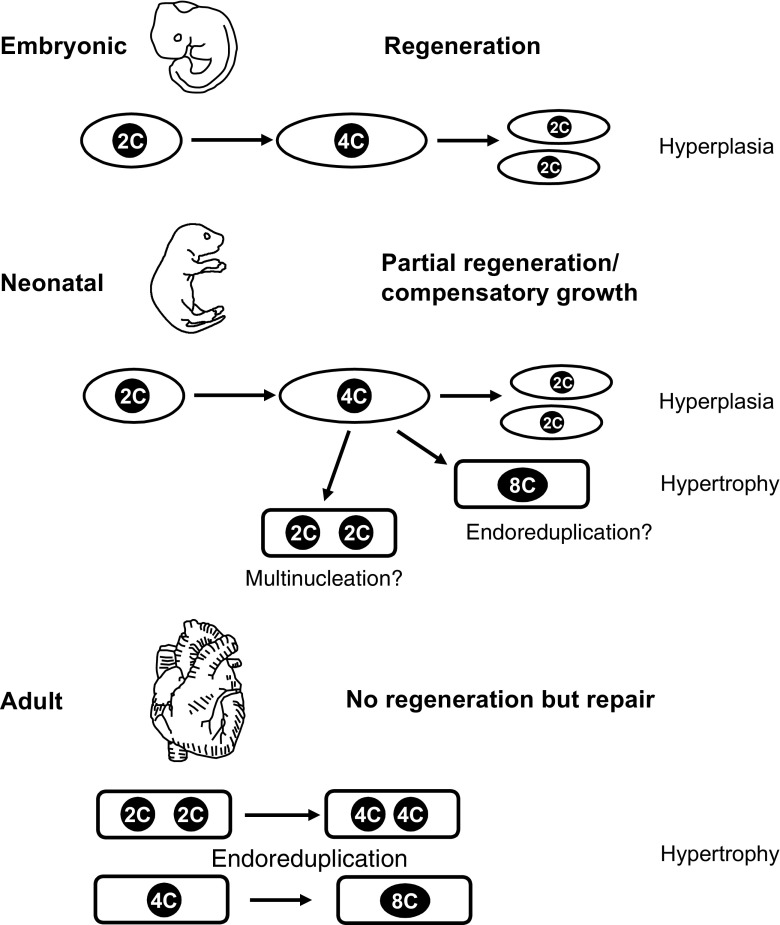
Cardiovascular disease and in particular, heart failure are still main causes of death; therefore, novel therapeutic approaches are urgently needed. Loss of contractile substrate in the heart and limited regenerative capacity of cardiomyocytes are mainly responsible for the poor cardiovascular outcome. This is related to the postmitotic state of differentiated cardiomyocytes, which is partly due to their polyploid nature caused by cell cycle variants. As such, the cardiomyocyte cell cycle is a key player, and its manipulation could be a promising strategy for enhancing the plasticity of the heart by inducing cardiomyocyte proliferation. This review focuses on the cardiac cell cycle and its variants during postnatal growth, the different regenerative responses of the heart in dependance of the developmental stage and on manipulations of the cell cycle. Because a therapeutic goal is to induce authentic cell division in cardiomyocytes, recent experimental approaches following this strategy are also discussed.
心血管疾病,尤其是心力衰竭仍然是主要的死亡原因;因此,迫切需要新的治疗方法。心脏收缩底物的丧失和心肌细胞有限的再生能力是导致心血管不良预后的主要原因。这与分化心肌细胞的有丝分裂后状态有关,部分原因是由于细胞周期变体导致的多倍性。因此,心肌细胞周期是一个关键因素,通过诱导心肌细胞增殖来操纵它可能是增强心脏可塑性的一种有前途的策略。本综述重点介绍心脏细胞周期及其在出生后生长过程中的变体,以及心脏在不同发育阶段的不同再生反应,以及对细胞周期的操纵。因为治疗目标是诱导心肌细胞的真正有丝分裂,所以也讨论了最近遵循这一策略的实验方法。