Jolles Diana R, Langford Rae, Stapleton Susan, Cesario Sandra, Koci Anne, Alliman Jill
Nurse-midwife El Rio Community Health Center, Faculty, Frontier Nursing University, Tucson, AZ, USA.
Texas Woman's University, Houston, TX, USA.
Birth. 2017 Dec;44(4):298-305. doi: 10.1111/birt.12302. Epub 2017 Aug 29.
Variations in care for pregnant women have been reported to affect pregnancy outcomes.
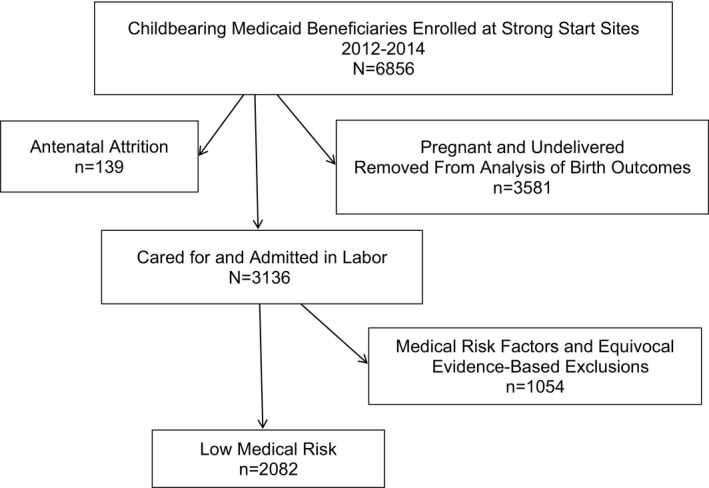
This study examined data for all 3136 Medicaid beneficiaries enrolled at American Association of Birth Centers (AABC) Center for Medicare and Medicaid Innovation Strong Start sites who gave birth between 2012 and 2014. Using the AABC Perinatal Data Registry, descriptive statistics were used to evaluate socio-behavioral and medical risks, and core perinatal quality outcomes. Next, the 2082 patients coded as low medical risk on admission in labor were analyzed for effective care and preference sensitive care variations. Finally, using binary logistic regression, the associations between selected care processes and cesarean delivery were explored.
Medicaid beneficiaries enrolled at AABC sites had diverse socio-behavioral and medical risk profiles and exceeded quality benchmarks for induction, episiotomy, cesarean, and breastfeeding. Among medically low-risk women, the model demonstrated effective care variations including 82% attendance at prenatal education classes, 99% receiving midwifery-led prenatal care, and 84% with midwifery- attended birth. Patient preferences were adhered to with 83% of women achieving birth at their preferred site of birth, and 95% of women using their preferred infant feeding method. Elective hospitalization in labor was associated with a 4-times greater risk of cesarean birth among medically low-risk childbearing Medicaid beneficiaries.
The birth center model demonstrates the capability to achieve the triple aims of improved population health, patient experience, and value.
据报道,孕妇护理方面的差异会影响妊娠结局。
本研究调查了2012年至2014年间在美国分娩中心协会(AABC)医疗保险和医疗补助创新中心“强力开端”项目点登记并分娩的所有3136名医疗补助受益人的数据。利用AABC围产期数据登记处的数据,采用描述性统计方法评估社会行为和医疗风险以及围产期核心质量指标。接下来,对2082名分娩入院时被编码为低医疗风险的患者进行有效护理和偏好敏感护理差异分析。最后,采用二元逻辑回归分析,探讨选定护理流程与剖宫产之间的关联。
在AABC项目点登记的医疗补助受益人具有不同的社会行为和医疗风险特征,在引产、会阴切开术、剖宫产和母乳喂养方面均超过了质量基准。在医疗低风险女性中,该模型显示出有效的护理差异,包括82%的人参加了产前教育课程,99%的人接受了由助产士主导的产前护理,84%的人由助产士接生。患者的偏好得到了遵循,83%的女性在她们首选的分娩地点分娩,95%的女性采用了她们首选的婴儿喂养方式。在医疗低风险的生育医疗补助受益人中,分娩时选择性住院与剖宫产风险高出4倍有关。
分娩中心模式显示出实现改善人群健康、患者体验和价值这三大目标的能力。