Matsuoka Hiromichi, Ishiki Hiroto, Iwase Satoru, Koyama Atsuko, Kawaguchi Takashi, Kizawa Yoshiyuki, Morita Tatsuya, Matsuda Yoshinobu, Miyaji Tempei, Ariyoshi Keisuke, Yamaguchi Takuhiro
Palliative Care Center, Cancer Center, Kindai University Hospital, Osaka, Japan.
Department of Psychosomatic Medicine, Kindai University Faculty of Medicine, Osaka, Japan.
BMJ Open. 2017 Aug 28;7(8):e017280. doi: 10.1136/bmjopen-2017-017280.
Management of patients with cancer suffering from neuropathic pain refractory to opioids and gabapentinoids remains an important challenge. Duloxetine is one of the choices after first-line treatment fails. The efficacy of duloxetine has been reported in patients with non-cancer disease and in chemotherapy-induced peripheral neuropathy, but no randomised clinical trials have examined its effects on neuropathic cancer pain refractory to first-line treatment. The objective of this study is to assess the analgesic efficacy of duloxetine in patients suffering from neuropathic cancer pain refractory to opioids and gabapentinoids.
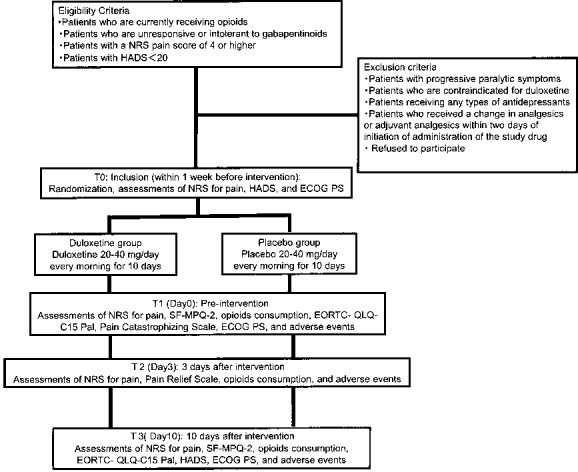
A multi-institutional, prospective, randomised, double-blind, placebo-controlled, two-parallel trial is planned. The inclusion criteria are adult patients with cancer suffering from neuropathic cancer pain refractory to opioids and gabapentinoids, patients with a Numerical Rating Scale (NRS) pain score of 4 or higher and patients with a total Hospital Anxiety and Depression Scale score of less than 20. Patients with chemotherapy-induced peripheral neuropathy are excluded. The study will take place at 14 sites across Japan. Participants will be randomised (1:1 allocation ratio) to a duloxetine intervention group or a placebo control group. Evaluations will be made at baseline (T0 randomisation), day 0 (T1), day 3 (T2) and day 10 (T3). The primary endpoint is defined as the difference in NRS score for pain intensity (average over the previous 24 hours) at T3 between the duloxetine and placebo groups. A sample size of 70 patients will be examined between July 2015 and March 2018.
Ethics approval was obtained at all participating sites.The results of this study will be submitted for publication in international peer-reviewed journals and the key findings presented at international scientific conferences.
UMIN000017647; Pre-results.
2.2, 26 April 2017.
对于患有神经性疼痛且对阿片类药物和加巴喷丁类药物治疗无效的癌症患者,其管理仍然是一项重大挑战。度洛西汀是一线治疗失败后的选择之一。度洛西汀在非癌症疾病患者和化疗引起的周围神经病变患者中的疗效已有报道,但尚无随机临床试验研究其对一线治疗无效的神经性癌痛的影响。本研究的目的是评估度洛西汀对患有对阿片类药物和加巴喷丁类药物治疗无效的神经性癌痛患者的镇痛效果。
计划开展一项多机构、前瞻性、随机、双盲、安慰剂对照、双平行试验。纳入标准为患有对阿片类药物和加巴喷丁类药物治疗无效的神经性癌痛的成年癌症患者、数字评定量表(NRS)疼痛评分4分或更高的患者以及医院焦虑抑郁量表总分低于20分的患者。排除化疗引起的周围神经病变患者。该研究将在日本的14个地点进行。参与者将被随机(1:1分配比例)分为度洛西汀干预组或安慰剂对照组。在基线(T0随机分组)、第0天(T1)、第3天(T2)和第10天(T3)进行评估。主要终点定义为度洛西汀组和安慰剂组在T3时疼痛强度的NRS评分差异(前24小时平均值)。2015年7月至2018年3月期间将对70例患者进行样本量检测。
所有参与地点均获得伦理批准。本研究结果将提交至国际同行评审期刊发表,并在国际科学会议上展示主要研究结果。
UMIN000017647;预结果。
2.2,2