Hung Keng-Lou James, Ascher John S, Holway David A
Division of Biological Sciences, University of California, San Diego, La Jolla, California, United States of America.
Department of Biological Sciences, National University of Singapore, Singapore, Singapore.
PLoS One. 2017 Aug 30;12(8):e0184136. doi: 10.1371/journal.pone.0184136. eCollection 2017.
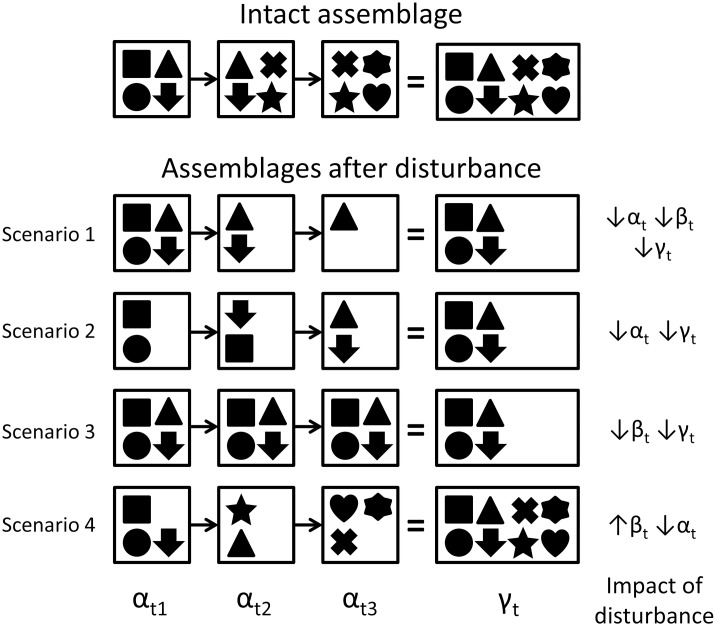
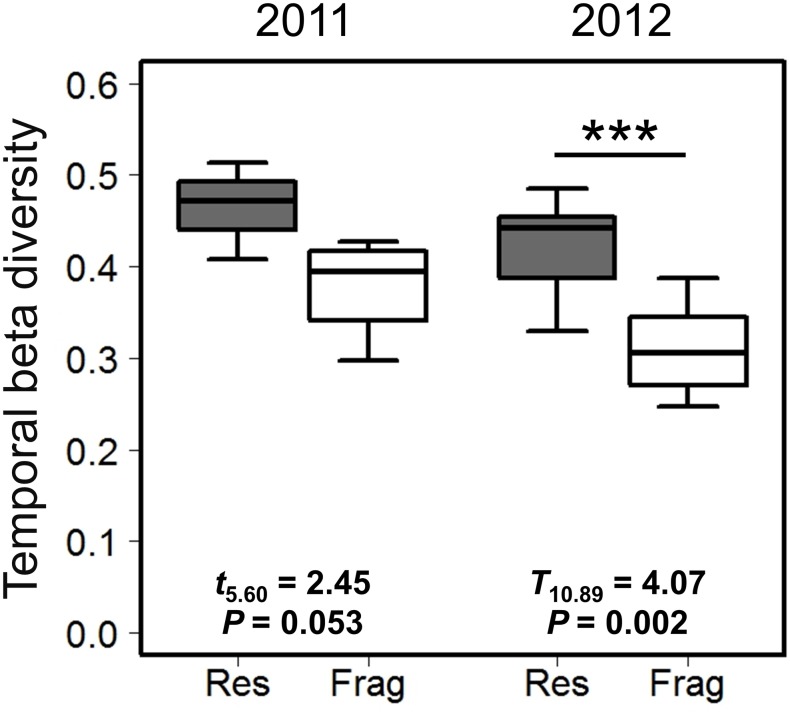
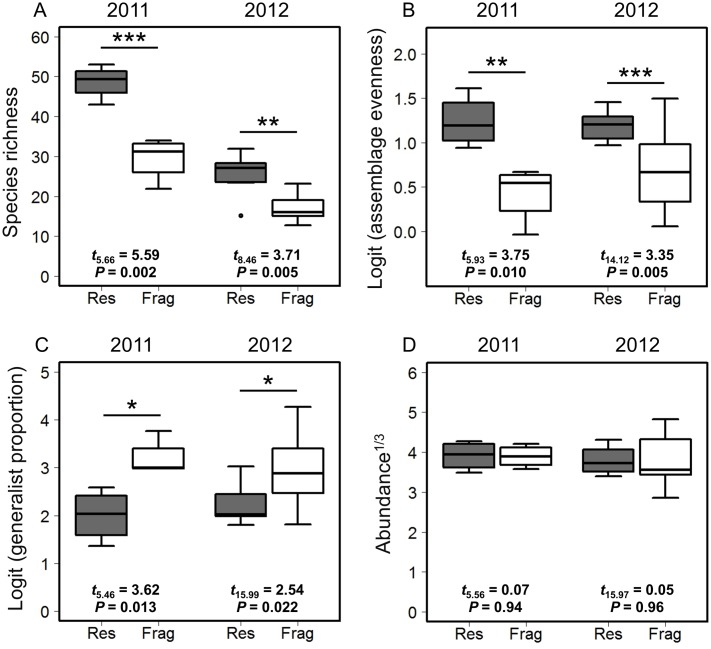
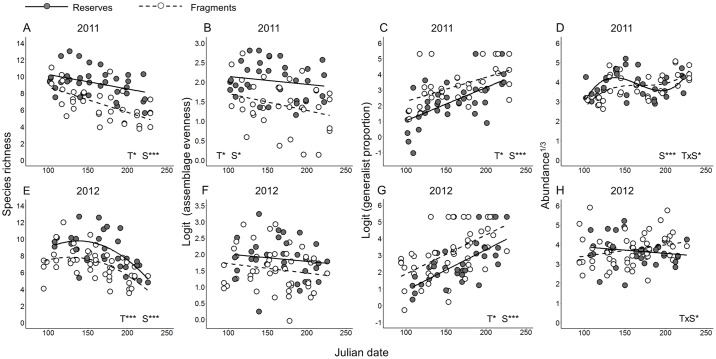
Despite a large number of ecological studies that document diversity loss resulting from anthropogenic disturbance, surprisingly few consider how disturbance affects temporal patterns of diversity that result from seasonal turnover of species. Temporal dynamics can play an important role in the structure and function of biological assemblages. Here, we investigate the temporal diversity patterns of bee faunas in Southern California coastal sage scrub ecosystems that have been extensively fragmented by urbanization. Using a two-year dataset of 235 bee species (n = 12,036 specimens), we compared 1-ha plots in scrub fragments and scrub reserves with respect to three components of temporal diversity: overall plot-level diversity pooled over time (temporal gamma diversity), diversity at discrete points in time (temporal alpha diversity), and seasonal turnover in assemblage composition (temporal beta diversity). Compared to reserves, fragments harbored bee assemblages with lower species richness and assemblage evenness both when summed across temporal samples (i.e., lower temporal gamma diversity) and at single points in time (i.e., lower temporal alpha diversity). Bee assemblages in fragments also exhibited reduced seasonal turnover (i.e., lower temporal beta diversity). While fragments and reserves did not differ in overall bee abundance, bee abundance in fragments peaked later in the season compared to that in reserves. Our results argue for an increased awareness of temporal diversity patterns, as information about the distinct components of temporal diversity is essential both for characterizing the assemblage dynamics of seasonal organisms and for identifying potential impacts of anthropogenic disturbance on ecosystem function through its effects on assemblage dynamics.
尽管大量生态学研究记录了人为干扰导致的生物多样性丧失,但令人惊讶的是,很少有研究考虑干扰如何影响由物种季节性更替所产生的多样性的时间格局。时间动态在生物群落的结构和功能中可能起着重要作用。在此,我们调查了南加州沿海鼠尾草灌丛生态系统中蜜蜂动物群的时间多样性模式,这些生态系统因城市化而被广泛分割。利用一个包含235种蜜蜂(n = 12,036个标本)的两年数据集,我们比较了灌丛片段和灌丛保护区中1公顷样地在时间多样性的三个组成部分:随时间汇总的总体样地水平多样性(时间伽马多样性)、离散时间点的多样性(时间阿尔法多样性)以及群落组成的季节性更替(时间贝塔多样性)。与保护区相比,片段中的蜜蜂群落无论是在跨时间样本求和时(即较低的时间伽马多样性)还是在单个时间点(即较低的时间阿尔法多样性),物种丰富度和群落均匀度都较低。片段中的蜜蜂群落季节性更替也有所减少(即较低的时间贝塔多样性)。虽然片段和保护区的蜜蜂总丰度没有差异,但片段中的蜜蜂丰度在季节后期达到峰值,而保护区的峰值出现得更早。我们的研究结果表明,需要提高对时间多样性模式的认识,因为有关时间多样性不同组成部分的信息对于描述季节性生物的群落动态以及通过其对群落动态的影响来识别人为干扰对生态系统功能的潜在影响都至关重要。