van Oostrom Sandra H, van der A Daphne L, Rietman M Liset, Picavet H Susan J, Lette Manon, Verschuren W M Monique, de Bruin Simone R, Spijkerman Annemieke M W
Centre for Nutrition, Prevention and Health Services, National Institute of Public Health and the Environment, P.O. Box 1, 3720, Bilthoven, BA, The Netherlands.
Julius Center for Health Sciences and Primary Care, University Medical Center Utrecht, Utrecht, the Netherlands.
BMC Geriatr. 2017 Aug 30;17(1):196. doi: 10.1186/s12877-017-0595-0.
Accumulation of problems in physical, psychological, cognitive, or social functioning is characteristic for frail individuals. Using a four-domain approach of frailty, this study explored how sociodemographic and lifestyle factors, life events and health are associated with frailty.
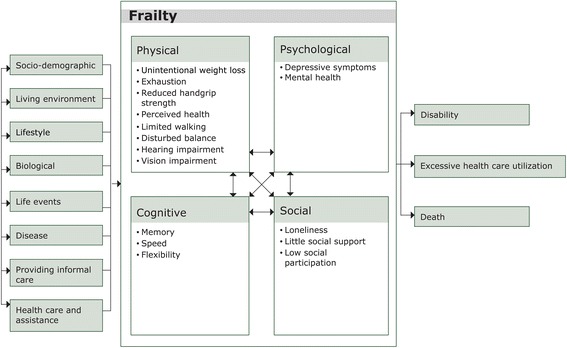
The study sample included 4019 men and women (aged 40-81 years) examined during the fifth round (2008-2012) of the Doetinchem Cohort Study. Four domains of frailty were considered: physical (≥4 of 8 criteria: unintentional weight loss, exhaustion, strength, perceived health, walking, balance, hearing and vision impairments), psychological (2 criteria: depressive symptoms, mental health), cognitive (<10th percentile on global cognitive functioning), and social frailty (≥2 of 3 criteria: loneliness, social support, social participation). Logistic regression was used to study the cross-sectional association of sociodemographic factors, lifestyle, life events and chronic diseases with frailty domains.
About 17% of the population was frail on one or more domains. Overlap between the frailty domains was limited since 82% of the frail population was frail on one domain only. Low educated respondents were at higher risk of being psychologically and socially frail. Having multiple diseases was associated with a higher risk of being physically and psychologically frail. Being physically active was consistently associated with a lower risk of frailty on each of the four domains. Short or long sleep duration was associated with a higher risk of being physically, psychologically, and socially frail.
Sociodemographic factors, lifestyle and multimorbidity contributed differently to the four frailty domains. It is important to consider multiple frailty domains since this helps to identify different groups of frail people, and as such to provide tailored care and support. Lifestyle factors including physical activity, smoking and sleep duration were associated with multiple domains of frailty.
身体、心理、认知或社会功能方面问题的积累是虚弱个体的特征。本研究采用虚弱的四领域方法,探讨社会人口学和生活方式因素、生活事件及健康状况与虚弱之间的关联。
研究样本包括在多廷赫姆队列研究第五轮(2008 - 2012年)期间接受检查的4019名男性和女性(年龄在40 - 81岁之间)。考虑了虚弱的四个领域:身体方面(8项标准中满足≥4项:非故意体重减轻、疲惫、力量、自我感知健康、行走、平衡、听力和视力障碍)、心理方面(2项标准:抑郁症状、心理健康)、认知方面(全球认知功能处于第10百分位数以下)以及社会虚弱方面(3项标准中满足≥2项:孤独感、社会支持、社会参与)。采用逻辑回归研究社会人口学因素、生活方式、生活事件和慢性病与虚弱领域的横断面关联。
约17%的人群在一个或多个领域存在虚弱。虚弱领域之间的重叠有限,因为82%的虚弱人群仅在一个领域存在虚弱。受教育程度低的受访者在心理和社会方面虚弱的风险更高。患有多种疾病与身体和心理方面虚弱的风险更高相关。身体活跃始终与四个领域中每个领域的虚弱风险较低相关。睡眠时间过短或过长与身体、心理和社会方面虚弱的风险更高相关。
社会人口学因素、生活方式和多种疾病对四个虚弱领域的影响各不相同。考虑多个虚弱领域很重要,因为这有助于识别不同的虚弱人群群体,从而提供量身定制的护理和支持。包括身体活动、吸烟和睡眠时间在内的生活方式因素与多个虚弱领域相关。