Warren Charlotte E, Ndwiga Charity, Sripad Pooja, Medich Melissa, Njeru Anne, Maranga Alice, Odhiambo George, Abuya Timothy
Population Council, 4301 Connecticut Avenue NW, Suite, Washington, DC, #280, USA.
Population Council, PO Box 17643-00500, Nairobi, Kenya.
BMC Womens Health. 2017 Aug 30;17(1):69. doi: 10.1186/s12905-017-0425-8.
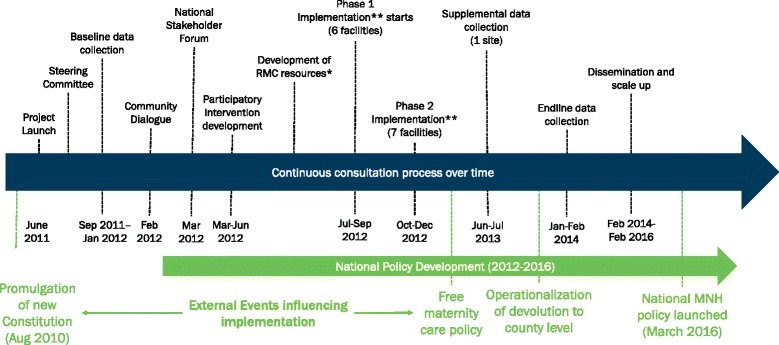
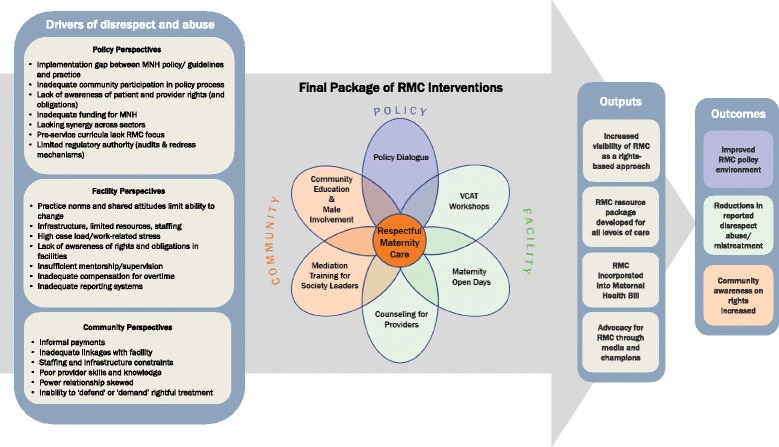
Despite years of growing concern about poor provider attitudes and women experiencing mistreatment during facility based childbirth, there are limited interventions that specifically focus on addressing these issues. The Heshima project is an evidence-based participatory implementation research study conducted in 13 facilities in Kenya. It engaged a range of community, facility, and policy stakeholders to address the causes of mistreatment during childbirth and promote respectful maternity care.
We used the consolidated framework for implementation research (CFIR) as an analytical lens to describe a complex, multifaceted set of interventions through a reflexive and iterative process for triangulating qualitative data. Data from a broad range of project documents, reports, and interviews were collected at different time points during the implementation of Heshima. Assessment of in-depth interview data used NVivo (Version 10) and Atlas.ti software to inductively derive codes for themes at baseline, supplemental, and endline. Our purpose was to generate categories of themes for analysis found across the intervention design and implementation stages.
The implementation process, intervention characteristics, individual champions, and inner and outer settings influenced both Heshima's successes and challenges at policy, facility, and community levels. Implementation success stemmed from readiness for change at multiple levels, constant communication between stakeholders, and perceived importance to communities. The relative advantage and adequacy of implementation of the Respectful Maternity Care (RMC) resource package was meaningful within Kenyan politics and health policy, given the timing and national promise to improve the quality of maternity care.
We found the CFIR lens a promising and flexible one for understanding the complex interventions. Despite the relatively nascent stage of RMC implementation research, we feel this study is an important start to understanding a range of interventions that can begin to address issues of mistreatment in maternity care; replication of these activities is needed globally to better understand if the Heshima implementation process can be successful in different countries and regions.
尽管多年来人们日益关注医护人员态度不佳以及女性在机构分娩期间遭受虐待的问题,但专门针对解决这些问题的干预措施却很有限。赫希马项目是一项在肯尼亚13个机构开展的基于证据的参与式实施研究。它让一系列社区、机构和政策利益相关者参与进来,以解决分娩期间虐待行为的成因,并促进尊重孕产妇的护理。
我们使用实施研究综合框架(CFIR)作为分析视角,通过一个反思性和迭代性的过程对定性数据进行三角测量,以描述一组复杂、多方面的干预措施。在赫希马项目实施期间的不同时间点,收集了来自广泛项目文件、报告和访谈的数据。对深入访谈数据的评估使用了NVivo(版本10)和Atlas.ti软件,以归纳得出基线、补充和终线阶段主题的代码。我们的目的是生成在干预设计和实施阶段发现的用于分析的主题类别。
实施过程、干预特征、个人倡导者以及内部和外部环境在政策、机构和社区层面影响了赫希马项目的成功与挑战。实施的成功源于多个层面的变革准备、利益相关者之间的持续沟通以及社区对其重要性的认知。鉴于改善孕产妇护理质量的时机和国家承诺,尊重孕产妇护理(RMC)资源包实施的相对优势和充分性在肯尼亚政治和卫生政策中具有重要意义。
我们发现CFIR视角对于理解复杂的干预措施是一个有前景且灵活的视角。尽管RMC实施研究尚处于相对初期阶段,但我们认为这项研究是理解一系列可着手解决孕产妇护理中虐待问题的干预措施的重要开端;全球需要复制这些活动,以更好地了解赫希马实施过程在不同国家和地区是否能够成功。