Division of Infection and Immunity, Cardiff University, Cardiff, United Kingdom.
Velindre NHS Trust, Whitchurch, Cardiff, United Kingdom.
Clin Cancer Res. 2017 Nov 15;23(22):6771-6780. doi: 10.1158/1078-0432.CCR-17-0895. Epub 2017 Aug 29.
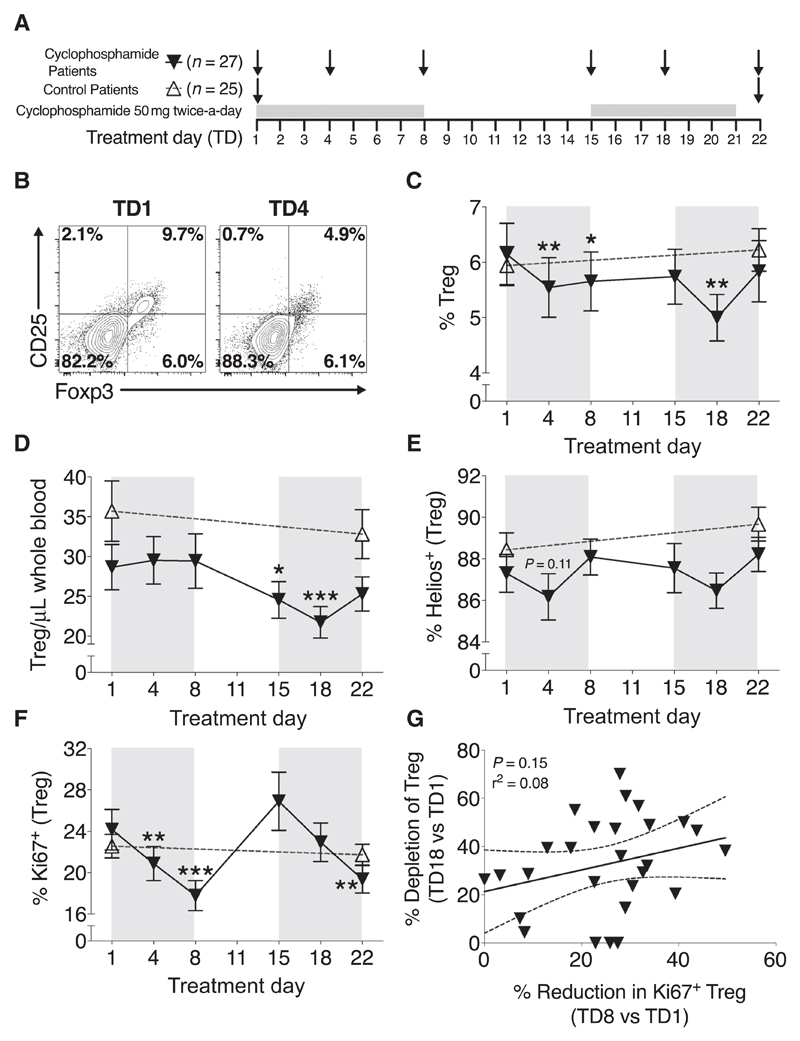
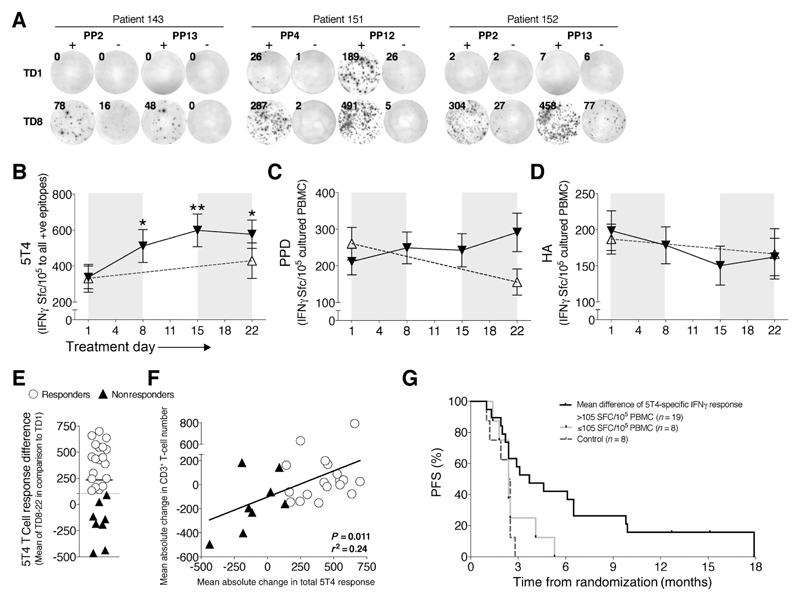
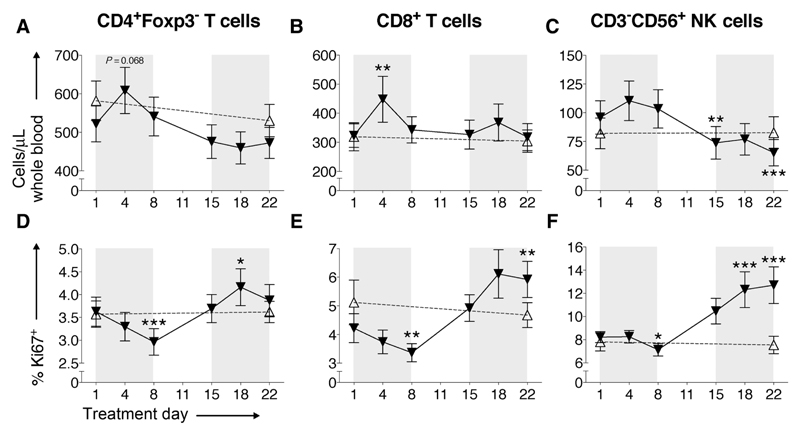
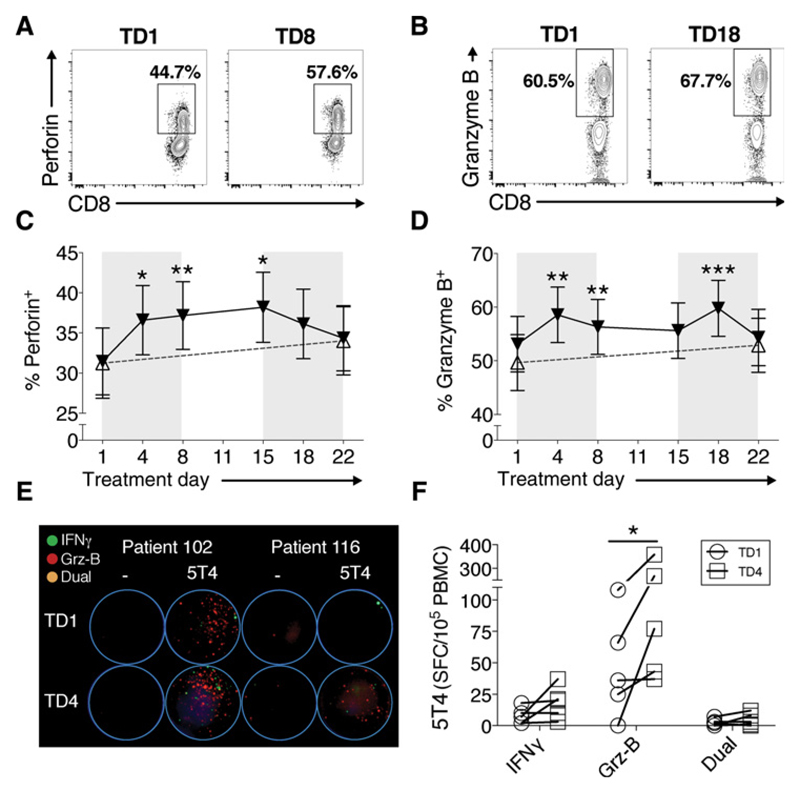
Anticancer T-cell responses can control tumors, but immunosuppressive mechanisms prevent their function. The role of regulatory T cells (Tregs) in metastatic colorectal cancer is unclear. We have previously shown depletion of Tregs enhances colorectal cancer-specific effector T-cell responses. Low-dose cyclophosphamide targets Tregs in animal models and some human studies; however, the effect of cyclophosphamide in metastatic colorectal cancer is unknown. Fifty-five patients with metastatic colorectal cancer were enrolled in a phase I/II trial and randomly assigned to receive 2-week-long courses of low-dose (50 mg twice a day) cyclophosphamide or not. The absolute number, phenotype, and antitumor function of peripheral blood-derived lymphocyte subsets were monitored throughout treatment, as well as during 18-month follow-up. Initially, cyclophosphamide reduced proliferation in all lymphocyte subsets; however, a rapid mobilization of effector T cells overcame this decrease, leading to increased absolute T-cell numbers. In contrast, a reduction in proportional and absolute Treg, B-cell, and NK-cell numbers occurred. The expansion and subsequent activation of effector T cells was focused on tumor-specific T cells, producing both granzyme B and IFNγ. Cyclophosphamide-treated patients demonstrating the most enhanced IFNγ tumor-specific T-cell responses exhibited a significant delay in tumor progression [HR = 0.29; 95% confidence interval (CI), 0.12-0.69; = 0.0047), compared with nonresponders and no-treatment controls. Cyclophosphamide-induced Treg depletion is mirrored by a striking boost in antitumor immunity. This study provides the first direct evidence of the benefit of naturally primed T cells in patients with metastatic colorectal cancer. Our results also support the concept that nonmutated self-antigens may act as useful targets for immunotherapies. .
抗癌 T 细胞反应可以控制肿瘤,但免疫抑制机制会阻止其发挥功能。调节性 T 细胞(Tregs)在转移性结直肠癌中的作用尚不清楚。我们之前的研究表明,耗尽 Tregs 可增强结直肠癌特异性效应 T 细胞反应。低剂量环磷酰胺在动物模型和一些人类研究中靶向 Tregs;然而,环磷酰胺在转移性结直肠癌中的作用尚不清楚。55 名转移性结直肠癌患者入组了一项 I/II 期临床试验,并随机分为接受 2 周低剂量(50mg,每天 2 次)环磷酰胺治疗或不治疗。在整个治疗过程中以及 18 个月的随访期间,监测外周血衍生淋巴细胞亚群的绝对数量、表型和抗肿瘤功能。最初,环磷酰胺降低了所有淋巴细胞亚群的增殖;然而,效应 T 细胞的快速动员克服了这种减少,导致 T 细胞绝对数量增加。相比之下,Treg、B 细胞和 NK 细胞的比例和绝对数量减少。效应 T 细胞的扩增和随后的激活集中在肿瘤特异性 T 细胞上,产生颗粒酶 B 和 IFNγ。与无反应者和未治疗对照组相比,表现出最增强的 IFNγ 肿瘤特异性 T 细胞反应的环磷酰胺治疗患者肿瘤进展明显延迟[风险比=0.29;95%置信区间(CI),0.12-0.69;P=0.0047]。环磷酰胺诱导的 Treg 耗竭与抗肿瘤免疫的显著增强相吻合。这项研究首次提供了转移性结直肠癌患者自然产生的 T 细胞获益的直接证据。我们的结果还支持非突变自身抗原可能作为免疫治疗有用靶点的概念。