Bagdany Miklos, Veit Guido, Fukuda Ryosuke, Avramescu Radu G, Okiyoneda Tsukasa, Baaklini Imad, Singh Jay, Sovak Guy, Xu Haijin, Apaja Pirjo M, Sattin Sara, Beitel Lenore K, Roldan Ariel, Colombo Giorgio, Balch William, Young Jason C, Lukacs Gergely L
Department of Physiology, McGill University, Montréal, QC, Canada, H3G 1Y6.
Department of Bioscience, School of Science and Technology, Kwansei Gakuin University, 2-1 Gakuen, Sanda, 669-1337, Japan.
Nat Commun. 2017 Aug 30;8(1):398. doi: 10.1038/s41467-017-00444-4.
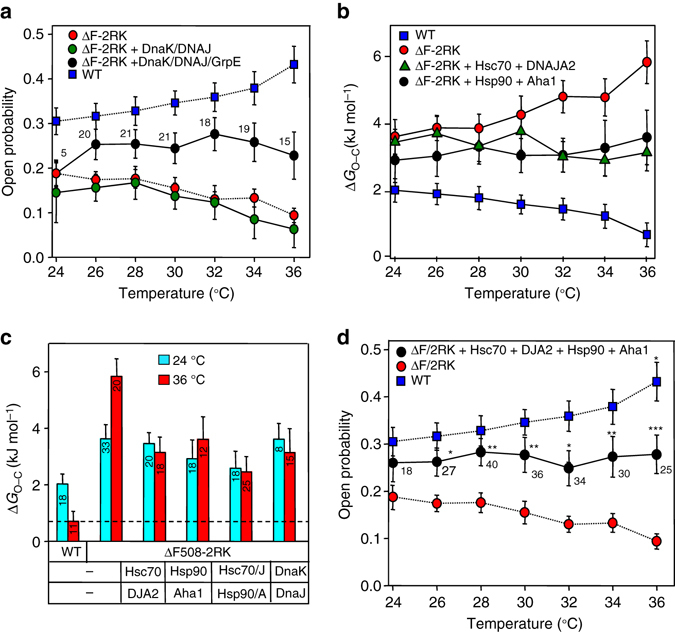
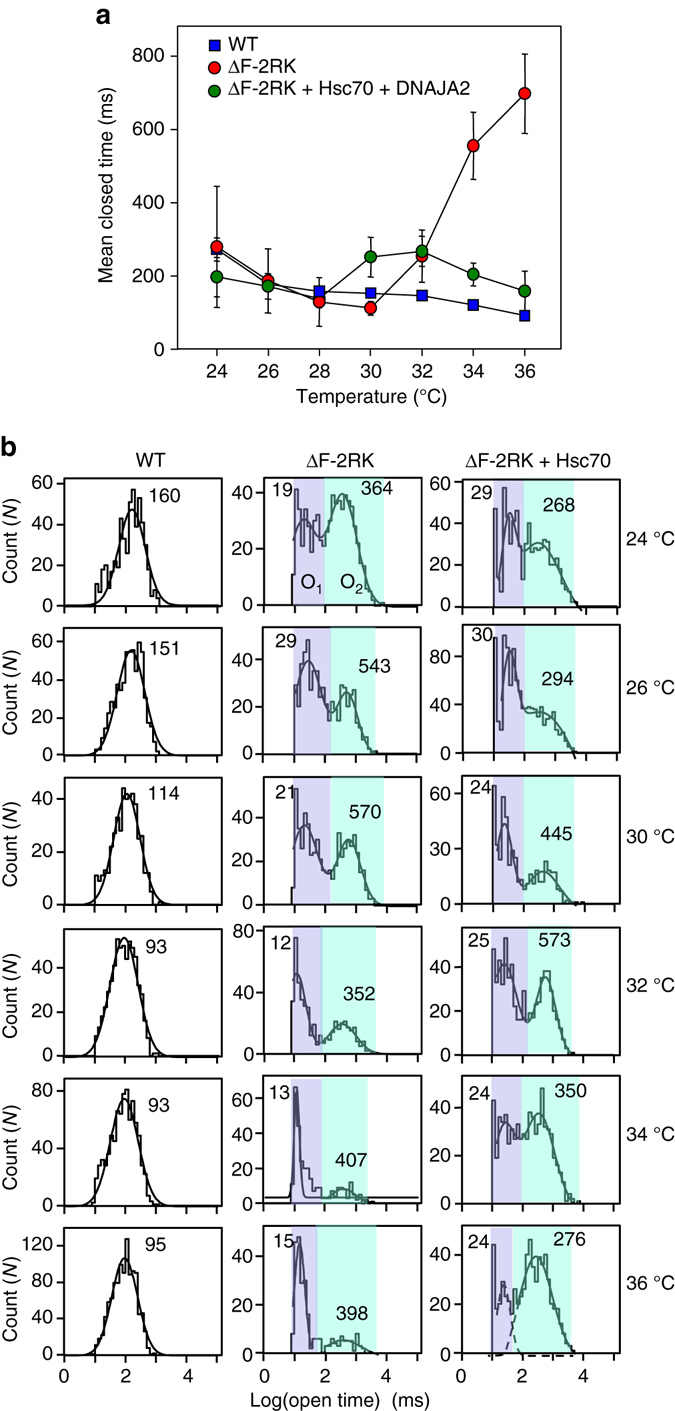
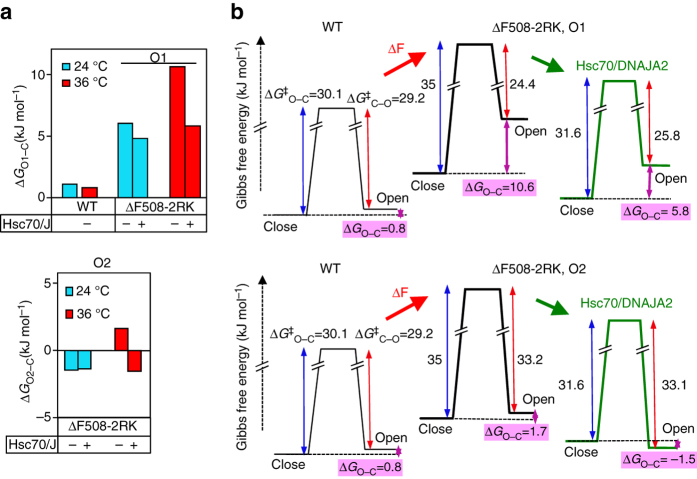
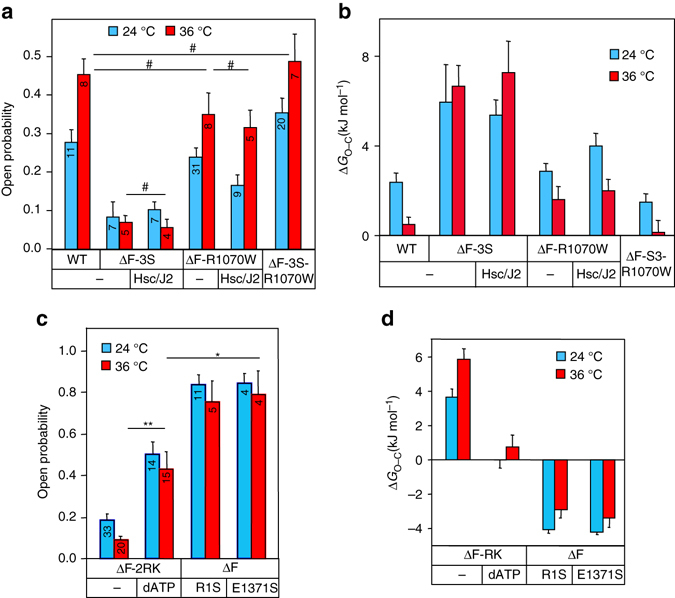
Molecular chaperones are pivotal in folding and degradation of the cellular proteome but their impact on the conformational dynamics of near-native membrane proteins with disease relevance remains unknown. Here we report the effect of chaperone activity on the functional conformation of the temperature-sensitive mutant cystic fibrosis channel (∆F508-CFTR) at the plasma membrane and after reconstitution into phospholipid bilayer. Thermally induced unfolding at 37 °C and concomitant functional inactivation of ∆F508-CFTR are partially suppressed by constitutive activity of Hsc70 and Hsp90 chaperone/co-chaperone at the plasma membrane and post-endoplasmic reticulum compartments in vivo, and at single-molecule level in vitro, indicated by kinetic and thermodynamic remodeling of the mutant gating energetics toward its wild-type counterpart. Thus, molecular chaperones can contribute to functional maintenance of ∆F508-CFTR by reshaping the conformational energetics of its final fold, a mechanism with implication in the regulation of metastable ABC transporters and other plasma membrane proteins activity in health and diseases.The F508 deletion (F508del) in the cystic fibrosis transmembrane conductance regulator (CFTR) is the most common CF causing mutation. Here the authors show that cytosolic chaperones shift the F508del channel conformation to the native fold by kinetic and thermodynamic remodelling of the gating energetics towards that of wild-type CTFR.
分子伴侣在细胞蛋白质组的折叠和降解过程中起着关键作用,但其对具有疾病相关性的近天然膜蛋白构象动力学的影响仍不清楚。在此,我们报告了伴侣活性对温度敏感型突变体囊性纤维化通道(∆F508-CFTR)在质膜上以及重组到磷脂双层后功能构象的影响。在体内,质膜和内质网后区室中Hsc70和Hsp90伴侣/共伴侣的组成型活性部分抑制了37°C时热诱导的∆F508-CFTR解折叠及伴随的功能失活,在体外单分子水平也是如此,这通过突变体门控能量学向野生型对应物的动力学和热力学重塑得以体现。因此,分子伴侣可通过重塑∆F508-CFTR最终折叠的构象能量来促进其功能维持,这一机制对健康和疾病状态下亚稳态ABC转运蛋白及其他质膜蛋白活性的调节具有重要意义。囊性纤维化跨膜传导调节因子(CFTR)中的F508缺失(F508del)是导致囊性纤维化最常见的突变。本文作者表明,胞质伴侣通过将门控能量学向野生型CFTR的方向进行动力学和热力学重塑,使F508del通道构象转变为天然折叠。