Volkmann Elizabeth R, Tashkin Donald P, Li Ning, Furst Daniel E, Clements Philip J, Elashoff Robert M
Department of Medicine, David Geffen School of Medicine, University of California, Los Angeles, USA.
Department of Biomathematics, University of California, Los Angeles, USA.
Rheumatology (Sunnyvale). 2015 Jun;5(2). doi: 10.4172/2161-1149.1000154. Epub 2015 Jun 30.
While systemic sclerosis-related interstitial lung disease (SSc-ILD) trials predominantly use forced vital capacity (FVC) as the primary outcome, combining individual outcomes may lead to a more comprehensive measure of treatment response and minimize the risk of type 1 error. The present analysis aimed to develop a composite outcome measure to assess treatment response in SSc-ILD patients.
We used data from the Scleroderma Lung Study I (SLS-I) to create the composite outcome measure. SLS I was a multi-institutional, double-blind clinical trial, in which 158 patients with SSc-ILD were randomized to receive either oral cyclophosphamide (CYC) (titrated to 2.0 mg/kg once daily) or matching placebo for one year. To select the variables for inclusion in the composite outcome, we first performed a univariate analysis using all of the outcome variables measured in SLS I. We subsequently combined the variables with significant treatment effects (p<0.05) in a principal component analysis (PCA) to assess the difference between treatment groups. These variables included the FVC% predicted, computer-based score for quantitative lung fibrosis in the zone of maximum fibrosis (QLF-ZM) from thoracic high-resolution computer tomography (HRCT) scans, transitional dyspnea index (TDI), and the Health Assessment Questionnaire-Disability Index (HAQ-DI) at 12 months.
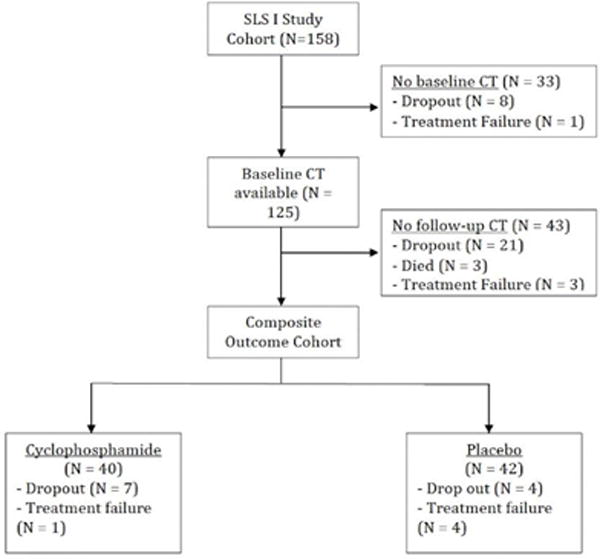
Of the 158 patients, 82 had complete outcome data and were included in this analysis. There were no significant differences in baseline characteristics between the 82 patients included in this analysis and the remaining 76 patients. The regression model with the first principal component for FVC% predicted, QLF-ZM, TDI and HAQ-DI as the composite outcome demonstrated a significant treatment effect favoring cyclophosphamide (Estimate 0.7 [SE 0.2]; p=0.005). Eliminating FVC% predicted from the composite outcome model did not change the overall treatment effect (Estimate 0.8 [SE 0.2]; p=0.004).
The CYC treatment effect observed from using the composite outcome of FVC% predicted, QLF-ZM, TDI and HAQ-DI was stronger than the effect observed using FVC% predicted alone. These findings suggest that combining patient-reported outcomes with structural and physiologic outcomes into a single outcome may serve as a more robust measure of treatment response compared with FVC alone in SSc-ILD trials.
虽然系统性硬化症相关间质性肺病(SSc-ILD)试验主要将用力肺活量(FVC)作为主要结局指标,但综合个体结局指标可能会得出更全面的治疗反应衡量标准,并将I型错误风险降至最低。本分析旨在制定一种综合结局指标,以评估SSc-ILD患者的治疗反应。
我们使用硬皮病肺部研究I(SLS-I)的数据来创建综合结局指标。SLS I是一项多机构双盲临床试验,158例SSc-ILD患者被随机分为两组,分别接受口服环磷酰胺(CYC)(滴定至每日一次2.0mg/kg)或匹配的安慰剂,为期一年。为了选择纳入综合结局指标的变量,我们首先使用SLS I中测量的所有结局变量进行单变量分析。随后,我们在主成分分析(PCA)中将具有显著治疗效果(p<0.05)的变量合并起来,以评估治疗组之间的差异。这些变量包括预测的FVC%、胸部高分辨率计算机断层扫描(HRCT)扫描中最大纤维化区域的基于计算机的定量肺纤维化评分(QLF-ZM)、过渡性呼吸困难指数(TDI)以及12个月时的健康评估问卷残疾指数(HAQ-DI)。
158例患者中,82例有完整的结局数据并纳入本分析。纳入本分析的82例患者与其余76例患者的基线特征无显著差异。以预测的FVC%、QLF-ZM、TDI和HAQ-DI的第一主成分为综合结局指标的回归模型显示,环磷酰胺有显著的治疗效果(估计值0.7 [标准误0.2];p=0.005)。从综合结局模型中剔除预测的FVC%并没有改变总体治疗效果(估计值0.8 [标准误0.2];p=0.004)。
使用预测的FVC%、QLF-ZM、TDI和HAQ-DI的综合结局指标观察到的CYC治疗效果,比单独使用预测的FVC%观察到的效果更强。这些发现表明,在SSc-ILD试验中,与单独使用FVC相比,将患者报告的结局指标与结构和生理结局指标合并为一个单一结局指标,可能是衡量治疗反应的更可靠指标。