Department of Gastrointestinal Surgery, The Sixth Affiliated Hospital (Guangdong Gastrointestinal and Anal Hospital), Sun Yat-Sen University, Guangzhou, China.
Guangdong Provincial Key Laboratory of Colorectal and Pelvic Floor Diseases, The Sixth Affiliated Hospital, Sun Yat-sen University, Guangzhou, China.
Cancer Med. 2017 Oct;6(10):2331-2346. doi: 10.1002/cam4.1169. Epub 2017 Aug 31.
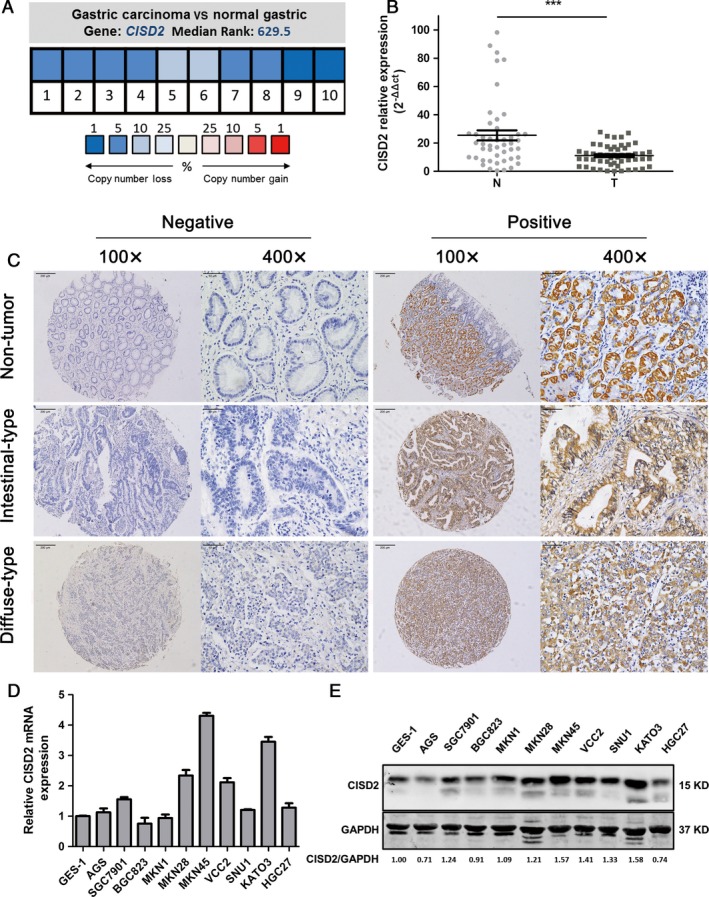
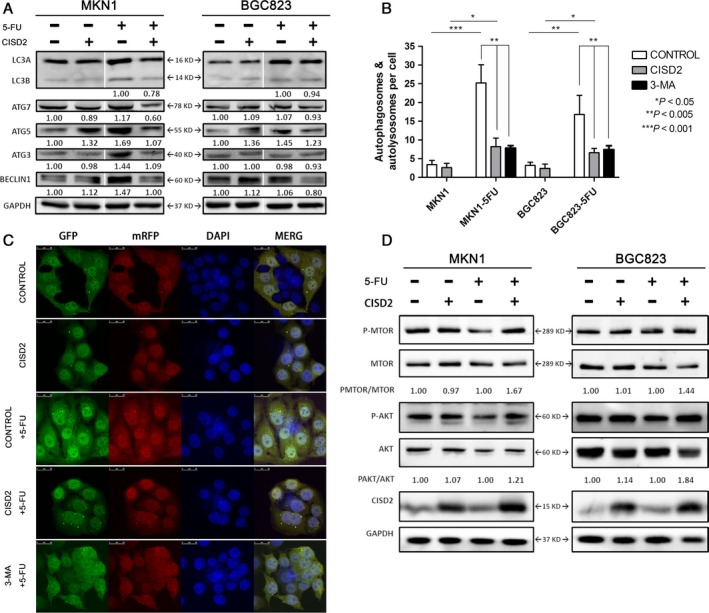
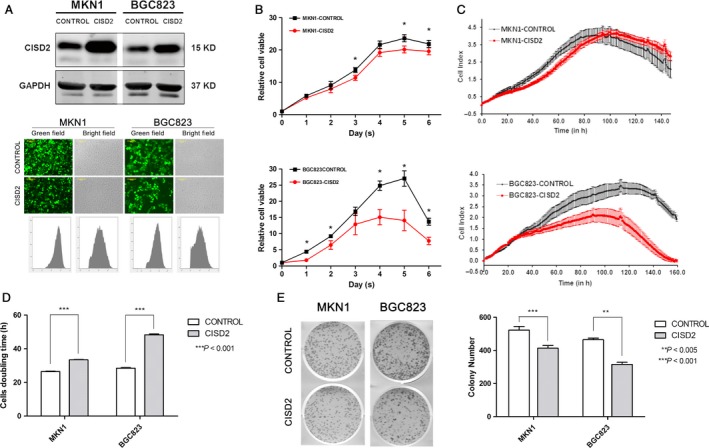
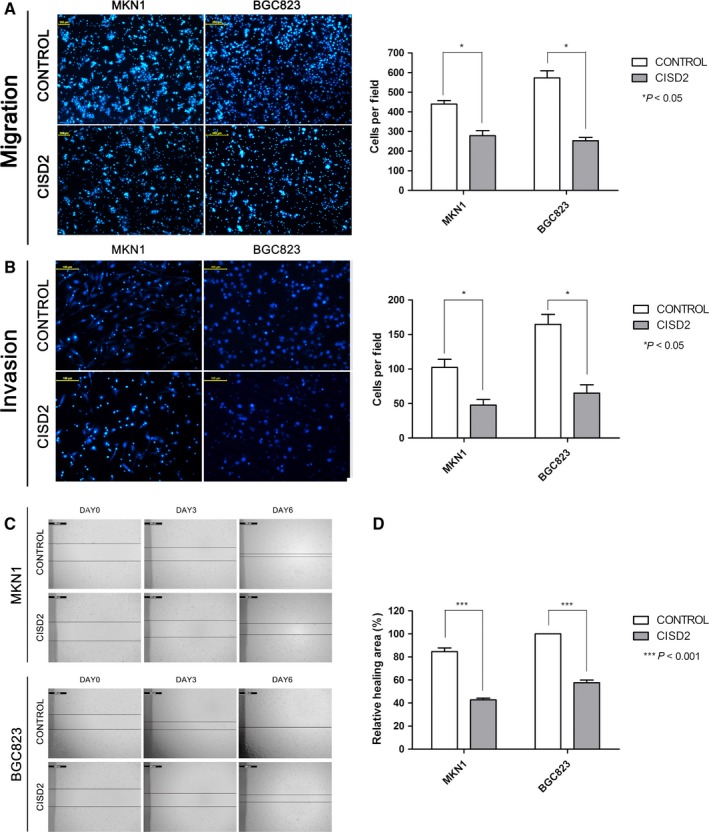
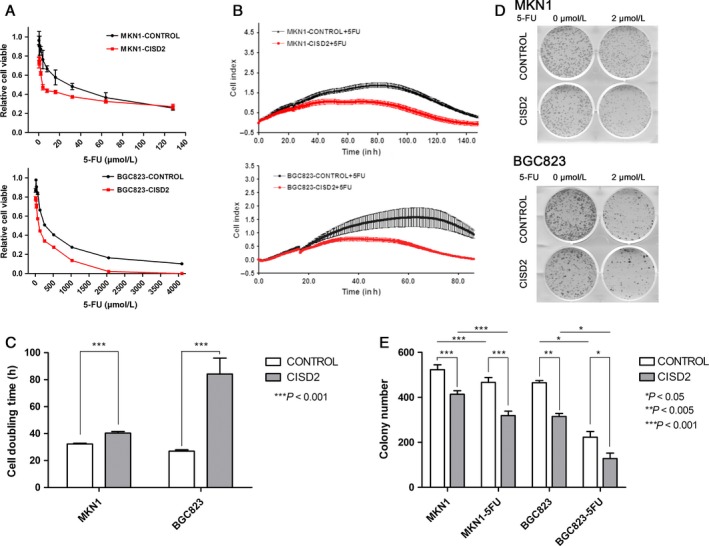
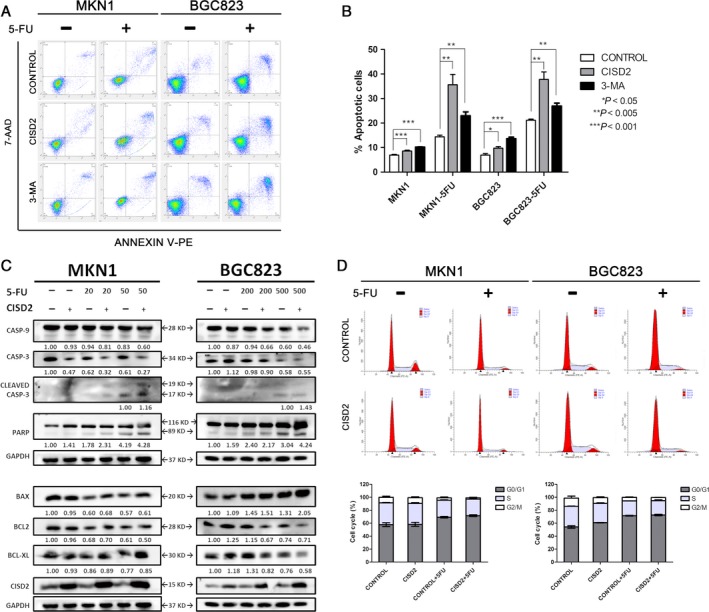
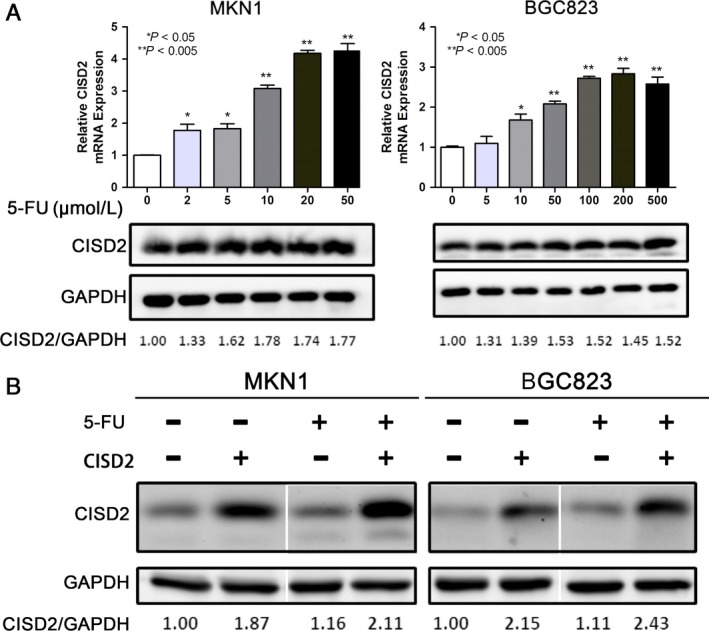
Gastric cancer (GC) is a prevalent upper gastrointestinal tumor characterized by high morbidity and mortality due to imperfect screening systems and the rapid development of resistance to 5-fluorouracil (5-FU). CDGSH iron sulfur domain 2 (CISD2) has been recently regarded as a candidate oncogene in several types of tumors. It is, therefore, necessary to investigate its biological function and clinical significance in gastric cancer. In this study, the down-regulated expression level of CISD2 in GC compared with adjacent normal tissues was evaluated by quantitative RT-PCR and Western blotting. An immunohistochemical analysis indicated that CISD2 expression in GC was significantly correlated with age (P = 0.002), Lauren's classification (P = 0.001), and differentiation (P = 0.049). Two cell lines, MKN1 and BGC823, were used to analyze the role of CISD2 in gastric carcinogenesis and response to 5-FU through CCK-8 assays, the RT-CES system, Transwell assays, flow cytometry, and confocal fluorescence microscopy. The overexpression of CISD2 resulted in reduced cellular growth and proliferation, inhibition of metastatic ability, and increased apoptosis. 5-FU treatment increased endogenous as well as exogenous overexpression of CISD2 in GC cells. Further investigation revealed that CISD2 enhanced sensitivity to 5-FU via an increase in apoptosis and inhibition of protective autophagy through the activation of the AKT/mTOR pathway. In conclusion, CISD2 is down-regulated in gastric cancer, and its effects on the inhibition of cellular proliferation, metastatic ability, and increased chemotherapy sensitivity are mediated by antagonism to 5-FU-induced autophagy through the AKT/mTOR pathway.
胃癌(GC)是一种常见的上消化道肿瘤,由于不完善的筛查系统和对 5-氟尿嘧啶(5-FU)的快速耐药性发展,其发病率和死亡率较高。CDGSH 铁硫域 2(CISD2)最近被认为是几种类型肿瘤的候选癌基因。因此,有必要研究其在胃癌中的生物学功能和临床意义。在这项研究中,通过定量 RT-PCR 和 Western blot 评估了 GC 中 CISD2 的下调表达水平。免疫组织化学分析表明,CISD2 在 GC 中的表达与年龄(P=0.002)、Lauren 分类(P=0.001)和分化(P=0.049)显著相关。使用两种细胞系 MKN1 和 BGC823 通过 CCK-8 测定、RT-CES 系统、Transwell 测定、流式细胞术和共聚焦荧光显微镜分析 CISD2 在胃癌发生和对 5-FU 反应中的作用。CISD2 的过表达导致细胞生长和增殖减少、转移能力抑制和凋亡增加。5-FU 处理增加了 GC 细胞中内源性和外源性 CISD2 的过表达。进一步的研究表明,CISD2 通过激活 AKT/mTOR 通路增加凋亡和抑制保护性自噬来增强对 5-FU 的敏感性。总之,CISD2 在胃癌中下调,其对细胞增殖抑制、转移能力抑制和化疗敏感性增加的影响是通过拮抗 5-FU 诱导的自噬来介导的,通过 AKT/mTOR 通路。