Zou Yuming, Zhang Ziteng, Liu Yangang, Liu Denghui, Xu Weidong
Department of Orthopedics, Changhai Hospital, The First Affiliated Hospital of the Second Military Medical University Department of Health Toxicology, College of Tropical Medicine and Public Health, Second Military Medical University, Shanghai, China.
Medicine (Baltimore). 2017 Sep;96(35):e7805. doi: 10.1097/MD.0000000000007805.
Several studies investigated the relationship between programmed cell death 1 (PDCD1) gene polymorphisms and rheumatoid arthritis (RA) risk, but the results were controversial. To explore whether PDCD1 gene polymorphisms have an effect on RA risk, we conducted this meta-analysis to investigate the relationships between PDCD1 polymorphisms (rs36084323 [PD-1.1 G/A], rs11568821 [PD-1.3 G/A] and rs2227981 [PD-1.5 C/T]) and RA risk under 4 genetic models.
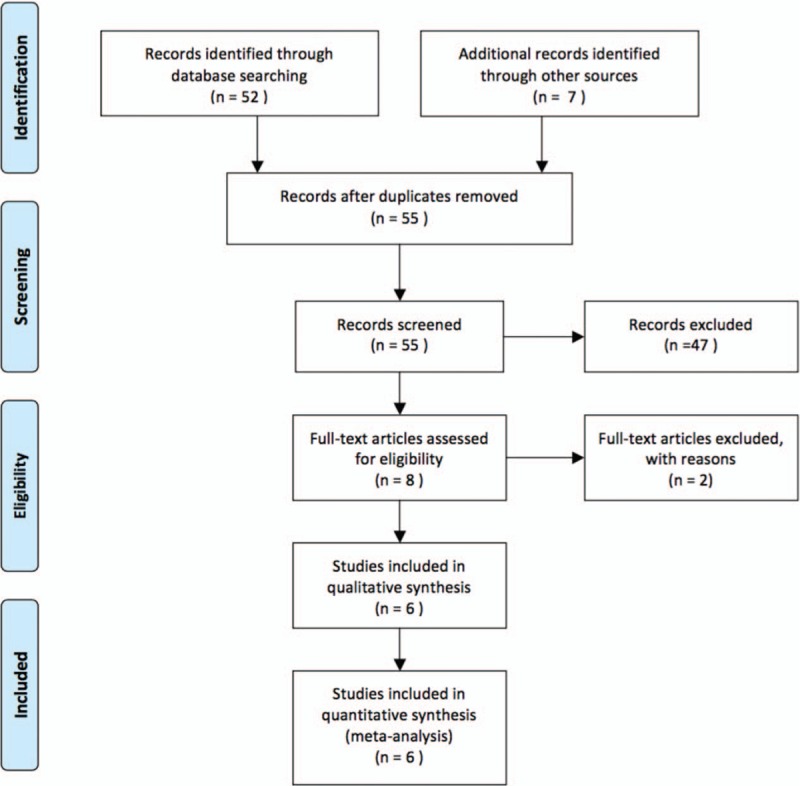
PubMed, EMBASE, Web of Science, Cochrane Library China National Knowledge Infrastructure (CNKI), and Chinese Biomedical Literature Database (CBLM) were systematically searched for all eligible case-control studies. The last search was updated on September 10, 2016. Studies were accessed using Newcastle-Ottawa Scale case control study (NOS), and the combined effect size was calculated using STATA software, version 12.0. The pooled odds ratio (OR) with 95% confidence interval (CI) was calculated to assess the association. Heterogeneity analysis and subgroup analysis were also performed. Sensitivity analysis and publication bias were also performed if necessary.
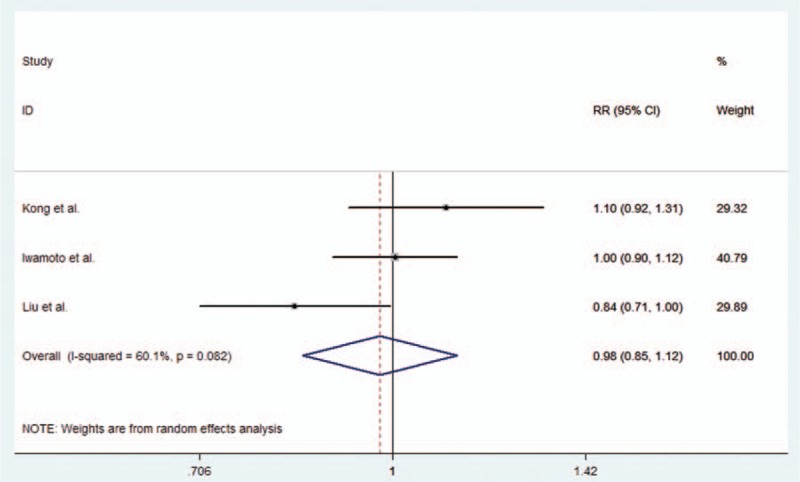
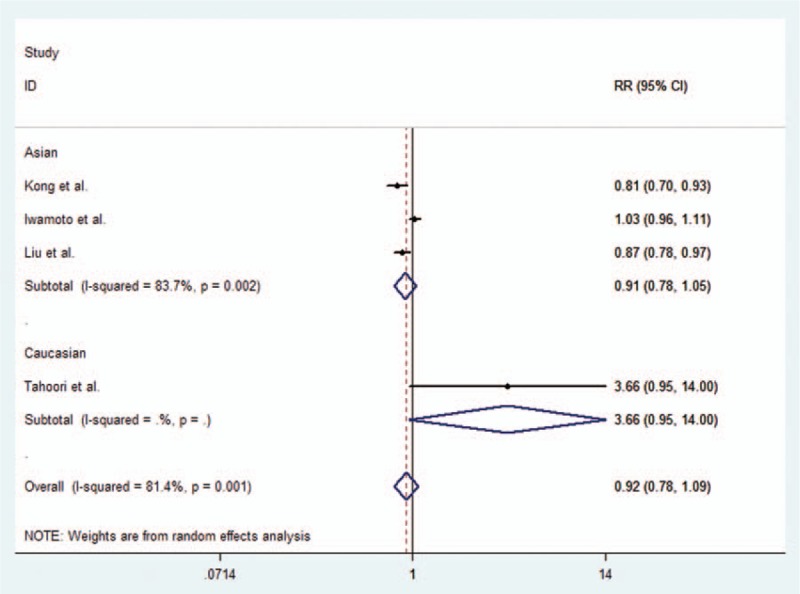
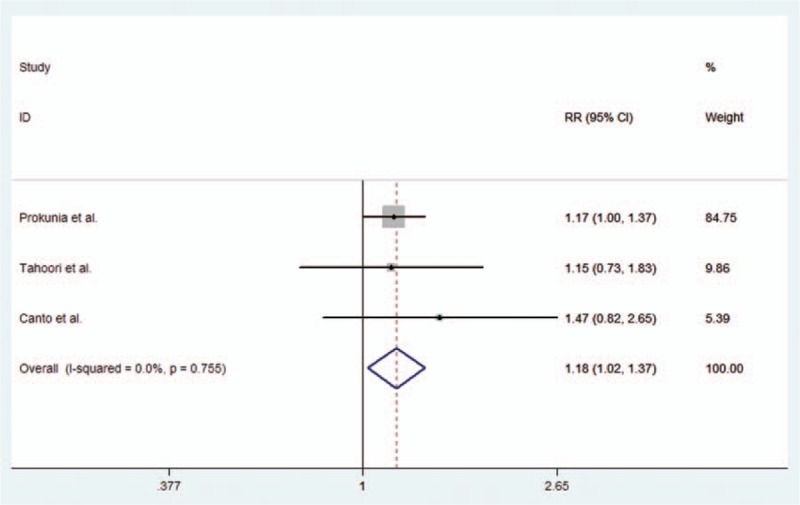
This meta-analysis included 6 studies. The result demonstrated null association between rs36084323 (PD-1.1 G/A) polymorphism and RA susceptibility in all 4 genetic models. With regard to rs11568821 (PD-1.3 G/A), statistically significant association with RA risk was observed under allele model in Caucasians (allele model A vs G, OR = 1.19, 95% CI = 1.03-1.41). There was no significant association between rs2227981 (PD-1.5 C/T) polymorphism and RA risk.
The present study suggests that mutant A allele in rs11568821 (PD-1.3 G/A) might increase the susceptibility to RA in Caucasians.
多项研究探讨了程序性细胞死亡1(PDCD1)基因多态性与类风湿关节炎(RA)风险之间的关系,但结果存在争议。为了探究PDCD1基因多态性是否对RA风险有影响,我们进行了这项荟萃分析,以研究PDCD1基因多态性(rs36084323 [PD - 1.1 G/A]、rs11568821 [PD - 1.3 G/A]和rs2227981 [PD - 1.5 C/T])与4种遗传模型下RA风险之间的关系。
系统检索PubMed、EMBASE、Web of Science、Cochrane图书馆、中国知网(CNKI)和中国生物医学文献数据库(CBLM)中所有符合条件的病例对照研究。最后一次检索更新于2016年9月10日。使用纽卡斯尔 - 渥太华量表病例对照研究(NOS)对研究进行评估,并使用STATA软件12.0版计算合并效应量。计算合并比值比(OR)及其95%置信区间(CI)以评估关联性。还进行了异质性分析和亚组分析。必要时也进行了敏感性分析和发表偏倚分析。
这项荟萃分析纳入了6项研究。结果表明,在所有4种遗传模型中,rs36084323(PD - 1.1 G/A)多态性与RA易感性之间无关联。对于rs11568821(PD - 1.3 G/A),在白种人的等位基因模型下观察到与RA风险存在统计学显著关联(等位基因模型A与G相比,OR = 1.19,95% CI = 1.03 - 1.41)。rs2227981(PD - 1.5 C/T)多态性与RA风险之间无显著关联。
本研究表明,rs11568821(PD - 1.3 G/A)中的突变A等位基因可能增加白种人患RA的易感性。