Wang Muding, Wu Dan, Qiu Wusi, Wang Weimi, Zeng Yunji, Shen Yi
Department of Emergency Medicine, Affiliated Hospital of Hangzhou Normal University Department of Surgery, The Second Affiliated Hospital of Zhejiang University School of Medicine Department of Neurosurgery, Affiliated Hospital of Hangzhou Normal University Department of Orthopedic, Affiliated Hospital of Hangzhou Normal University Department of Epidemiology and Health Statistics, School of Public Health, Zhejiang University, Hangzhou, Zhejiang, China.
Medicine (Baltimore). 2017 Sep;96(35):e7945. doi: 10.1097/MD.0000000000007945.
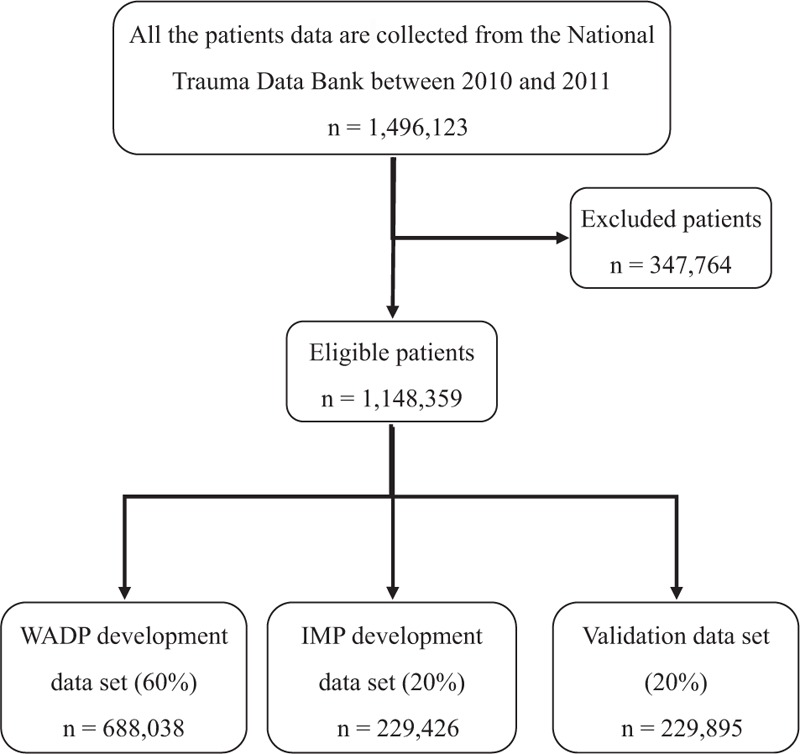
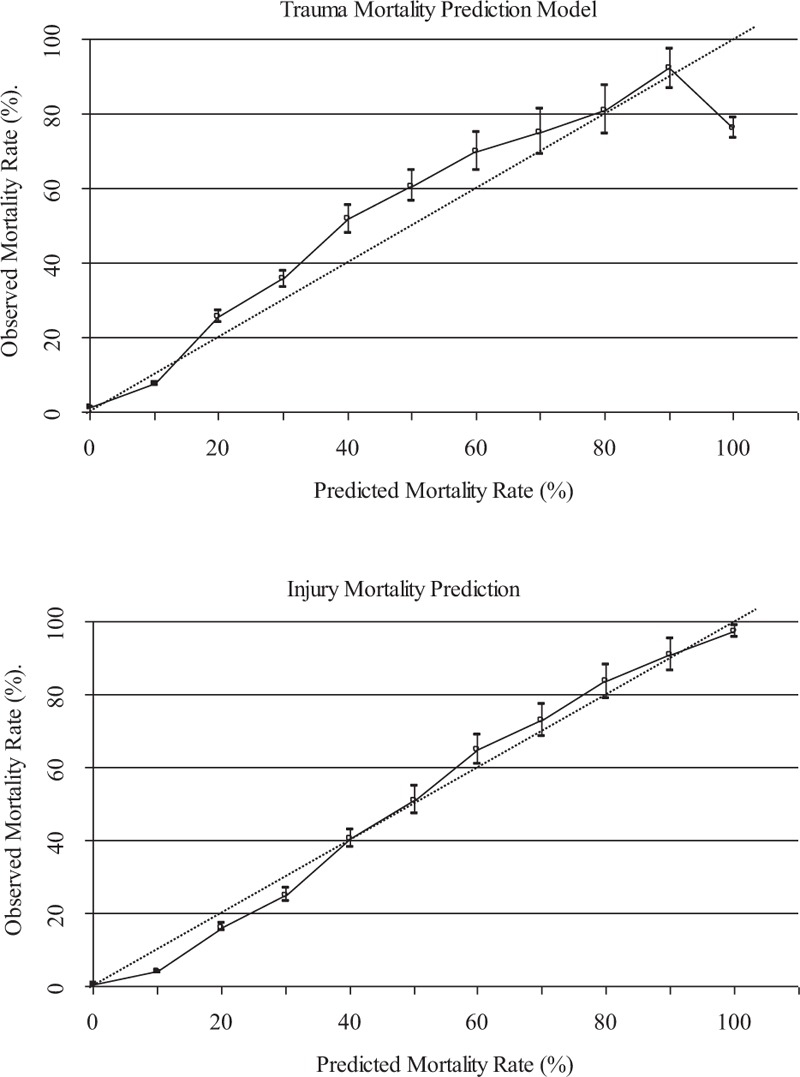
To determine whether the injury mortality prediction (IMP) statistically outperforms the trauma mortality prediction model (TMPM) as a predictor of mortality.The TMPM is currently the best trauma score method, which is based on the anatomic injury. Its ability of mortality prediction is superior to the injury severity score (ISS) and to the new injury severity score (NISS). However, despite its statistical significance, the predictive power of TMPM needs to be further improved.Retrospective cohort study is based on the data of 1,148,359 injured patients in the National Trauma Data Bank hospitalized from 2010 to 2011. Sixty percent of the data was used to derive an empiric measure of severity of different Abbreviated Injury Scale predot codes by taking the weighted average death probabilities of trauma patients. Twenty percent of the data was used to create computing method of the IMP model. The remaining 20% of the data was used to evaluate the statistical performance of IMP and then be compared with the TMPM and the single worst injury by examining area under the receiver operating characteristic curve (ROC), the Hosmer-Lemeshow (HL) statistic, and the Akaike information criterion.IMP exhibits significantly both better discrimination (ROC-IMP, 0.903 [0.899-0.907] and ROC-TMPM, 0.890 [0.886-0.895]) and calibration (HL-IMP, 9.9 [4.4-14.7] and HL-TMPM, 197 [143-248]) compared with TMPM. All models show slight changes after the extension of age, gender, and mechanism of injury, but the extended IMP still dominated TMPM in every performance.The IMP has slight improvement in discrimination and calibration compared with the TMPM and can accurately predict mortality. Therefore, we consider it as a new feasible scoring method in trauma research.
为确定损伤死亡率预测(IMP)作为死亡率预测指标在统计学上是否优于创伤死亡率预测模型(TMPM)。TMPM是目前基于解剖损伤的最佳创伤评分方法,其死亡率预测能力优于损伤严重度评分(ISS)和新损伤严重度评分(NISS)。然而,尽管具有统计学意义,TMPM的预测能力仍需进一步提高。回顾性队列研究基于2010年至2011年在国家创伤数据库住院的1148359例受伤患者的数据。60%的数据用于通过计算创伤患者的加权平均死亡概率得出不同简明损伤定级代码严重程度的经验性测量值。20%的数据用于创建IMP模型的计算方法。其余20%的数据用于评估IMP的统计性能,然后通过检查受试者工作特征曲线(ROC)下面积、Hosmer-Lemeshow(HL)统计量和赤池信息准则,与TMPM和单一最严重损伤进行比较。与TMPM相比,IMP在区分度(ROC-IMP,0.903[0.899-0.907]和ROC-TMPM,0.890[0.886-0.895])和校准度(HL-IMP,9.9[4.4-14.7]和HL-TMPM,197[143-248])方面均表现出显著优势。在年龄、性别和损伤机制扩展后,所有模型均有轻微变化,但扩展后的IMP在各项性能上仍优于TMPM。与TMPM相比,IMP在区分度和校准度上有轻微改善,且能准确预测死亡率。因此,我们认为它是创伤研究中一种新的可行评分方法。