Proskuryakova Anastasia A, Kulemzina Anastasia I, Perelman Polina L, Makunin Alexey I, Larkin Denis M, Farré Marta, Kukekova Anna V, Lynn Johnson Jennifer, Lemskaya Natalya A, Beklemisheva Violetta R, Roelke-Parker Melody E, Bellizzi June, Ryder Oliver A, O'Brien Stephen J, Graphodatsky Alexander S
Institute of Molecular and Cellular Biology, SB RAS, Lavrentiev Ave. 8/2, Novosibirsk 630090, Russia.
Synthetic Biology Unit, Novosibirsk State University, Pirogova Str. 1, Novosibirsk 630090, Russia.
Genes (Basel). 2017 Aug 31;8(9):216. doi: 10.3390/genes8090216.
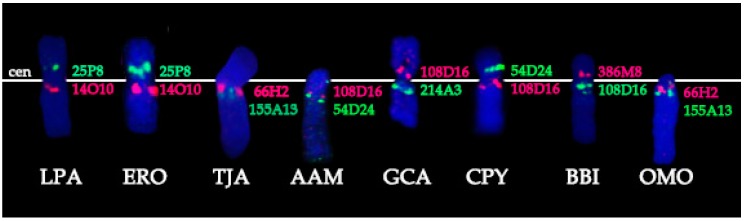
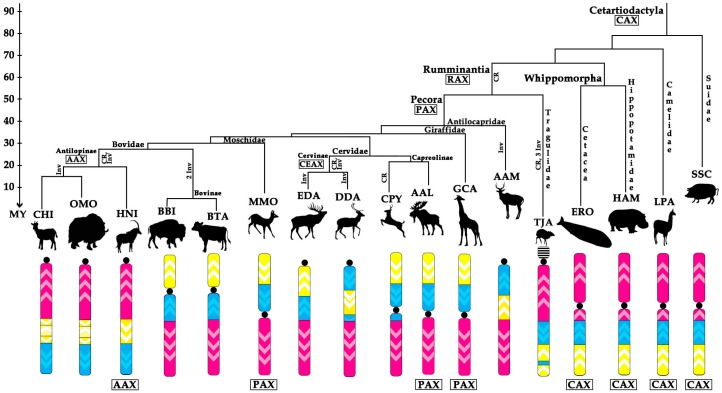
The phenomenon of a remarkable conservation of the X chromosome in eutherian mammals has been first described by Susumu Ohno in 1964. A notable exception is the cetartiodactyl X chromosome, which varies widely in morphology and G-banding pattern between species. It is hypothesized that this sex chromosome has undergone multiple rearrangements that changed the centromere position and the order of syntenic segments over the last 80 million years of Cetartiodactyla speciation. To investigate its evolution we have selected 26 evolutionarily conserved bacterial artificial chromosome (BAC) clones from the cattle CHORI-240 library evenly distributed along the cattle X chromosome. High-resolution BAC maps of the X chromosome on a representative range of cetartiodactyl species from different branches: pig (Suidae), alpaca (Camelidae), gray whale (Cetacea), hippopotamus (Hippopotamidae), Java mouse-deer (Tragulidae), pronghorn (Antilocapridae), Siberian musk deer (Moschidae), and giraffe (Giraffidae) were obtained by fluorescent in situ hybridization. To trace the X chromosome evolution during fast radiation in specious families, we performed mapping in several cervids (moose, Siberian roe deer, fallow deer, and Pere David's deer) and bovid (muskox, goat, sheep, sable antelope, and cattle) species. We have identified three major conserved synteny blocks and rearrangements in different cetartiodactyl lineages and found that the recently described phenomenon of the evolutionary new centromere emergence has taken place in the X chromosome evolution of Cetartiodactyla at least five times. We propose the structure of the putative ancestral cetartiodactyl X chromosome by reconstructing the order of syntenic segments and centromere position for key groups.
1964年,大野干首次描述了真兽亚纲哺乳动物X染色体显著保守的现象。一个显著的例外是偶蹄目动物的X染色体,其在物种间的形态和G带模式差异很大。据推测,在偶蹄目物种形成的过去8000万年里,这条性染色体经历了多次重排,改变了着丝粒位置和同线区段的顺序。为了研究其进化过程,我们从牛CHORI - 240文库中选择了26个沿牛X染色体均匀分布的进化保守细菌人工染色体(BAC)克隆。通过荧光原位杂交获得了来自不同分支的代表性偶蹄目物种(猪(猪科)、羊驼(骆驼科)、灰鲸(鲸目)、河马(河马科)、爪哇鼷鹿(鼷鹿科)、叉角羚(叉角羚科)、西伯利亚麝(麝科)和长颈鹿(长颈鹿科))的X染色体高分辨率BAC图谱。为了追踪在不同科快速辐射过程中的X染色体进化,我们在几种鹿科动物(驼鹿、西伯利亚狍、黇鹿和麋鹿)和牛科动物(麝牛、山羊、绵羊、貂羚和牛)物种中进行了图谱绘制。我们在不同的偶蹄目谱系中鉴定出了三个主要的保守同线区段和重排,并发现最近描述的进化新着丝粒出现的现象在偶蹄目的X染色体进化中至少发生了五次。我们通过重建关键类群的同线区段顺序和着丝粒位置,提出了假定的祖先偶蹄目X染色体的结构。