Nance Nerissa, Pendo Prosper, Masanja Joseph, Ngilangwa David Paul, Webb Karen, Noronha Rita, McCoy Sandra I
School of Public Health, University of California, Berkeley, California, United States of America.
Ministry of Health, Community Development, Gender, Elderly, and Children (MOHCDGEC), Dar es Salaam, Tanzania.
PLoS One. 2017 Aug 31;12(8):e0181919. doi: 10.1371/journal.pone.0181919. eCollection 2017.
Community health workers (CHWs) are lay workers who have the potential to enhance services to prevent mother-to-child HIV transmission (PMTCT) and improve the health of women living with HIV infection. We conducted a cluster-randomized trial of an intervention to integrate CHWs with 'Option B+' PMTCT services in Shinyanga Region, Tanzania.
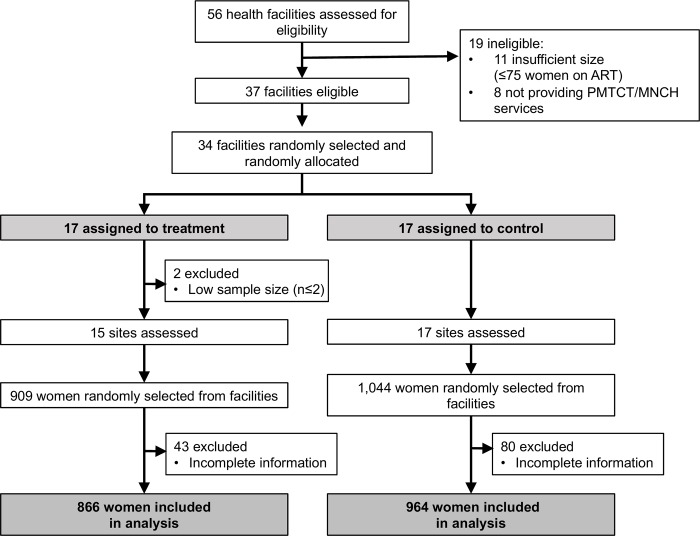
The intervention was implemented for 11 months and included four integrated components: 1) formal linkage of CHWs to health facilities; 2) CHW-led antiretroviral therapy (ART) adherence counseling; 3) loss to follow-up tracing by CHWs; and 4) distribution of Action Birth Cards (ABCs), a birth planning tool. We cluster-randomized 32 facilities offering PMTCT services, within strata of size, to the intervention (n = 15) or comparison (standard of care, n = 17) groups. Intervention effectiveness was determined with a difference-in-differences strategy based on clinical and pharmacy data from HIV-infected postpartum women at baseline (births in 2014) and endline (births April-Oct 2015). The primary outcome was retention in care between 60 and 120 days postpartum. Secondary outcomes included ART initiation, timing of ART initiation (as measured by week of gestation), and ART adherence 90 days postpartum, measured using the medication possession ratio (MPR≥95%).
Intervention and comparison facilities were similar at baseline. Data were collected from 1,152 and 678 mother-infant pairs at baseline and endline, respectively. There were no significant differences in retention in care, ART initiation, or timing of ART initiation between the intervention and control groups. Adherence (MPR≥95%) at 90 days postpartum was 11.3 percentage points higher in the intervention group in ITT analyses (95% CI: -0.7, 23.3, p = 0.06), though this effect was attenuated after adjusting for baseline imbalance (9.5 percentage points, 95% CI: -2.9, 22.0, p = 0.13). Among only sites that had the greatest fidelity to the intervention, however, we found a stronger effect on adherence (13.6 percentage points, 95% CI: 2.5, 24.6).
Despite being feasible and acceptable, the CHW-based intervention did not have strong effects on most PMTCT indicators. CHW involvement in PMTCT programs may improve ART adherence among HIV-infected postpartum women, however, and success appears heavily dependent on program implementation.
Registry for International Development Impact Evaluations (RIDIE, ID 552553838b402) and ClinicalTrials.gov (NCT03058484).
社区卫生工作者(CHW)是基层工作者,他们有潜力加强预防母婴传播艾滋病毒(PMTCT)的服务,并改善感染艾滋病毒妇女的健康状况。我们在坦桑尼亚的希尼安加地区开展了一项整群随机试验,以将社区卫生工作者与“B+方案”的预防母婴传播服务相结合。
干预措施实施了11个月,包括四个综合组成部分:1)社区卫生工作者与卫生设施的正式联系;2)由社区卫生工作者主导的抗逆转录病毒疗法(ART)依从性咨询;3)社区卫生工作者对失访情况的追踪;4)发放行动出生卡(ABC),这是一种生育计划工具。我们将32个提供预防母婴传播服务的设施按规模分层,随机分为干预组(n = 15)或对照组(标准护理组,n = 17)。基于2014年基线(分娩)和2015年4月至10月终末(分娩)时感染艾滋病毒的产后妇女的临床和药房数据,采用差异中的差异策略确定干预效果。主要结局是产后60至120天的护理保留率。次要结局包括抗逆转录病毒疗法的启动、启动时间(以孕周衡量)以及产后90天的抗逆转录病毒疗法依从性,采用药物持有率(MPR≥95%)进行测量。
干预设施和对照设施在基线时相似。分别在基线和终末从1152对母婴和678对母婴收集了数据。干预组和对照组在护理保留率、抗逆转录病毒疗法启动或启动时间方面没有显著差异。意向性分析中,干预组产后90天的依从性(MPR≥95%)高出11.3个百分点(95%CI:-0.7,23.3,p = 0.06),不过在调整基线不平衡后,这一效果有所减弱(9.5个百分点,95%CI:-2.9,22.0,p = 0.13)。然而,仅在对干预措施忠诚度最高的站点中,我们发现对依从性有更强的效果(13.6个百分点,95%CI:2.5,24.6)。
尽管基于社区卫生工作者的干预措施可行且可接受,但对大多数预防母婴传播指标没有显著效果。不过,社区卫生工作者参与预防母婴传播项目可能会提高感染艾滋病毒的产后妇女的抗逆转录病毒疗法依从性,而成功似乎在很大程度上取决于项目实施情况。
国际发展影响评估注册库(RIDIE,ID 552553838b402)和ClinicalTrials.gov(NCT03058484)。