Department of Medicine, University of Missouri-Kansas City, Kansas City, Missouri, United States of America.
Center for Microbiology Research, Kenya Medical Research Institute, Nairobi, Kenya.
PLoS Med. 2019 Oct 2;16(10):e1002924. doi: 10.1371/journal.pmed.1002924. eCollection 2019 Oct.
Timely diagnosis of infant HIV infection is essential for antiretroviral therapy (ART) initiation. In a randomized controlled trial, we found the Texting Improves Testing (TextIT) intervention (a theory-based text messaging system) to be efficacious for improving infant HIV testing rates and maternal retention in prevention of mother-to-child HIV transmission (PMTCT) programs. Using an implementation science approach, we aimed to evaluate real-world effectiveness of the intervention.
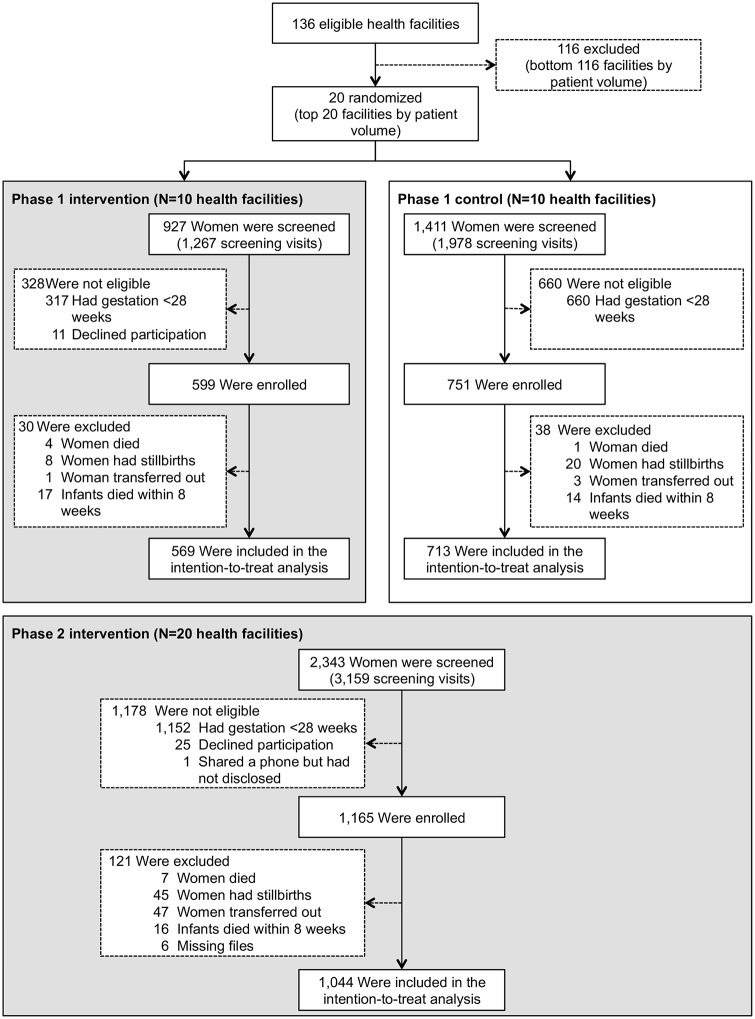
In a pragmatic, cluster-randomized, stepped-wedge trial with 2 time periods of observation, we randomly allocated 10 clinics to begin implementing the intervention immediately and 10 clinics to begin implementing 6 months later. To approximate real-world conditions, inclusion criteria were broad. Women at clinics implementing the intervention received up to 14 text messages during pregnancy and after delivery and had the option to respond to text messages, call, or send inquiry text messages to a designated clinic phone. The primary outcomes were infant HIV testing and maternal retention in care during the first 8 weeks after delivery. We used modified Poisson regression with robust variance estimation to estimate the relative risk and 95% confidence intervals (CIs). Generalized estimating equations were applied on individual-level data to account for clustering by site. Between February 2015 and December 2016, 4,681 women were assessed for study participation, and 2,515 were included. Participant characteristics at enrollment did not differ by study arm. Overall median age was 27 years (interquartile range [IQR] 23-30), median gestational age was 30 weeks (IQR 28-34), 99% were receiving ART, and 87% who enrolled during intervention phases owned a phone. Of 2,326 infants analyzed, 1,466 of 1,613 (90.9%) in the intervention group and 609 of 713 (85.4%) in the control group met the primary outcome of HIV virologic testing performed before 8 weeks after birth (adjusted relative risk [aRR] 1.03; 95% CI 0.97-1.10; P = 0.3). Of 2,472 women analyzed, 1,548 of 1,725 (90%) in the intervention group and 571 of 747 (76%) in the control group met the primary outcome of retention in care during the first 8 weeks after delivery (aRR 1.12; 95% CI 0.97-1.30; P = 0.1). This study had two main limitations. Staff at all facilities were aware of ongoing observation, which may have contributed to increased rates of infant HIV testing and maternal retention in care at both intervention and control facilities, and programmatic initiatives to improve maternal and infant retention in care were ongoing at all facilities at the time of this study, which likely limited the ability to demonstrate effectiveness of the trial intervention.
In this study, a larger proportion of infants in the intervention group received HIV testing compared with the control group, but the difference was small and not statistically significant. There was also a nonsignificant increase in maternal postpartum retention in the intervention periods. Despite the lack of a significant effect of the intervention, key lessons emerged, both for strengthening PMTCT and for implementation research in general. Perhaps most important, improving the implementation of usual care may have been sufficient to substantially improve infant HIV testing rates.
ClinicalTrials.gov Trial Number NCT02350140.
及时诊断婴儿艾滋病毒感染对于启动抗逆转录病毒治疗(ART)至关重要。在一项随机对照试验中,我们发现 Texting Improves Testing(TextIT)干预措施(一种基于理论的短信系统)在提高婴儿 HIV 检测率和预防母婴传播(PMTCT)项目中母亲保留率方面是有效的。我们采用实施科学方法,旨在评估该干预措施的实际效果。
在一项具有 2 个观察期的实用、聚类随机、逐步楔形试验中,我们随机分配了 10 个诊所立即实施干预,10 个诊所 6 个月后开始实施。为了接近实际情况,纳入标准很宽泛。在实施干预的诊所中,妇女在怀孕期间和分娩后最多可以收到 14 条短信,并可以选择回复短信、打电话或向指定诊所电话发送查询短信。主要结局是婴儿在分娩后 8 周内接受 HIV 检测和母亲接受护理。我们使用具有稳健方差估计的修正泊松回归来估计相对风险和 95%置信区间(CI)。应用广义估计方程来解释个体水平数据中的站点聚类。2015 年 2 月至 2016 年 12 月,有 4681 名妇女接受了研究参与评估,其中 2515 名妇女被纳入。研究臂之间的参与者特征在入组时没有差异。总体中位年龄为 27 岁(四分位距 [IQR] 23-30),中位孕龄为 30 周(IQR 28-34),99%接受 ART 治疗,87%在干预阶段入组的妇女拥有手机。在分析的 2326 名婴儿中,干预组的 1613 名婴儿中有 1466 名(90.9%)和对照组的 713 名婴儿中有 609 名(85.4%)在出生后 8 周内进行了 HIV 病毒学检测(调整后的相对风险 [aRR] 1.03;95%CI 0.97-1.10;P=0.3)。在分析的 2472 名妇女中,干预组的 1725 名妇女中有 1548 名(90%)和对照组的 747 名妇女中有 571 名(76%)在分娩后 8 周内保持护理(aRR 1.12;95%CI 0.97-1.30;P=0.1)。本研究有两个主要局限性。所有设施的工作人员都意识到正在进行观察,这可能导致干预和对照组设施的婴儿 HIV 检测率和产妇护理保留率均有所提高,并且在本研究进行时,所有设施都在开展改善产妇和婴儿护理保留的计划举措,这可能限制了试验干预措施有效性的证明。
在这项研究中,干预组中接受 HIV 检测的婴儿比例高于对照组,但差异较小且无统计学意义。在干预期间,产妇产后保留率也略有增加,但无统计学意义。尽管干预措施没有显著效果,但还是出现了一些重要的经验教训,不仅对加强 PMTCT 有帮助,对实施研究也有帮助。也许最重要的是,改善常规护理的实施情况可能足以大幅提高婴儿 HIV 检测率。
ClinicalTrials.gov 注册号 NCT02350140。