Andersen Morten, Sajid Zamra, Pedersen Rasmus K, Gudmand-Hoeyer Johanne, Ellervik Christina, Skov Vibe, Kjær Lasse, Pallisgaard Niels, Kruse Torben A, Thomassen Mads, Troelsen Jesper, Hasselbalch Hans Carl, Ottesen Johnny T
Department of Science and Environment, Roskilde University, Roskilde, Denmark.
Department of Laboratory Medicine at Boston Children's Hospital, Boston, Massachusetts, United States of America.
PLoS One. 2017 Aug 31;12(8):e0183620. doi: 10.1371/journal.pone.0183620. eCollection 2017.
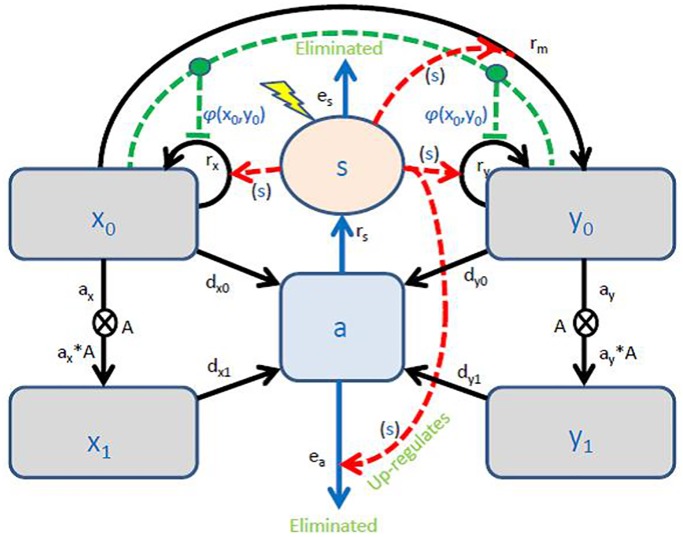
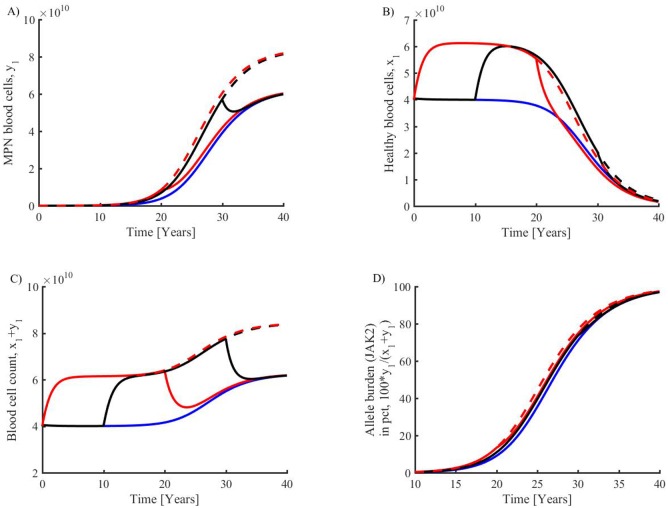
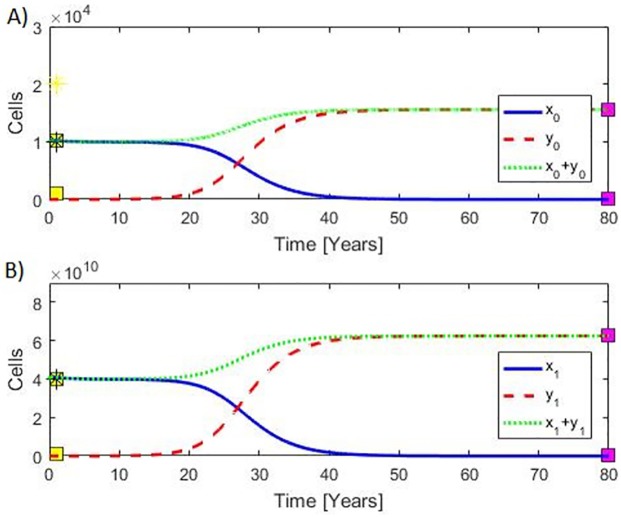
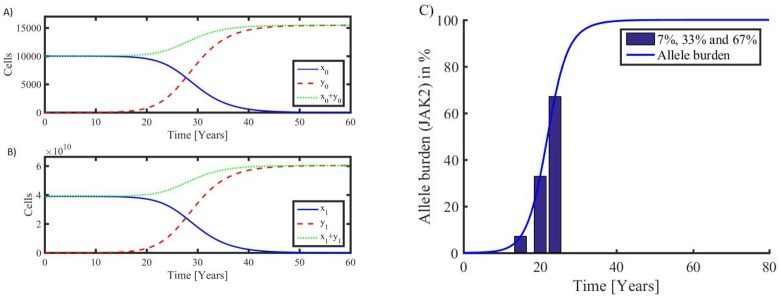
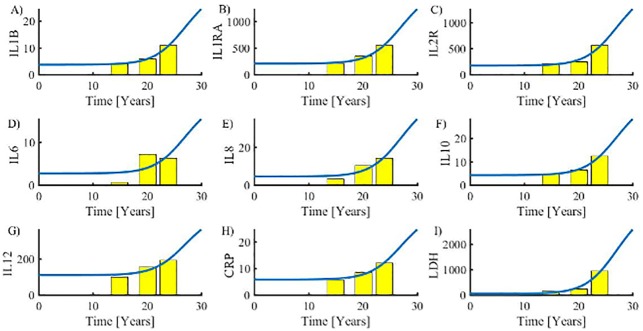
The chronic Philadelphia-negative myeloproliferative neoplasms (MPNs) are acquired stem cell neoplasms which ultimately may transform to acute myelogenous leukemia. Most recently, chronic inflammation has been described as an important factor for the development and progression of MPNs in the biological continuum from early cancer stage to the advanced myelofibrosis stage, the MPNs being described as "A Human Inflammation Model for Cancer Development". This novel concept has been built upon clinical, experimental, genomic, immunological and not least epidemiological studies. Only a few studies have described the development of MPNs by mathematical models, and none have addressed the role of inflammation for clonal evolution and disease progression. Herein, we aim at using mathematical modelling to substantiate the concept of chronic inflammation as an important trigger and driver of MPNs.The basics of the model describe the proliferation from stem cells to mature cells including mutations of healthy stem cells to become malignant stem cells. We include a simple inflammatory coupling coping with cell death and affecting the basic model beneath. First, we describe the system without feedbacks or regulatory interactions. Next, we introduce inflammatory feedback into the system. Finally, we include other feedbacks and regulatory interactions forming the inflammatory-MPN model. Using mathematical modeling, we add further proof to the concept that chronic inflammation may be both a trigger of clonal evolution and an important driving force for MPN disease progression. Our findings support intervention at the earliest stage of cancer development to target the malignant clone and dampen concomitant inflammation.
慢性费城染色体阴性骨髓增殖性肿瘤(MPNs)是获得性干细胞肿瘤,最终可能转化为急性髓系白血病。最近,慢性炎症被描述为MPNs从早期癌症阶段到晚期骨髓纤维化阶段的生物学连续过程中发生和进展的一个重要因素,MPNs被称为“癌症发展的人类炎症模型”。这一新颖概念是建立在临床、实验、基因组、免疫学尤其是流行病学研究基础之上的。只有少数研究通过数学模型描述了MPNs的发生,且没有一项研究探讨炎症在克隆进化和疾病进展中的作用。在此,我们旨在利用数学建模来证实慢性炎症是MPNs重要触发因素和驱动因素这一概念。该模型的基本原理描述了从干细胞到成熟细胞的增殖过程,包括健康干细胞突变为恶性干细胞。我们纳入了一个简单的炎症耦合机制,以应对细胞死亡并影响其下的基本模型。首先,我们描述无反馈或调节相互作用的系统。接下来,我们将炎症反馈引入该系统。最后,我们纳入其他反馈和调节相互作用,形成炎症-MPN模型。通过数学建模,我们进一步证明了慢性炎症可能既是克隆进化的触发因素,也是MPN疾病进展的重要驱动力这一概念。我们的研究结果支持在癌症发展的最早阶段进行干预,以靶向恶性克隆并减轻伴随的炎症。