Department of Hematology, Albert Schweitzer Hospital, Dordrecht, the Netherlands.
Department of Hematology, VU University Medical Center, Amsterdam, the Netherlands.
Haematologica. 2017 Nov;102(11):1842-1849. doi: 10.3324/haematol.2017.174953. Epub 2017 Aug 31.
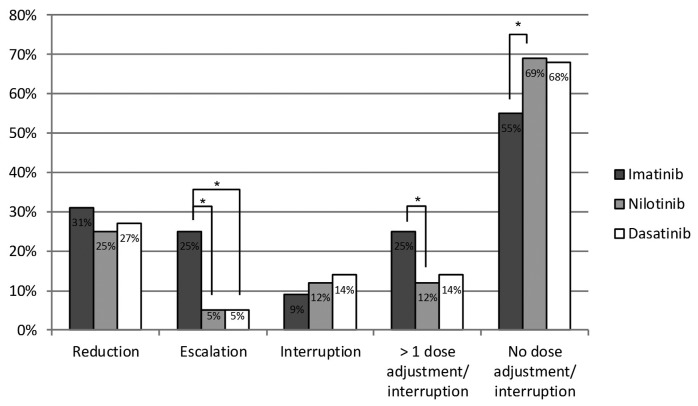
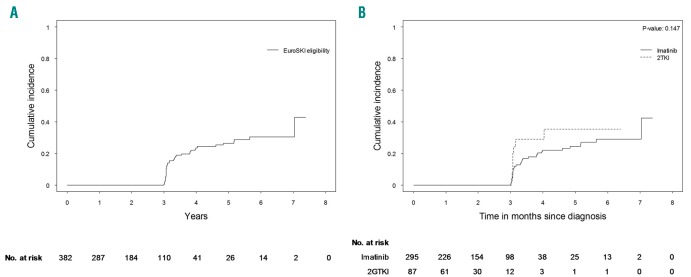
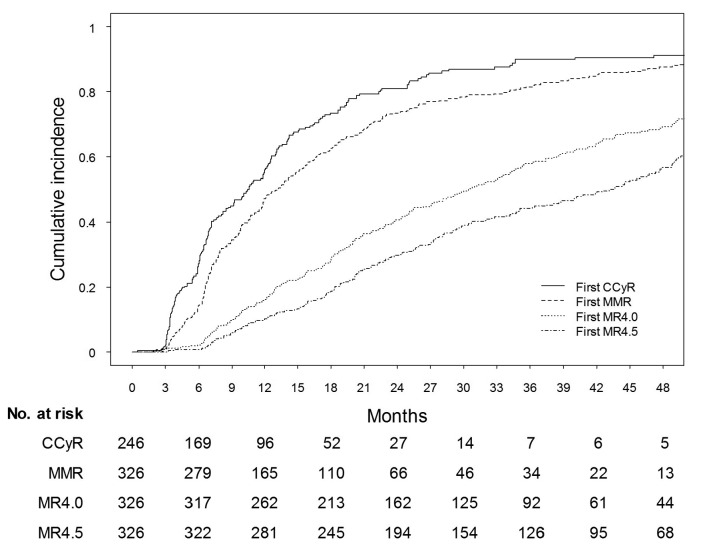
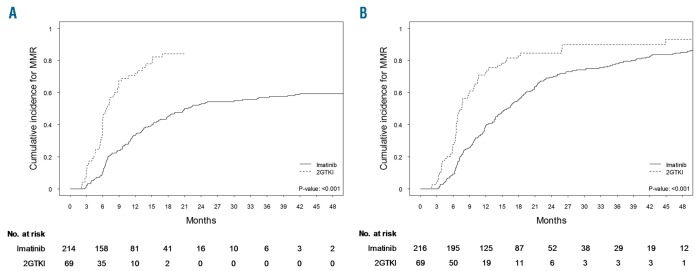
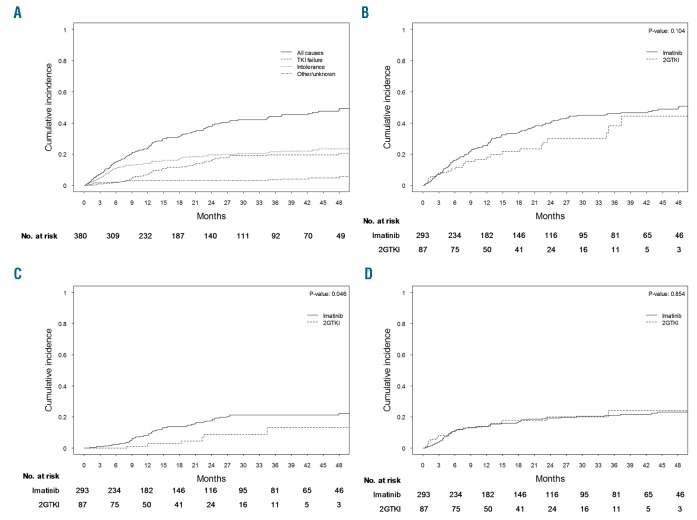
Evaluations of the 'real-world' efficacy and safety of tyrosine kinase inhibitors in patients with chronic myeloid leukemia are scarce. A nationwide, population-based, chronic myeloid leukemia registry was analyzed to evaluate (deep) response rates to first and subsequent treatment lines and eligibility for a treatment cessation attempt in adults diagnosed between January 2008 and April 2013 in the Netherlands. The registry covered 457 patients; 434 in chronic phase (95%) and 15 (3%) in advanced disease phase. Seventy-five percent of the patients in chronic phase were treated with imatinib and 25% with a second-generation tyrosine kinase inhibitor. At 3 years 44% of patients had discontinued their first-line treatment, mainly due to intolerance (21%) or treatment failure (19%). At 18 months 73% of patients had achieved a complete cytogenetic response and 63% a major molecular response. Deep molecular responses (MR and MR) were achieved in 69% and 56% of patients, respectively, at 48 months. All response milestones were achieved faster in patients treated upfront with a second-generation tyrosine kinase inhibitor, but ultimately patients initially treated with imatinib also reached similar levels of responses. The 6-year cumulative incidence of eligibility for a tyrosine kinase cessation attempt, according to EURO-SKI criteria, was 31%. Our findings show that in a 'real-world' setting the long-term outcome of patients treated with tyrosine kinase inhibitors is excellent and the conditions for an attempt to stop tyrosine kinase inhibitor therapy are met by a third of the patients.
评估酪氨酸激酶抑制剂在慢性髓性白血病患者中的“真实世界”疗效和安全性的研究很少。本研究通过对 2008 年 1 月至 2013 年 4 月期间在荷兰确诊的慢性髓性白血病成人患者进行全国性、基于人群的慢性髓性白血病登记研究,评估了一线和二线治疗的深度缓解率,以及尝试停止酪氨酸激酶抑制剂治疗的条件。该登记处共纳入 457 例患者,其中 434 例处于慢性期(95%),15 例处于晚期疾病期(3%)。75%的慢性期患者接受伊马替尼治疗,25%的患者接受第二代酪氨酸激酶抑制剂治疗。3 年时,44%的患者停止了一线治疗,主要是由于不耐受(21%)或治疗失败(19%)。18 个月时,73%的患者达到完全细胞遗传学缓解,63%的患者达到主要分子学缓解。48 个月时,分别有 69%和 56%的患者达到深度分子学缓解(MR 和 MR)。在接受第二代酪氨酸激酶抑制剂初始治疗的患者中,所有的缓解里程碑都更快地实现,但最终接受伊马替尼初始治疗的患者也达到了相似的缓解水平。根据 EURO-SKI 标准,6 年累积酪氨酸激酶抑制剂停药尝试的资格发生率为 31%。我们的研究结果表明,在“真实世界”环境中,接受酪氨酸激酶抑制剂治疗的患者的长期预后非常好,三分之一的患者具备尝试停止酪氨酸激酶抑制剂治疗的条件。