Woodman Richard J, Baghdadi Leena R, Shanahan Michael E, Mangoni Arduino A
Centre for Epidemiology and Biostatistics, School of Medicine, Flinders UniversityAdelaide, SA, Australia.
Department of Clinical Pharmacology, School of Medicine, Flinders University and Flinders Medical CentreAdelaide, SA, Australia.
Front Physiol. 2017 Aug 15;8:593. doi: 10.3389/fphys.2017.00593. eCollection 2017.
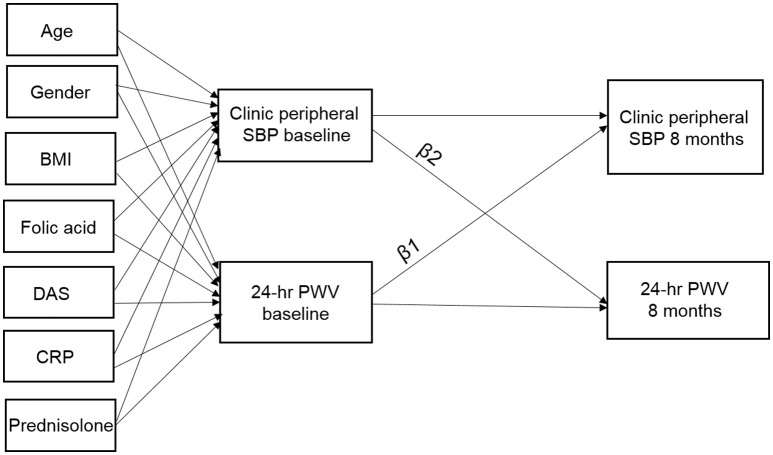
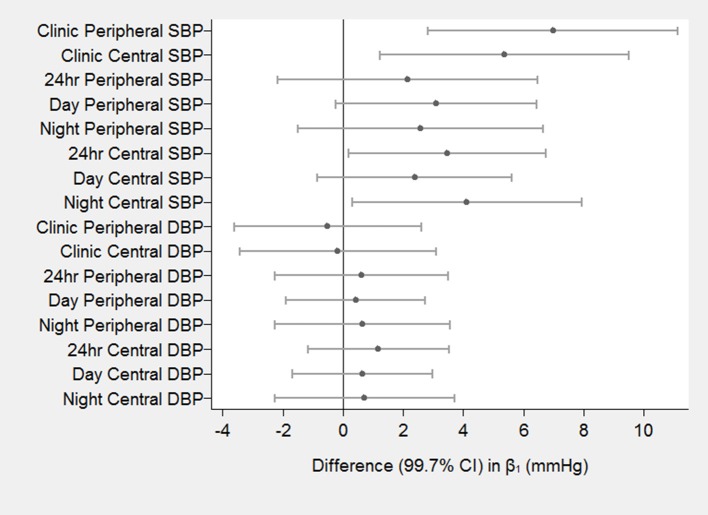
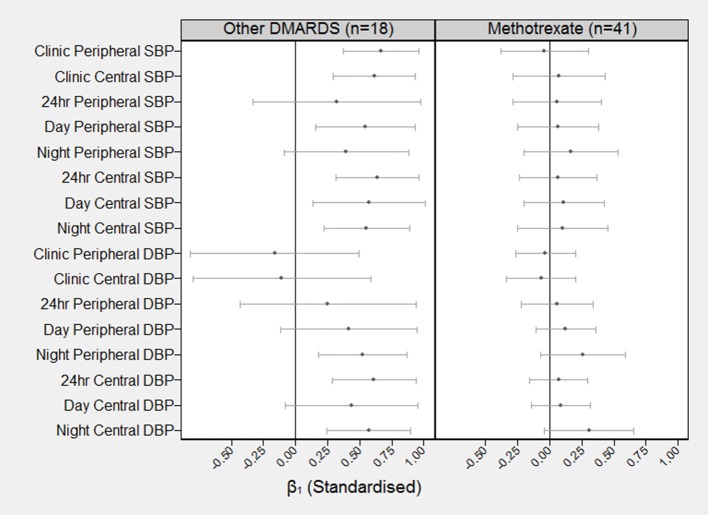
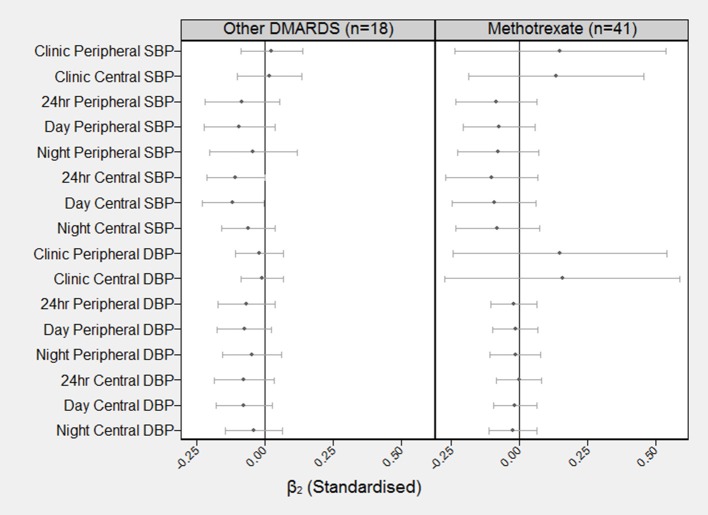
The temporal relationship between arterial stiffness and blood pressure (BP) may vary depending on age and other clinical and demographic factors. Since both BP and arterial stiffness are also affected by inflammatory processes, we examined the temporal arterial stiffness-BP relationship in patients with rheumatoid arthritis (RA) treated with either methotrexate (MTX), an anti-rheumatic agent shown to reduce cardiovascular risk in meta-analyses, or other disease-modifying anti-rheumatic drugs (DMARDs). Measurements of clinic and 24-h peripheral and central systolic and diastolic BP (SBP and DBP), and pulse wave velocity (PWV) were assessed in RA patients on stable treatment with either MTX ± other DMARDs (MTX group, = 41, age 61 ± 14 years, 73% females) or other DMARDs (non-MTX group, = 18, age 65 ± 13 years, 89% females). Measurements were performed at baseline and after 8 months. The temporal relationships were examined using cross-lagged path analysis with models that included age, sex, body mass index, prednisolone, and folic acid use and 28-joint disease activity score. There were significant differences in the temporal arterial stiffness-BP relationships between those in the MTX and DMARD groups. A higher PWV at baseline caused a significant increase in 6 out of 8 different measures of SBP at 8 months amongst those treated with DMARDs (standardized β, range = 0.54-0.66, < 0.003 for each) and 3 out of 8 different measures of DBP (standardized β, range = 0.52-0.61, < 0.003 for each) but was not associated with either SBP or DBP at 8 months amongst those treated with MTX. The difference in the effect of baseline PWV on 8-month BP between the 2 groups was also significant ( < 0.003) for 4 measures including clinic peripheral SBP (β = 7.0, 95% CI = 2.8-11.1 mmHg per 1 m/s higher baseline PWV; < 0.001). Higher arterial stiffness preceded increases in BP in subjects with RA treated with DMARDs, but these effects did not occur amongst those treated with MTX. The different effects were seen mostly in measures of SBP but were also present in some measures of DBP. Our findings suggest MTX may confer a protective effect against stiffness mediated increases in BP in patients with RA.
动脉僵硬度与血压(BP)之间的时间关系可能因年龄以及其他临床和人口统计学因素而有所不同。由于血压和动脉僵硬度均受炎症过程影响,我们研究了类风湿关节炎(RA)患者中动脉僵硬度与血压的时间关系,这些患者接受了甲氨蝶呤(MTX)或其他改善病情抗风湿药物(DMARDs)治疗,MTX是一种在荟萃分析中显示可降低心血管风险的抗风湿药物。对接受MTX±其他DMARDs稳定治疗的RA患者(MTX组,n = 41,年龄61±14岁,73%为女性)或其他DMARDs(非MTX组,n = 18,年龄65±13岁,89%为女性)进行诊室及24小时外周和中心收缩压及舒张压(SBP和DBP)测量以及脉搏波速度(PWV)评估。测量在基线和8个月后进行。使用交叉滞后路径分析检查时间关系,模型包括年龄、性别、体重指数、泼尼松龙、叶酸使用情况以及28关节疾病活动评分。MTX组和DMARD组之间动脉僵硬度与血压的时间关系存在显著差异。在接受DMARDs治疗的患者中,基线时较高的PWV导致8个月时8种不同SBP测量值中的6种显著升高(标准化β,范围 = 0.54 - 0.66,每种均P < 0.003)以及8种不同DBP测量值中的3种显著升高(标准化β,范围 = 0.52 - 0.61,每种均P < 0.003),但在接受MTX治疗的患者中,基线PWV与8个月时的SBP或DBP均无关联。两组之间基线PWV对8个月血压影响的差异在包括诊室外周SBP在内的4种测量中也具有显著性(P < 0.003)(β = 7.0,95%CI = 每升高1 m/s基线PWV 2.8 - 11.1 mmHg;P < 0.001)。在接受DMARDs治疗的RA患者中,较高的动脉僵硬度先于血压升高,但在接受MTX治疗的患者中未出现这些效应。不同效应主要见于SBP测量值,但在一些DBP测量值中也存在。我们的研究结果表明,MTX可能对RA患者中僵硬度介导的血压升高具有保护作用。