Heggenes Jan, Odland Arvid, Chevalier Tomas, Ahlberg Jörgen, Berg Amanda, Larsson Håkan, Bjerketvedt Dag K
Department of Environmental and Health Sciences University College of Southeast Norway Bø i Telemark Norway.
Scienvisic Linköping Sweden.
Ecol Evol. 2017 Jul 10;7(16):6423-6431. doi: 10.1002/ece3.3130. eCollection 2017 Aug.
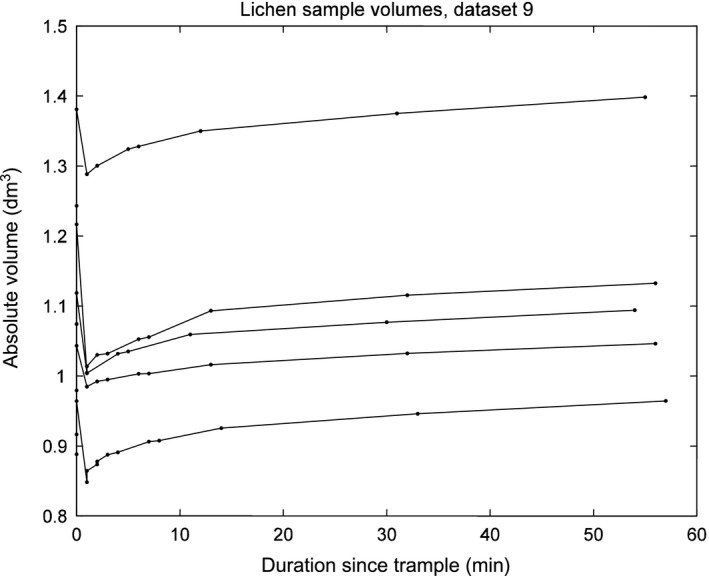
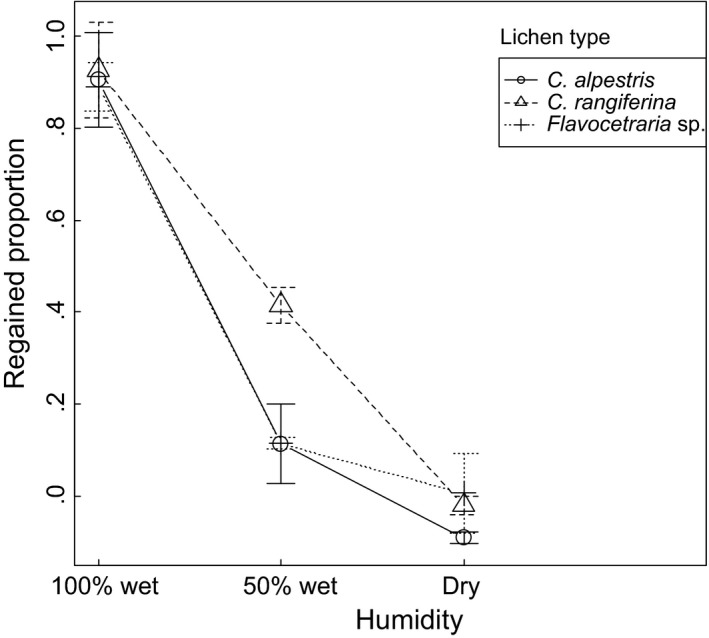
Mammalian herbivores have important top-down effects on ecological processes and landscapes by generating vegetation changes through grazing and trampling. For free-ranging herbivores on large landscapes, trampling is an important ecological factor. However, whereas grazing is widely studied, low-intensity trampling is rarely studied and quantified. The cold-adapted northern tundra reindeer () is a wide-ranging keystone herbivore in large open alpine and Arctic ecosystems. Reindeer may largely subsist on different species of slow-growing ground lichens, particularly in winter. Lichen grows in dry, snow-poor habitats with frost. Their varying elasticity makes them suitable for studying trampling. In replicated factorial experiments, high-resolution 3D laser scanning was used to quantify lichen volume loss from trampling by a reindeer hoof. Losses were substantial, that is, about 0.3 dm per imprint in dry thick lichen, but depended on type of lichen mat and humidity. Immediate trampling volume loss was about twice as high in dry, compared to humid thin (2-3 cm), lichen mats and about three times as high in dry vs. humid thick (6-8 cm) lichen mats, There was no significant difference in volume loss between 100% and 50% wetted lichen. Regained volume with time was insignificant for dry lichen, whereas 50% humid lichen regained substantial volumes, and 100% humid lichen regained almost all lost volume, and mostly within 10-20 min. Reindeer trampling may have from near none to devastating effects on exposed lichen forage. During a normal week of foraging, daily moving 5 km across dry 6- to 8-cm-thick continuous lichen mats, one adult reindeer may trample a lichen volume corresponding to about a year's supply of lichen. However, the lichen humidity appears to be an important factor for trampling loss, in addition to the extent of reindeer movement.
哺乳动物食草动物通过放牧和践踏导致植被变化,从而对生态过程和景观产生重要的自上而下的影响。对于大型景观中的自由放养食草动物来说,践踏是一个重要的生态因素。然而,虽然放牧受到广泛研究,但低强度践踏却很少被研究和量化。适应寒冷的北方苔原驯鹿()是大型开阔高山和北极生态系统中广泛分布的关键食草动物。驯鹿在很大程度上可能以不同种类生长缓慢的地衣为食,尤其是在冬季。地衣生长在干燥、少雪且有霜冻的栖息地。它们不同的弹性使其适合用于研究践踏。在重复析因实验中,利用高分辨率3D激光扫描来量化驯鹿蹄践踏造成的地衣体积损失。损失相当大,即在干燥的厚地衣中,每个蹄印约损失0.3立方分米,但这取决于地衣垫的类型和湿度。与潮湿的薄(2 - 3厘米)地衣垫相比,干燥地衣垫上立即发生的践踏体积损失约为其两倍,与潮湿的厚(6 - 8厘米)地衣垫相比约为其三倍。100%湿润和50%湿润的地衣之间在体积损失上没有显著差异。对于干燥地衣,随着时间推移恢复的体积微不足道,而50%湿度的地衣恢复了大量体积,100%湿度的地衣几乎恢复了所有损失的体积,且大多在10 - 20分钟内。驯鹿践踏对暴露的地衣草料可能产生从几乎没有到毁灭性的影响。在正常的一周觅食期间,成年驯鹿每天在干燥的6至8厘米厚的连续地衣垫上移动5公里,可能会践踏相当于约一年地衣供应量的地衣体积。然而,除了驯鹿移动的范围外,地衣湿度似乎也是践踏损失的一个重要因素。