Department of Geography and the Environment, University of Texas at Austin, Austin, TX, USA.
Laboratorio de Florística, Departamento de Dicotiledóneas, Museo de Historia Natural, Universidad Nacional Mayor de San Marcos, Lima, Peru.
Sci Rep. 2023 Sep 24;13(1):15936. doi: 10.1038/s41598-023-41458-x.
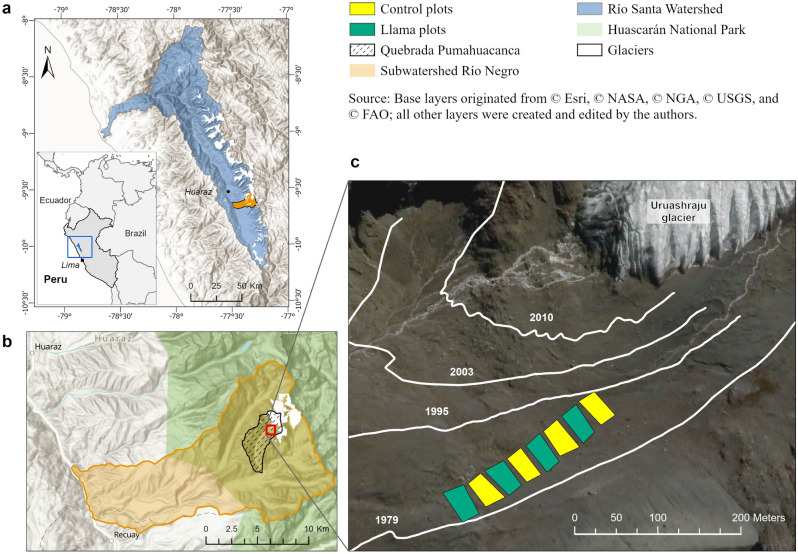
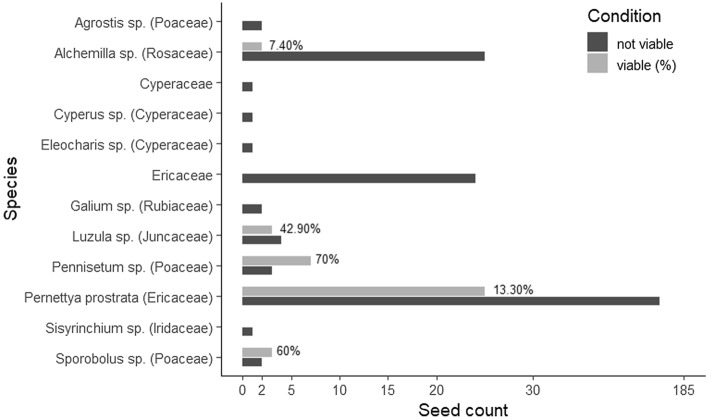
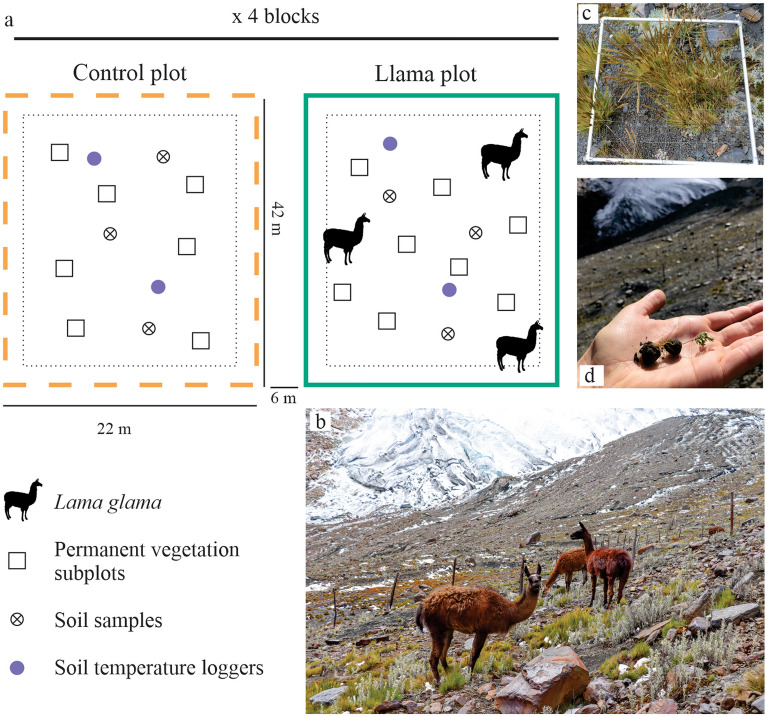
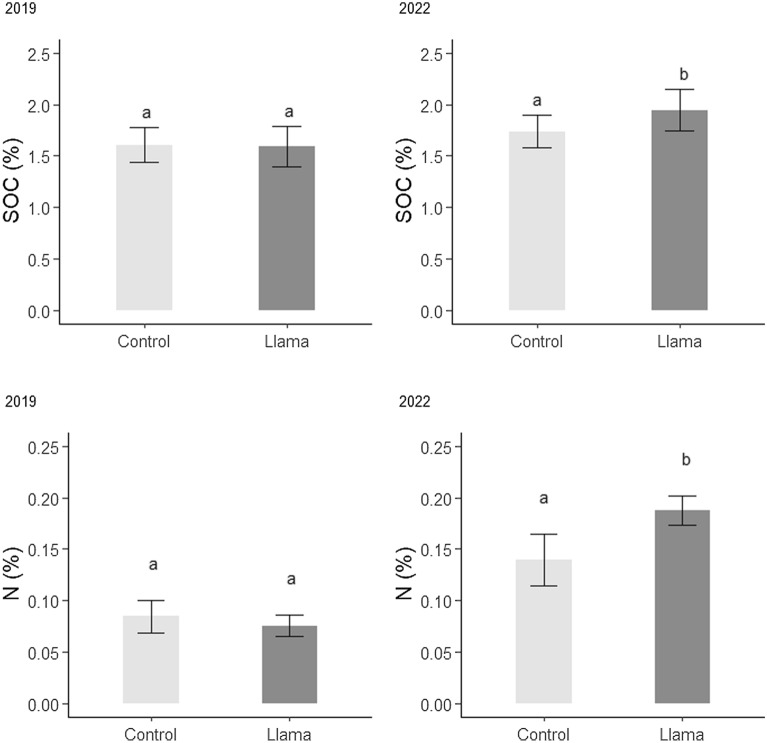
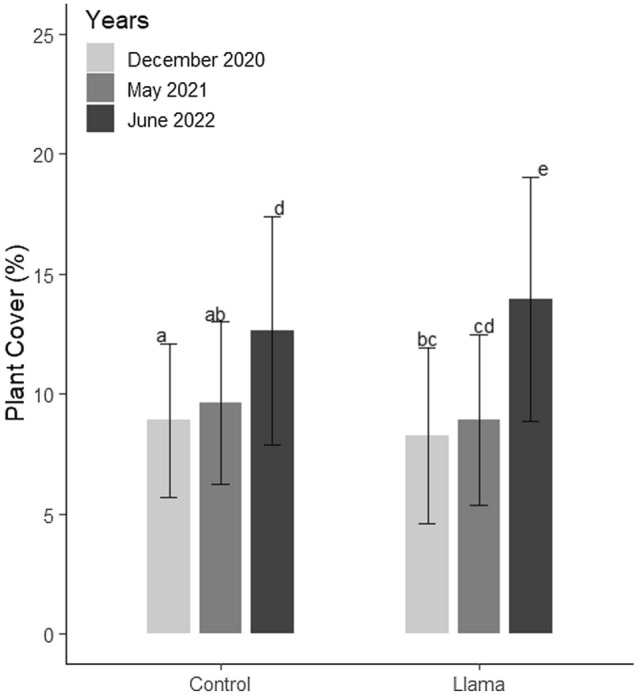
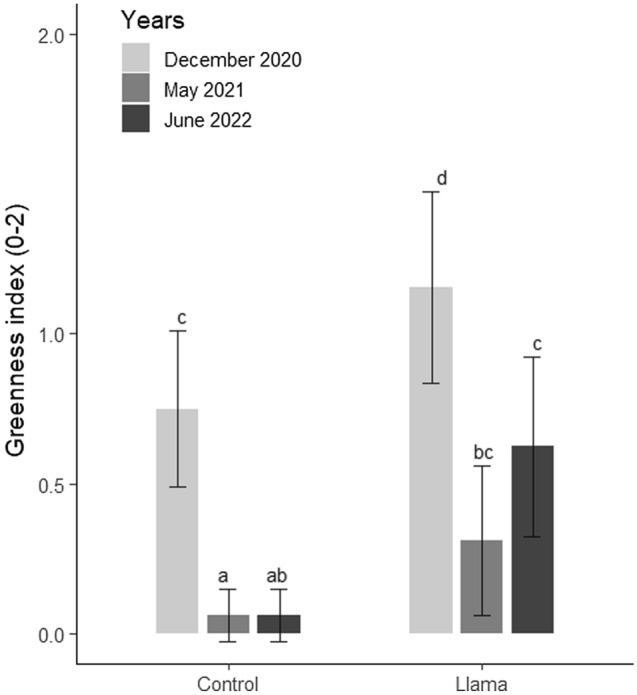
Worldwide, mountain glaciers are shrinking rapidly. Consequently, large areas are becoming available for the development of novel alpine ecosystems. These harsh environments, however, delay primary succession. In this study with a local community, we conducted an inclusion experiment to investigate whether Llama glama influences soils and vegetation primary succession following glacial retreat. At the foot of the Uruashraju glacier in the Cordillera Blanca, Peru (~ 4680 m.a.s.l.), we established four llama inclusion plots and four control plots that we studied from 2019 to 2022, 24-40 years after deglacierization. After three years, the llama plots had significantly increased soil organic carbon and soil nitrogen. In the llama plots, we found a large, significant increase in vascular plant cover (+ 57%) between the second and third years of experimentation, and we identified four new species that were not present in 2019. Our results suggest that Llama glama, through their latrine behavior and role as a seed disperser, enhances the primary succession and novel ecosystem formation in recently deglacierized landscapes. Our study provides scientific support that rewilding of native Andean camelids may favor adaptation to glacier retreat and inform conservation and management strategies in proglacial landscapes.
在全球范围内,山地冰川正在迅速消退。因此,大量地区可供开发新型高山生态系统。然而,这些恶劣的环境会延迟原生演替。在这项有当地社区参与的研究中,我们进行了一项包含实验,以调查羊驼是否会影响冰川退缩后土壤和植被的原生演替。在秘鲁布兰卡山脉的乌鲁阿沙朱冰川脚下(约 4680 米海拔),我们建立了四个包含羊驼的样地和四个对照样地,并从 2019 年到 2022 年,即冰川消退后 24-40 年进行了研究。三年后,羊驼样地的土壤有机碳和土壤氮含量显著增加。在羊驼样地中,我们发现,在实验的第二到第三年,维管束植物盖度显著增加了 57%,并且发现了 2019 年未出现的四种新物种。我们的结果表明,羊驼通过其粪便行为和种子传播者的作用,促进了最近冰川消退地区的原生演替和新型生态系统的形成。我们的研究提供了科学支持,表明安第斯本土骆驼的重新引入可能有利于适应冰川退缩,并为冰川前缘景观的保护和管理策略提供信息。