Chisolm-Straker Makini, Jardine Logan, Bennouna Cyril, Morency-Brassard Nina, Coy Lauren, Egemba Maria Olivia, Shearer Peter L
Department of Emergency Medicine, Icahn School of Medicine at Mount Sinai, New York City, New York.
Department of Emergency Medicine, SUNY Downstate College of Medicine, Brooklyn, New York.
Transgend Health. 2017 Feb 1;2(1):8-16. doi: 10.1089/trgh.2016.0026. eCollection 2017.
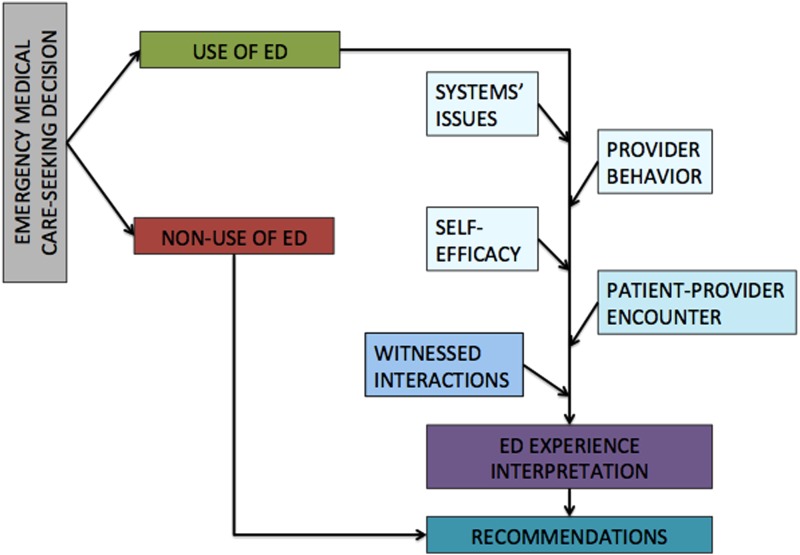
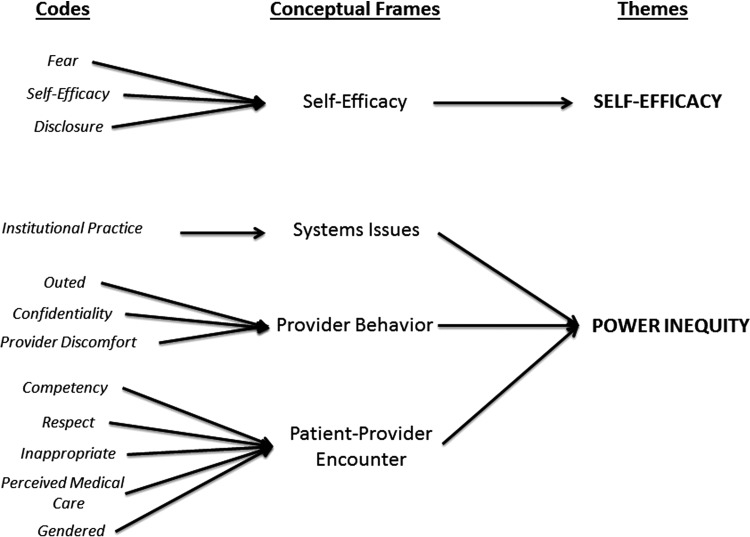
Individuals who have a transgender or gender nonconforming (TGGNC) experience belong to a marginalized segment of the U.S. population, and healthcare can be difficult for them to navigate. Although emergency departments (EDs) traditionally serve as healthcare "safety nets" for vulnerable populations, quantitative studies outside the United States have found that TGGNC-experienced persons tend to avoid EDs and/or have negative experiences. This qualitative study primarily describes the ED experiences of people with a TGGNC history; furthermore, the study explores reasons why this population avoids U.S. EDs and their recommendations for improvements to ED care. This qualitative study used data about TGGNC-historied persons' experiences in U.S. EDs from retrospective, anonymous, written surveys (paper or web based). National data collection took place from June 2012 through December 2014. Participant responses (=240) were examined using thematic analysis. Using a framework that recognized positive and negative responses, the themes of Self-Efficacy and Power Inequity surfaced. These themes exposed the tension between patients with TGGNC experiences and clinicians who were perceived to lack training in this area, resulting in negative patient experiences. When practitioners had specific training about this population, participants reported positive care experiences. This study indicates that many TGGNC-historied persons who use U.S. EDs have negative experiences, largely due to lack of provider sensitivity toward and training about this patient population. Data from this investigation suggest that training of U.S. ED providers and institutional support would help improve care for this marginalized group.
有跨性别或性别不一致(TGGNC)经历的个人属于美国人口中的边缘化群体,他们很难在医疗保健系统中顺利就医。尽管急诊科(EDs)传统上是弱势群体的医疗“安全网”,但美国以外的定量研究发现,有TGGNC经历的人往往会避开急诊科,和/或有负面经历。这项定性研究主要描述了有TGGNC经历的人的急诊科就医经历;此外,该研究还探讨了这一群体避开美国急诊科的原因以及他们对改善急诊科护理的建议。这项定性研究使用了回顾性、匿名书面调查(纸质或网络)中有关有TGGNC经历的人在美国急诊科经历的数据。全国性数据收集于2012年6月至2014年12月进行。使用主题分析法对参与者的回复(=240)进行了分析。采用一个认可积极和消极回复的框架,自我效能感和权力不平等的主题浮现出来。这些主题揭示了有TGGNC经历的患者与被认为在该领域缺乏培训的临床医生之间的紧张关系,导致患者产生负面经历。当从业者接受了关于这一群体的特定培训时,参与者报告了积极的就医经历。这项研究表明,许多有TGGNC经历且使用美国急诊科的人有负面经历,主要原因是提供者对这一患者群体缺乏敏感性和相关培训。这项调查的数据表明,对美国急诊科提供者的培训和机构支持将有助于改善对这一边缘化群体的护理。