Department of Biochemistry & Clinical Pharmacology, ICMR- National Institute for Research in Tuberculosis, Chennai, India.
Department of Statistics, ICMR- National Institute for Research in Tuberculosis, Chennai, India.
Indian J Med Res. 2017 Apr;145(4):530-535. doi: 10.4103/ijmr.IJMR_552_15.
BACKGROUND & OBJECTIVES: Concomitant feeding and anti-tuberculosis (TB) drug administration are likely to reduce nausea and enhance compliance to treatment. However, food could lower plasma drug concentrations. This study was undertaken to examine the effect of food on two-hour plasma concentrations of rifampicin (RMP), isoniazid (INH) and pyrazinamide (PZA), and pharmacokinetics of these drugs in adult TB patients.
Newly diagnosed adult TB patients were recruited from the Revised National Tuberculosis Control Programme (RNTCP) treatment centres in Chennai Corporation, Chennai, India. Two-hour post-dosing plasma concentrations were determined in 25 patients, and a semi-intensive pharmacokinetic study was undertaken in six patients. RMP, INH and PZA concentrations were determined by high-performance liquid chromatography.
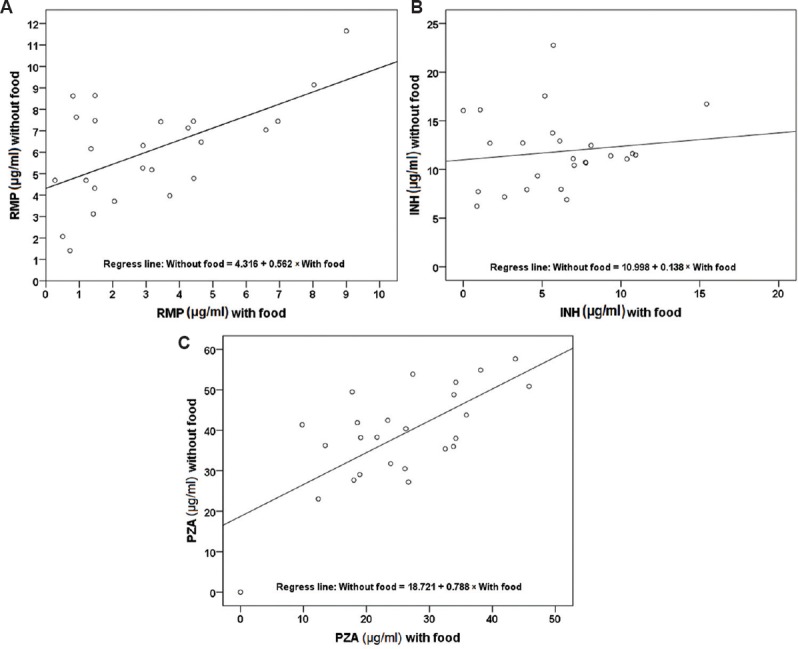
The geometric mean two-hour concentrations with food and under fasting conditions were 2.2 and 5.5 μg/ml for RMP (P<0.001), 3.9 and 11.3 μg/ml for INH (P<0.001), and 18.0 and 28.2 μg/ml for PZA (P<0.001), respectively. Drug administration with food caused the plasma concentration to decrease by 50, 45 and 34 per cent for RMP, INH and PZA, respectively. Significant decreases in peak concentrations and exposures of drugs and delay in time to attain peak concentrations of drugs when taken with food were also observed.
INTERPRETATION & CONCLUSIONS: Our findings showed that food lowered anti-TB drug concentrations significantly and delayed absorption. Patients may be explained the beneficial effects of taking anti-TB drugs in a fasting state and advised to do so. There is a need for more research on optimization of dosing to maximize efficacy and safety of currently used drugs.
同时进食和给予抗结核(TB)药物可能会减轻恶心感并提高治疗依从性。然而,食物可能会降低血浆药物浓度。本研究旨在检测食物对成人肺结核患者利福平(RMP)、异烟肼(INH)和吡嗪酰胺(PZA)两小时血浆浓度以及这些药物药代动力学的影响。
从印度钦奈市修正国家结核病控制规划(RNTCP)治疗中心招募新诊断的成人肺结核患者。在 25 名患者中测定了两小时后给药后的血浆浓度,并对 6 名患者进行了半强化药代动力学研究。通过高效液相色谱法测定 RMP、INH 和 PZA 浓度。
进食和空腹状态下的两小时平均浓度分别为 RMP 2.2μg/ml 和 5.5μg/ml(P<0.001),INH 3.9μg/ml 和 11.3μg/ml(P<0.001),PZA 18.0μg/ml 和 28.2μg/ml(P<0.001)。与空腹相比,进食时 RMP、INH 和 PZA 的血浆浓度分别降低了 50%、45%和 34%。还观察到药物的峰浓度和暴露量显著降低,以及药物达到峰浓度的时间延迟。
我们的研究结果表明,食物显著降低了抗结核药物的浓度并延迟了吸收。可以向患者解释空腹服用抗结核药物的有益效果,并建议他们这样做。需要进一步研究优化剂量,以最大限度地提高目前使用药物的疗效和安全性。