Department of Anesthesia, Center of Head and Orthopedics, Rigshospitalet, University of Copenhagen, Denmark.
Hyperbaric Unit, Department of Anesthesia, Center of Head and Orthopedics, Rigshospitalet, University of Copenhagen, Denmark.
Shock. 2018 Jun;49(6):667-674. doi: 10.1097/SHK.0000000000000975.
The nitric oxide system could play an important role in the pathophysiology related to necrotizing soft tissue infection (NSTI). Accordingly, we investigated the association between plasma nitrite level at admission and the presence of septic shock in patients with NSTI. We also evaluated the association between nitrite, asymmetric dimethylarginine (ADMA), L-arginine, L-arginine/ADMA ratio, and outcome.
We analyzed plasma from 141 NSTI patients taken upon hospital admission. The severity of NSTI was assessed by the presence of septic shock, Simplified Acute Physiology Score (SAPS) II, Sepsis-Related Organ Failure Assessment (SOFA) score, use of renal replacement therapy (RRT), amputation, and 28-day mortality.
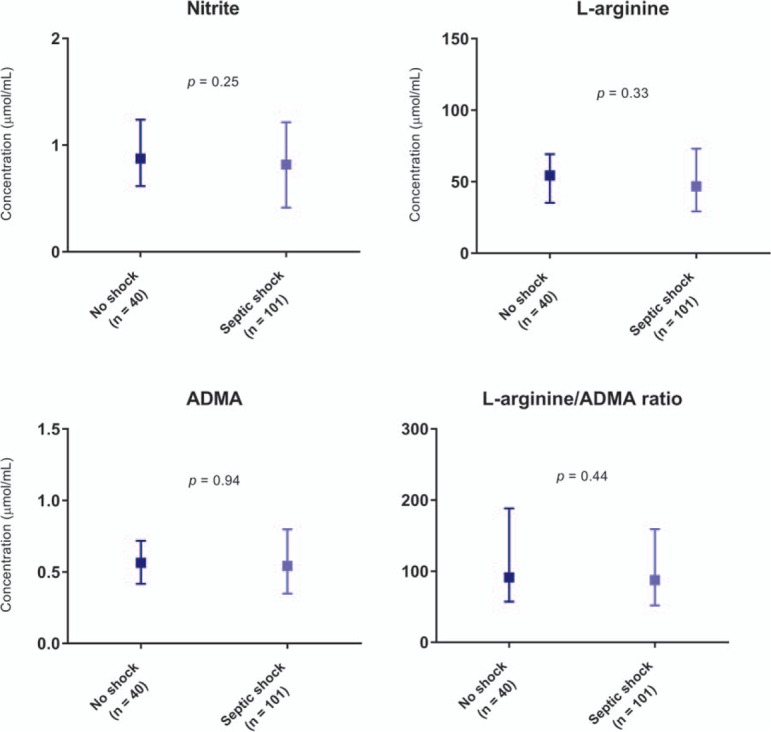
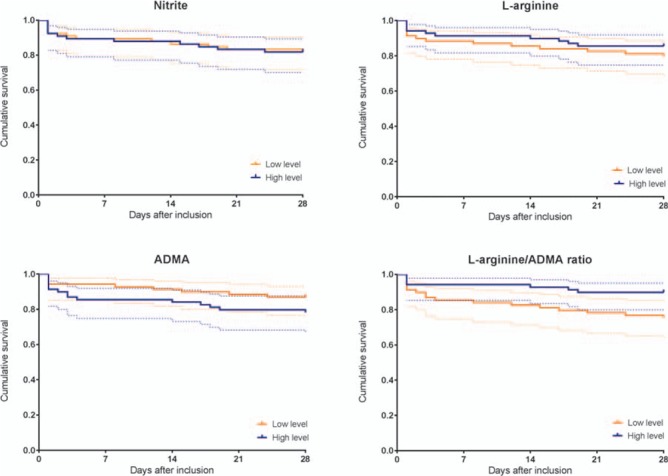
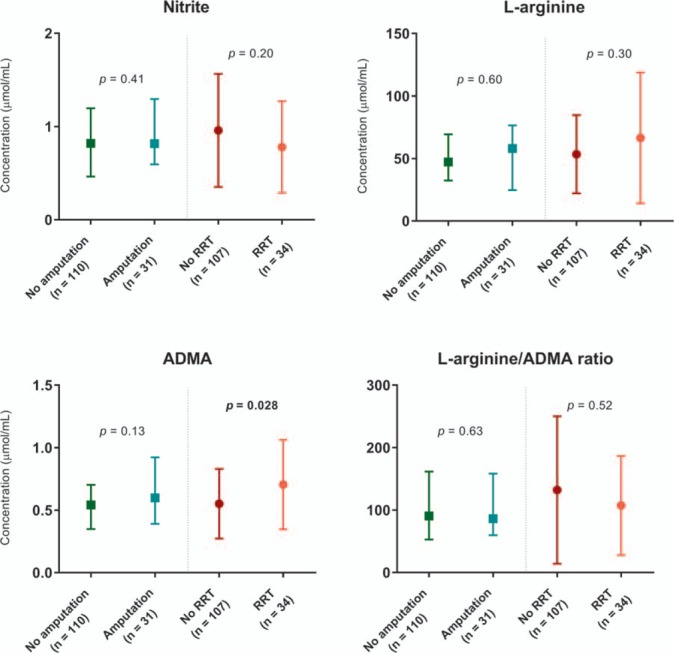
No difference in nitrite levels was found between patients with and without septic shock (median 0.82 μmol/L [interquartile range (IQR) 0.41-1.21] vs. 0.87 μmol/L (0.62-1.24), P = 0.25). ADMA level was higher in patients in need of RRT (0.64 μmol/L (IQR 0.47-0.90) vs. (0.52 μmol/L (0.34-0.70), P = 0.028), and ADMA levels correlated positively with SAPS II (rho = 0.32, P = 0.0002) and SOFA scores (rho = 0.22, P = 0.01). In a logistic regression analysis, an L-arginine/ADMA ratio below 101.59 was independently associated with 28-day mortality, odds ratio 6.03 (95% confidence interval, 1.41-25.84), P = 0.016. None of the other analyses indicated differences in the NO system based on differences in disease severity.
In patients with NSTI, we found no difference in baseline nitrite levels according to septic shock. High baseline ADMA level was associated with the use of RRT and patients with a low baseline L-arginine/ADMA ratio were at higher risk of dying within 28 days after hospital admission.
一氧化氮系统可能在与坏死性软组织感染(NSTI)相关的病理生理学中发挥重要作用。因此,我们研究了入院时血浆亚硝酸盐水平与 NSTI 患者脓毒性休克的关系。我们还评估了亚硝酸盐、不对称二甲基精氨酸(ADMA)、L-精氨酸、L-精氨酸/ADMA 比值与结局的关系。
我们分析了 141 例 NSTI 患者入院时的血浆。NSTI 的严重程度通过脓毒性休克、简化急性生理学评分(SAPS)Ⅱ、脓毒症相关器官衰竭评估(SOFA)评分、使用肾脏替代治疗(RRT)、截肢和 28 天死亡率来评估。
无脓毒性休克患者的亚硝酸盐水平无差异(中位数 0.82μmol/L[四分位距(IQR)0.41-1.21] vs. 0.87μmol/L[0.62-1.24],P=0.25)。需要 RRT 的患者 ADMA 水平更高(0.64μmol/L[IQR 0.47-0.90] vs. 0.52μmol/L[0.34-0.70],P=0.028),ADMA 水平与 SAPS Ⅱ(rho=0.32,P=0.0002)和 SOFA 评分(rho=0.22,P=0.01)呈正相关。在逻辑回归分析中,L-精氨酸/ADMA 比值低于 101.59 与 28 天死亡率独立相关,比值比 6.03(95%置信区间,1.41-25.84),P=0.016。根据疾病严重程度的不同,其他分析均未显示 NO 系统存在差异。
在 NSTI 患者中,我们没有发现根据脓毒性休克入院时亚硝酸盐水平存在差异。高基线 ADMA 水平与 RRT 的使用相关,而基线 L-精氨酸/ADMA 比值较低的患者在入院后 28 天内死亡的风险更高。