Department of Internal Medicine and Pediatrics, Faculty of Medicine and Health Sciences, Ghent University, Campus UZ Gent, Corneel Heymanslaan 10, 9000, Ghent, Belgium.
Burns, Trauma, and Critical Care Research Centre, Faculty of Medicine, The University of Queensland, Brisbane, Australia.
Intensive Care Med. 2021 Jan;47(1):28-38. doi: 10.1007/s00134-020-06276-z. Epub 2020 Oct 16.
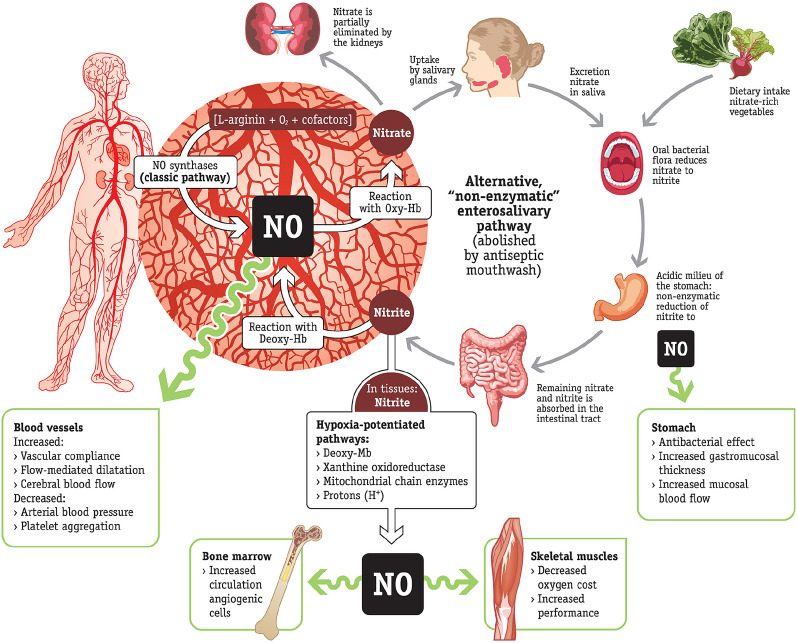
Meta-analyses and several large cohort studies have demonstrated that antiseptic mouthwashes are associated with mortality in hospitalized patients. A clear pathogenic mechanism is lacking, leading to controversy and a reluctance to abandon or limit the use of antiseptic mouthwashes. Here, we generate the hypothesis that a disturbance in nitric oxide homeostasis by antiseptic mouthwashes may be responsible for the observed increase in mortality risk. Nitric oxide is essential in multiple physiological processes, and a reduction in nitric oxide bioavailability is associated with the occurrence or worsening of pathologies, such as atherosclerosis, diabetes, and sepsis. Oral facultative anaerobic bacteria are essential for the enterosalivary nitrate-nitrite-nitric oxide pathway due to their capacity to reduce nitrate to nitrite. Nitrate originates from dietary sources or from the active uptake by salivary glands of circulating nitrate, which is then excreted in the saliva. Because antiseptic mouthwashes eradicate the oral bacterial flora, this nitric oxide-generating pathway is abolished, which may result in nitric oxide-deficient conditions potentially leading to life-threatening complications such as ischaemic heart events or sepsis.
荟萃分析和几项大型队列研究表明,抗菌漱口水与住院患者的死亡率有关。缺乏明确的发病机制,导致争议不断,人们不愿意放弃或限制使用抗菌漱口水。在这里,我们提出假设,即抗菌漱口水引起的一氧化氮动态平衡紊乱可能是导致观察到的死亡率风险增加的原因。一氧化氮在多种生理过程中必不可少,一氧化氮生物利用度降低与动脉粥样硬化、糖尿病和败血症等疾病的发生或恶化有关。口腔兼性厌氧菌由于能够将硝酸盐还原为亚硝酸盐,因此是肠唾液硝酸盐-亚硝酸盐-一氧化氮途径所必需的。硝酸盐来源于饮食来源或唾液腺对循环硝酸盐的主动摄取,然后在唾液中排出。由于抗菌漱口水会消灭口腔细菌菌群,因此这种产生一氧化氮的途径被废除,这可能导致一氧化氮缺乏的情况,从而导致危及生命的并发症,如缺血性心脏病事件或败血症。