Chadeka Evans Asena, Nagi Sachiyo, Sunahara Toshihiko, Cheruiyot Ngetich Benard, Bahati Felix, Ozeki Yuriko, Inoue Manabu, Osada-Oka Mayuko, Okabe Mayuko, Hirayama Yukio, Changoma Mwatasa, Adachi Keishi, Mwende Faith, Kikuchi Mihoko, Nakamura Risa, Kalenda Yombo Dan Justin, Kaneko Satoshi, Hirayama Kenji, Shimada Masaaki, Ichinose Yoshio, Njenga Sammy M, Matsumoto Sohkichi, Hamano Shinjiro
Leading Program, Graduate School of Biomedical Sciences, Nagasaki University, Nagasaki, Japan.
Department of Parasitology, Institute of Tropical Medicine (NEKKEN), Nagasaki University, Nagasaki, Japan.
PLoS Negl Trop Dis. 2017 Sep 1;11(9):e0005872. doi: 10.1371/journal.pntd.0005872. eCollection 2017 Sep.
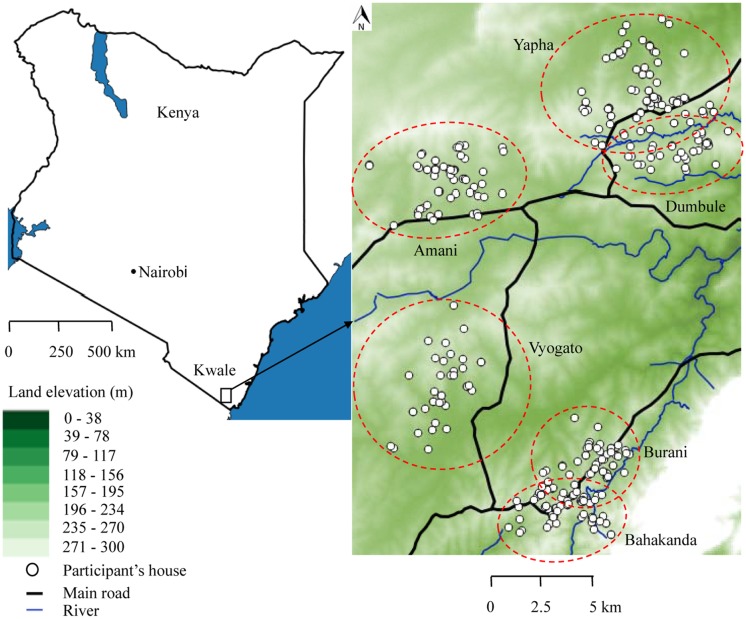
Large-scale schistosomiasis control programs are implemented in regions with diverse social and economic environments. A key epidemiological feature of schistosomiasis is its small-scale heterogeneity. Locally profiling disease dynamics including risk factors associated with its transmission is essential for designing appropriate control programs. To determine spatial distribution of schistosomiasis and its drivers, we examined schoolchildren in Kwale, Kenya.
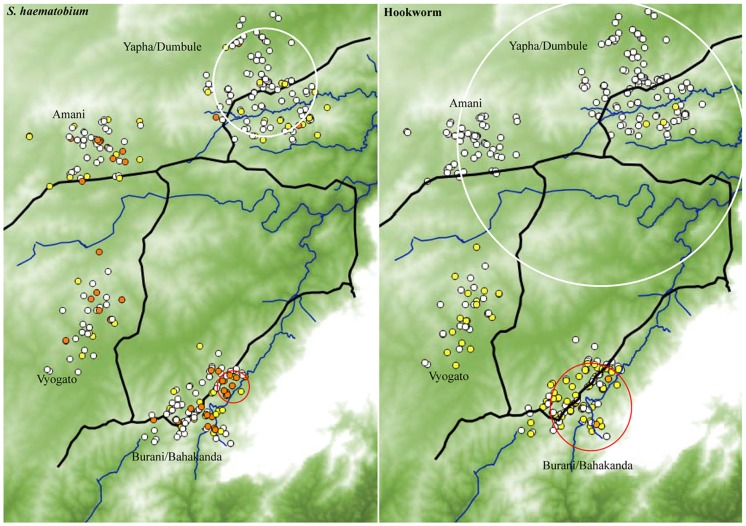
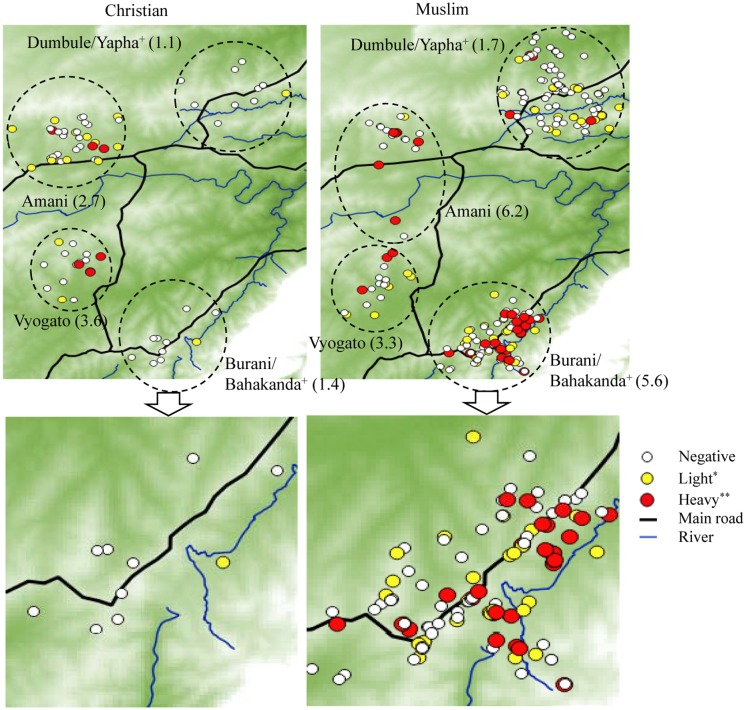
METHODOLOGY/PRINCIPAL FINDINGS: We conducted a cross-sectional study of 368 schoolchildren from six primary schools. Soil-transmitted helminths and Schistosoma mansoni eggs in stool were evaluated by the Kato-Katz method. We measured the intensity of Schistosoma haematobium infection by urine filtration. The geometrical mean intensity of S. haematobium was 3.1 eggs/10 ml urine (school range, 1.4-9.2). The hookworm geometric mean intensity was 3.2 eggs/g feces (school range, 0-17.4). Heterogeneity in the intensity of S. haematobium and hookworm infections was evident in the study area. To identify factors associated with the intensity of helminth infections, we utilized negative binomial generalized linear mixed models. The intensity of S. haematobium infection was associated with religion and socioeconomic status (SES), while that of hookworm infection was related to SES, sex, distance to river and history of anthelmintic treatment.
CONCLUSIONS/SIGNIFICANCE: Both S. haematobium and hookworm infections showed micro-geographical heterogeneities in this Kwale community. To confirm and explain our observation of high S. haematobium risk among Muslims, further extensive investigations are necessary. The observed small scale clustering of the S. haematobium and hookworm infections might imply less uniform strategies even at finer scale for efficient utilization of limited resources.
大规模血吸虫病防治项目在社会经济环境多样的地区实施。血吸虫病的一个关键流行病学特征是其小规模异质性。对包括与传播相关的危险因素在内的疾病动态进行局部分析对于设计适当的防治项目至关重要。为了确定血吸虫病及其驱动因素的空间分布,我们对肯尼亚夸勒的学童进行了检查。
方法/主要发现:我们对来自六所小学的368名学童进行了横断面研究。采用加藤厚涂片法评估粪便中的土源性蠕虫和曼氏血吸虫卵。通过尿液过滤测量埃及血吸虫感染强度。埃及血吸虫的几何平均感染强度为3.1个虫卵/10毫升尿液(学校范围为1.4 - 9.2)。钩虫的几何平均感染强度为3.2个虫卵/克粪便(学校范围为0 - 17.4)。在研究区域,埃及血吸虫和钩虫感染强度的异质性明显。为了确定与蠕虫感染强度相关的因素,我们使用了负二项广义线性混合模型。埃及血吸虫感染强度与宗教和社会经济地位(SES)相关,而钩虫感染强度与SES、性别、到河流的距离和驱虫治疗史有关。
结论/意义:在这个夸勒社区,埃及血吸虫和钩虫感染均呈现微观地理异质性。为了证实并解释我们观察到的穆斯林中埃及血吸虫高风险情况,需要进一步进行广泛调查。观察到的埃及血吸虫和钩虫感染的小规模聚集可能意味着即使在更精细的尺度上,为有效利用有限资源也需要采用不太统一的策略。