National Institute of Radiological Sciences Hospital, National Institutes for Quantum and Radiological Sciences and Technology, 4-9-1, Anagawa, Inage-ward, Chiba, 263-8555, Japan.
Department of Radiology, the University of Tokyo Hospital, Hongo, Bunkyo-ward, Tokyo, 113-8655, Japan.
Radiat Oncol. 2017 Sep 2;12(1):144. doi: 10.1186/s13014-017-0881-1.
Lung cancer is frequently complicated by interstitial lung disease (ILD). Treatment protocols for lung cancer patients with ILD have not been established; surgery, chemotherapy, and radiotherapy can all cause acute exacerbation of ILD. This study evaluated the toxicity and efficacy of carbon ion radiotherapy (CIRT) in patients with non-small cell lung cancer (NSCLC) and ILD.
Between June 2004 and November 2014, 29 patients diagnosed with NSCLC and ILD were treated with CIRT. No patient was eligible for curative surgery or conventional radiotherapy secondary to ILD. Owing to prior symptomology, radiation pneumonitis (RP) and symptom progression pre- and post-treatment were evaluated. The relationships between RP and clinical factors were investigated.
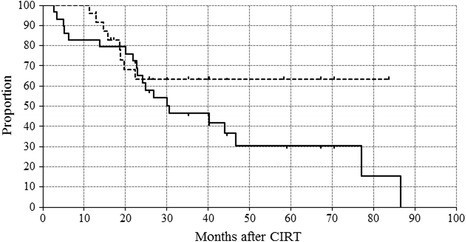
Twenty-eight men and one woman, aged 62 to 90 years old, were followed for 2.7-77.1 months (median: 22.8 months). Single-grade symptomatic progression (grade 2-3) was observed in 4 patients, while 1 patient experiencedtwo-grade progression. Two patients experienced radiation-induced acute exacerbation. Local control at 3 years was 63.3% (72.2% for stage I disease); survival at 3 years was 46.3% (57.2% for stage I disease). Eighteen patients had died by the time of this writing, 10 of lung cancer progression. Radiation pneumonitis post-treatment progression correlated with dosimetric factors of the lungs (V5, V10) and a low pre-treatment serum surfactant protein-D.
We found that CIRT may be useful as a low-risk, curative option for NSCLC patients with ILD, a population that is typically ineligible for conventional therapy. The DVH analysis showed that minimizing the low-dose region is important for reducing the risk of severe RP.
NIRS-9404 . Registered 1 March 1994.
肺癌常并发间质性肺疾病(ILD)。ILD 患者的肺癌治疗方案尚未建立;手术、化疗和放疗均可引起 ILD 急性加重。本研究评估了碳离子放疗(CIRT)治疗非小细胞肺癌(NSCLC)合并 ILD 患者的毒性和疗效。
2004 年 6 月至 2014 年 11 月,29 例诊断为 NSCLC 和 ILD 的患者接受了 CIRT 治疗。由于 ILD,没有患者适合进行根治性手术或常规放疗。由于先前的症状,评估了治疗前后的放射性肺炎(RP)和症状进展。研究了 RP 与临床因素的关系。
28 名男性和 1 名女性,年龄 62 至 90 岁,随访 2.7-77.1 个月(中位数:22.8 个月)。4 例患者出现单级症状进展(2-3 级),1 例患者出现 2 级进展。2 例患者发生放射性急性加重。3 年局部控制率为 63.3%(I 期疾病为 72.2%);3 年生存率为 46.3%(I 期疾病为 57.2%)。截至本报告撰写时,18 例患者已死亡,其中 10 例死于肺癌进展。治疗后放射性肺炎进展与肺部剂量学因素(V5、V10)和低治疗前表面活性蛋白-D 相关。
我们发现 CIRT 可能是 ILD 合并 NSCLC 患者的一种低风险、根治性选择,而这一人群通常不符合常规治疗标准。剂量-体积直方图(DVH)分析表明,尽量减少低剂量区域对于降低严重放射性肺炎的风险很重要。
NIRS-9404。1994 年 3 月 1 日注册。