Otoshi Ryota, Ikeda Satoshi, Kaneko Taichi, Sagawa Shinobu, Yamada Chieri, Kumagai Kosumi, Moriuchi Asami, Sekine Akimasa, Baba Tomohisa, Ogura Takashi
Department of Respiratory Medicine, Kanagawa Cardiovascular and Respiratory Center, 6-16-1, Tomioka-higashi, Kanazawa-ku, Yokohama 236-0051, Japan.
Cancers (Basel). 2024 Apr 29;16(9):1734. doi: 10.3390/cancers16091734.
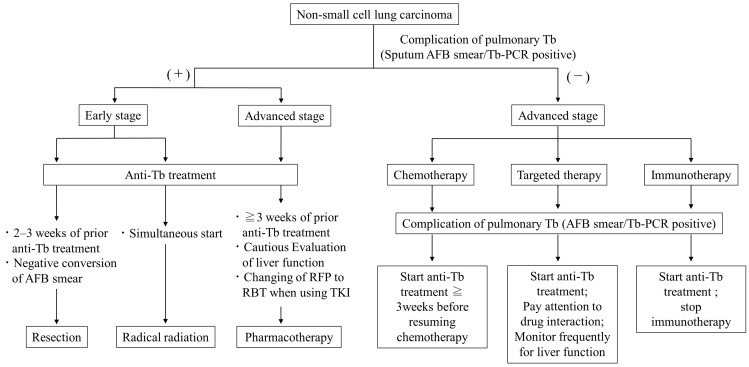
Non-small cell lung cancer (NSCLC) patients are often complicated by other respiratory diseases, including interstitial pneumonia (IP), chronic obstructive pulmonary disease (COPD), and pulmonary tuberculosis (TB), and the management of which can be problematic. NSCLC patients with IP sometimes develop fatal acute exacerbation induced by pharmacotherapy, and the establishment of a safe treatment strategy is desirable. For advanced NSCLC with IP, carboplatin plus nanoparticle albumin-bound paclitaxel is a relatively safe and effective first-line treatment option. Although the safety of immune checkpoint inhibitors (ICIs) for these populations remains controversial, ICIs have the potential to provide long-term survival. The severity of COPD is an important prognostic factor in NSCLC patients. Although COPD complications do not necessarily limit treatment options, it is important to select drugs with fewer side effects on the heart and blood vessels as well as the lungs. Active TB is complicated by 2-5% of NSCLC cases during their disease course. Since pharmacotherapy, especially ICIs, reportedly induces the development of TB, the possibility of developing TB should always be kept in mind during NSCLC treatment. To date, there is no coherent review article on NSCLC with these pulmonary complications. This review article summarizes the current evidence and discusses future prospects for treatment strategies for NSCLC patients complicated with IP, severe COPD, and TB.
非小细胞肺癌(NSCLC)患者常并发其他呼吸系统疾病,包括间质性肺炎(IP)、慢性阻塞性肺疾病(COPD)和肺结核(TB),而这些疾病的管理可能存在问题。患有IP的NSCLC患者有时会因药物治疗引发致命的急性加重,因此需要制定安全的治疗策略。对于患有IP的晚期NSCLC,卡铂联合纳米白蛋白结合型紫杉醇是一种相对安全有效的一线治疗选择。尽管免疫检查点抑制剂(ICI)对这些人群的安全性仍存在争议,但ICI有提供长期生存的潜力。COPD的严重程度是NSCLC患者的一个重要预后因素。虽然COPD并发症不一定会限制治疗选择,但选择对心脏、血管以及肺部副作用较少的药物很重要。在NSCLC病程中,2%-5%的病例会并发活动性TB。据报道,由于药物治疗,尤其是ICI,会诱发TB的发生,因此在NSCLC治疗期间应始终牢记发生TB的可能性。迄今为止,尚无关于伴有这些肺部并发症的NSCLC的连贯综述文章。这篇综述文章总结了当前证据,并讨论了伴有IP、重度COPD和TB的NSCLC患者治疗策略的未来前景。