Department of Cancer Biology, Dana-Farber Cancer Institute, Boston, Massachusetts.
Department of Cell Biology, Harvard Medical School, Boston, Massachusetts.
Ann N Y Acad Sci. 2018 Jan;1411(1):21-35. doi: 10.1111/nyas.13435. Epub 2017 Sep 3.
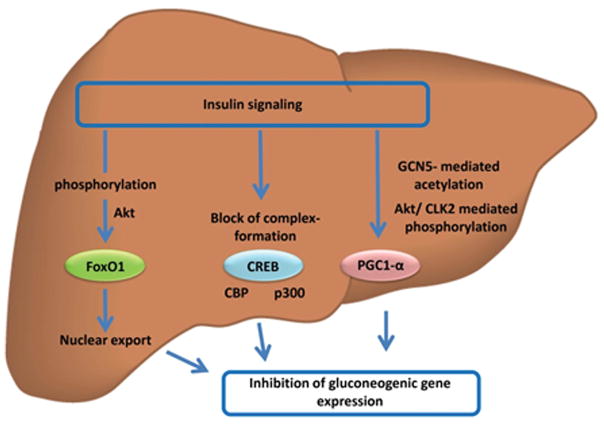
The coordinated regulation between cellular glucose uptake and endogenous glucose production is indispensable for the maintenance of constant blood glucose concentrations. The liver contributes significantly to this process by altering the levels of hepatic glucose release, through controlling the processes of de novo glucose production (gluconeogenesis) and glycogen breakdown (glycogenolysis). Various nutritional and hormonal stimuli signal to alter hepatic gluconeogenic flux, and suppression of this metabolic pathway during the postprandial state can, to a significant extent, be attributed to insulin. Here, we review some of the molecular mechanisms through which insulin modulates hepatic gluconeogenesis, thus controlling glucose production by the liver to ultimately maintain normoglycemia. Various signaling pathways governed by insulin converge at the level of transcriptional regulation of the key hepatic gluconeogenic genes PCK1 and G6PC, highlighting this as one of the focal mechanisms through which gluconeogenesis is modulated. In individuals with compromised insulin signaling, such as insulin resistance in type 2 diabetes, insulin fails to suppress hepatic gluconeogenesis, even in the fed state; hence, an insight into these insulin-moderated pathways is critical for therapeutic purposes.
细胞葡萄糖摄取和内源性葡萄糖生成之间的协调调节对于维持恒定的血糖浓度是必不可少的。肝脏通过改变肝葡萄糖释放的水平,通过控制从头葡萄糖生成(糖异生)和糖原分解(糖原分解)的过程,对这一过程做出重大贡献。各种营养和激素刺激信号改变肝糖异生通量,并且在餐后状态下抑制这种代谢途径在很大程度上可以归因于胰岛素。在这里,我们回顾了一些胰岛素调节肝糖异生的分子机制,从而控制肝脏的葡萄糖生成,最终维持正常血糖水平。胰岛素调控的各种信号通路在关键的肝糖异生基因 PCK1 和 G6PC 的转录调控水平上汇聚,突出了这是调节糖异生的焦点机制之一。在胰岛素信号受损的个体中,例如 2 型糖尿病中的胰岛素抵抗,即使在进食状态下,胰岛素也不能抑制肝糖异生;因此,深入了解这些胰岛素介导的途径对于治疗目的至关重要。