Department of Cardiovascular Medicine, Graduate School of Medical Sciences, Kumamoto University, Kumamoto, Japan.
Department of Cardiovascular Medicine, National Cerebral and Cardiovascular Center, Osaka, Japan.
ESC Heart Fail. 2018 Feb;5(1):27-35. doi: 10.1002/ehf2.12203. Epub 2017 Sep 4.
The aim of this study was to evaluate the diagnostic utility of high-sensitivity cardiac troponin T (hs-cTnT) levels in discriminating cardiac amyloidosis from patients with cardiac hypertrophy caused by aetiologies other than cardiac amyloidosis.
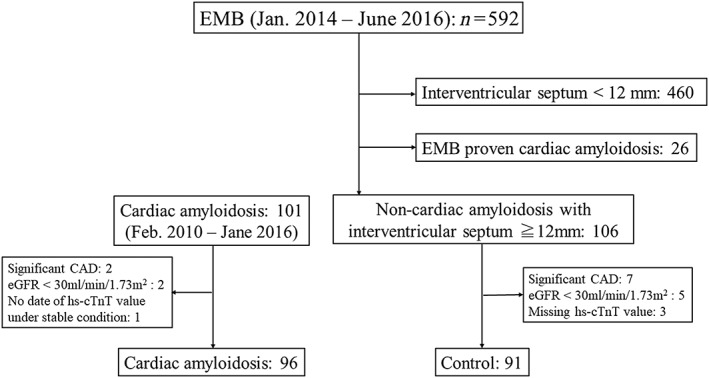
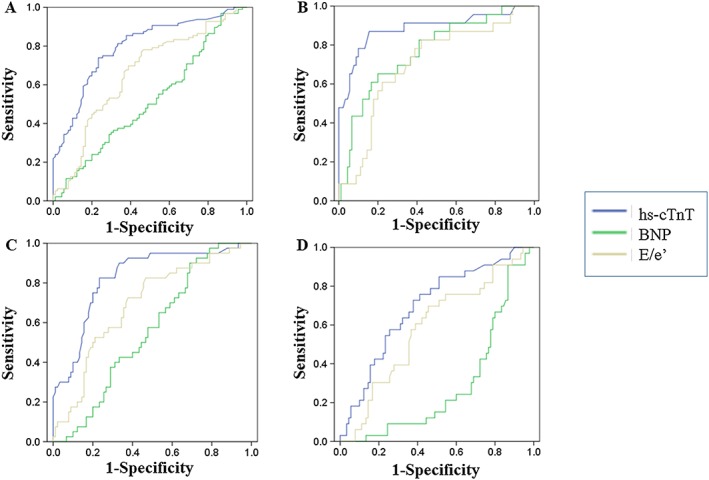
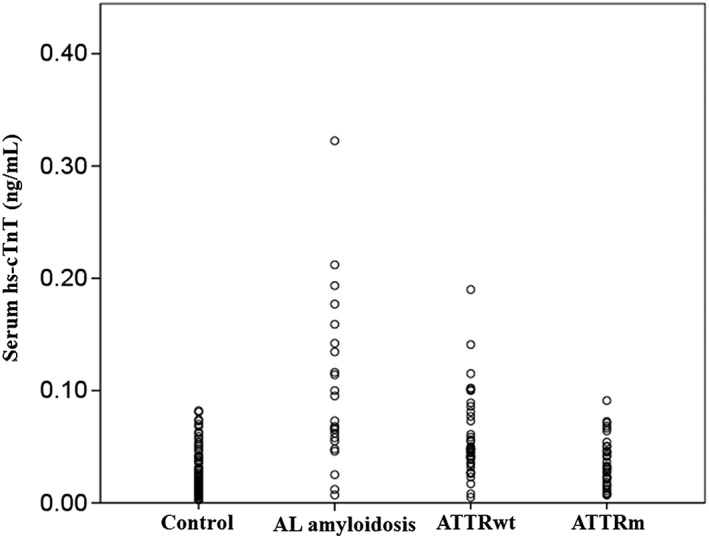
Serum hs-cTnT levels were measured in 96 patients with cardiac amyloidosis (light chain: 23, wild-type transthyretin amyloidosis: 40, and mutated transthyretin amyloidosis: 33), and 91 patients with other causes of cardiac hypertrophy who were confirmed to have no cardiac amyloidosis by endomyocardial biopsy (control group). The diagnostic utility and cut-off value of hs-cTnT were evaluated by receiver operating characteristic analysis. The median hs-cTnT levels were higher in cardiac amyloidosis than the control group [0.048 (0.029-0.073) vs. 0.016 (0.010-0.031) ng/mL; P < 0.001]. High levels of hs-cTnT were suggestive of cardiac amyloidosis (cut-off value: 0.0312 ng/mL, sensitivity: 0.74, specificity: 0.76, area under the curve: 0.788; 95% confidence interval: 0.723-0.854, P < 0.001), compared with brain natriuretic peptide and E/e' ratio. The hs-cTnT levels were also useful in differentiating each type of amyloidosis from the control group. Multivariate analysis identified log hs-cTnT as an independent diagnostic factor for cardiac amyloidosis (odds ratio: 2.22; 95% confidence interval: 1.30-3.80; P = 0.004).
High serum levels of hs-cTnT are highly suggestive of cardiac amyloidosis, allowing its differentiation from cardiac hypertrophy of other aetiologies. Further refined diagnostic approaches that include imaging modalities and histopathological examination are needed for these patients to avoid underdiagnosis of cardiac amyloidosis.
本研究旨在评估高敏心肌肌钙蛋白 T(hs-cTnT)水平在鉴别由非心肌淀粉样变病因引起的心肌肥厚与心肌淀粉样变患者中的诊断效用。
检测了 96 例心肌淀粉样变患者(轻链:23 例,野生型转甲状腺素蛋白淀粉样变:40 例,突变型转甲状腺素蛋白淀粉样变:33 例)和 91 例经心内膜心肌活检证实无心肌淀粉样变的其他病因引起的心肌肥厚患者(对照组)的血清 hs-cTnT 水平。通过受试者工作特征分析评估 hs-cTnT 的诊断效用和临界值。心肌淀粉样变患者的 hs-cTnT 中位数水平高于对照组[0.048(0.029-0.073)vs. 0.016(0.010-0.031)ng/ml;P<0.001]。hs-cTnT 水平升高提示心肌淀粉样变(临界值:0.0312ng/ml,灵敏度:0.74,特异性:0.76,曲线下面积:0.788;95%置信区间:0.723-0.854,P<0.001),优于脑钠肽和 E/e' 比值。hs-cTnT 水平也有助于将每种类型的淀粉样变与对照组区分开来。多变量分析确定 log hs-cTnT 是心肌淀粉样变的独立诊断因素(优势比:2.22;95%置信区间:1.30-3.80;P=0.004)。
高血清 hs-cTnT 水平高度提示心肌淀粉样变,可将其与其他病因引起的心肌肥厚相鉴别。对于这些患者,需要进一步细化包括影像学和组织病理学检查在内的诊断方法,以避免心肌淀粉样变的漏诊。