Arcaro Michael J, Schade Peter F, Vincent Justin L, Ponce Carlos R, Livingstone Margaret S
Department of Neurobiology, Harvard Medical School, Boston, Massachusetts, USA.
Nat Neurosci. 2017 Oct;20(10):1404-1412. doi: 10.1038/nn.4635. Epub 2017 Sep 4.
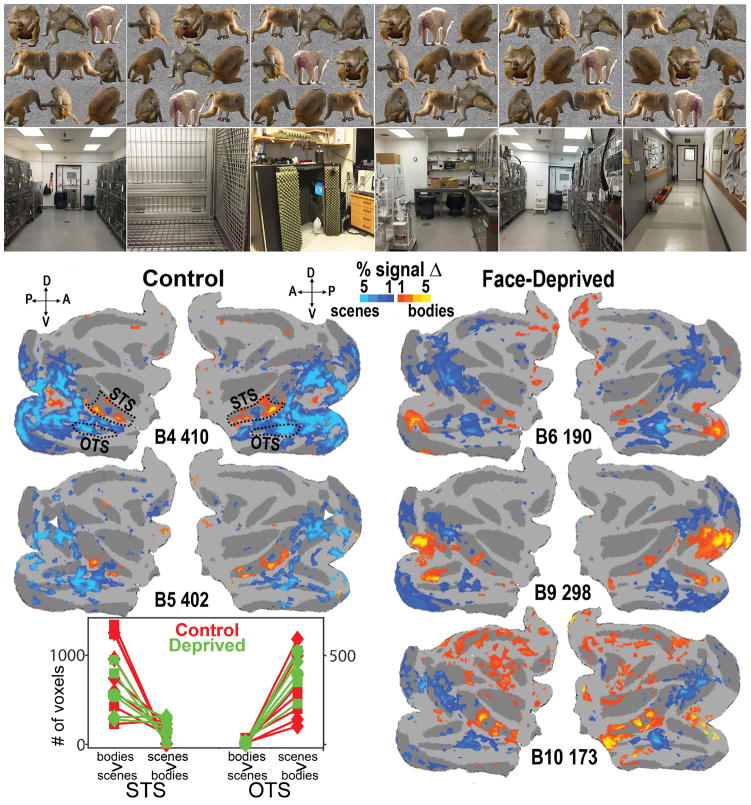
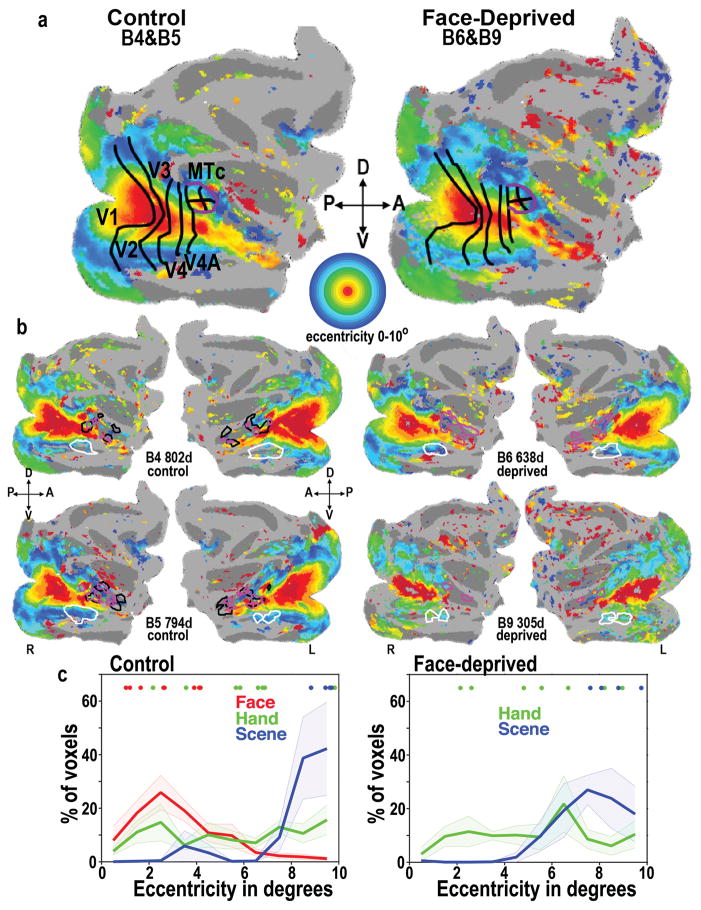
Here we report that monkeys raised without exposure to faces did not develop face domains, but did develop domains for other categories and did show normal retinotopic organization, indicating that early face deprivation leads to a highly selective cortical processing deficit. Therefore, experience must be necessary for the formation (or maintenance) of face domains. Gaze tracking revealed that control monkeys looked preferentially at faces, even at ages prior to the emergence of face domains, but face-deprived monkeys did not, indicating that face looking is not innate. A retinotopic organization is present throughout the visual system at birth, so selective early viewing behavior could bias category-specific visual responses toward particular retinotopic representations, thereby leading to domain formation in stereotyped locations in inferotemporal cortex, without requiring category-specific templates or biases. Thus, we propose that environmental importance influences viewing behavior, viewing behavior drives neuronal activity, and neuronal activity sculpts domain formation.
我们在此报告,在没有接触过面孔的环境中饲养的猴子没有形成面孔区域,但确实形成了其他类别的区域,并且显示出正常的视网膜拓扑组织,这表明早期面孔剥夺会导致高度选择性的皮层加工缺陷。因此,经验对于面孔区域的形成(或维持)必定是必要的。注视追踪显示,对照猴子即使在面孔区域出现之前的年龄也优先注视面孔,但面孔剥夺的猴子则不然,这表明注视面孔并非天生的。视网膜拓扑组织在出生时就存在于整个视觉系统中,因此选择性的早期观看行为可能会使特定类别的视觉反应偏向于特定的视网膜拓扑表征,从而导致在颞下皮质的固定位置形成区域,而无需特定类别的模板或偏差。因此,我们提出环境重要性影响观看行为,观看行为驱动神经元活动,而神经元活动塑造区域形成。