Department of Obstetrics and Gynaecology, Academic Medical Center (AMC), Meibergdreef 9, 1105, AZ, Amsterdam, The Netherlands.
Julius Centre for General Practice and Health Sciences, University Medical Centre Utrecht (UMCU), Utrecht, The Netherlands.
BMC Pregnancy Childbirth. 2017 Sep 4;17(1):284. doi: 10.1186/s12884-017-1454-x.
Preterm birth is in quantity and in severity the most important topic in obstetric care in the developed world. Progestogens and cervical pessaries have been studied as potential preventive treatments with conflicting results. So far, no study has compared both treatments.
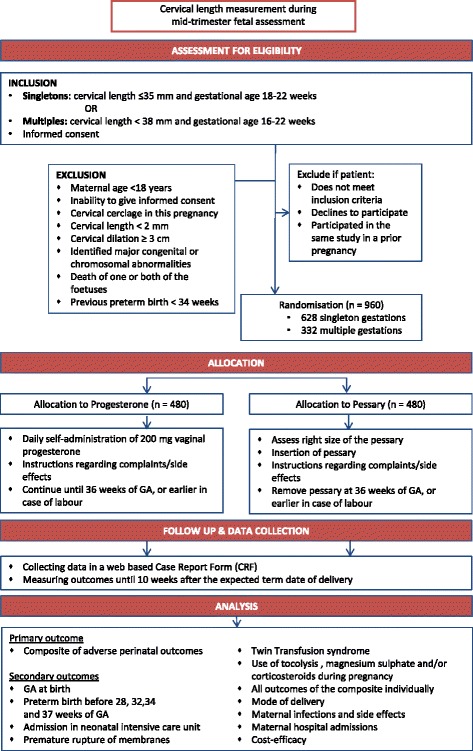
METHODS/DESIGN: The Quadruple P study aims to compare the efficacy of vaginal progesterone and cervical pessary in the prevention of adverse perinatal outcome associated with preterm birth in asymptomatic women with a short cervix, in singleton and multiple pregnancies separately. It is a nationwide open-label multicentre randomized clinical trial (RCT) with a superiority design and will be accompanied by an economic analysis. Pregnant women undergoing the routine anomaly scan will be offered cervical length measurement between 18 and 22 weeks in a singleton and at 16-22 weeks in a multiple pregnancy. Women with a short cervix, defined as less than, or equal to 35 mm in a singleton and less than 38 mm in a multiple pregnancy, will be invited to participate in the study. Eligible women will be randomly allocated to receive either progesterone or a cervical pessary. Following randomization, the silicone cervical pessary will be placed during vaginal examination or 200 mg progesterone capsules will be daily self-administered vaginally. Both interventions will be continued until 36 weeks gestation or until delivery, whichever comes first. Primary outcome will be composite adverse perinatal outcome of perinatal mortality and perinatal morbidity including bronchopulmonary dysplasia, intraventricular haemorrhage grade III and IV, periventricular leukomalacia higher than grade I, necrotizing enterocolitis higher than stage I, Retinopathy of prematurity (ROP) or culture proven sepsis. These outcomes will be measured up until 10 weeks after the expected due date. Secondary outcomes will be, among others, time to delivery, preterm birth rate before 28, 32, 34 and 37 weeks, admission to neonatal intensive care unit, maternal morbidity, maternal admission days for threatened preterm labour and costs.
This trial will provide evidence on whether vaginal progesterone or a cervical pessary is more effective in decreasing adverse perinatal outcome in both singletons and multiples.
Trial registration number: NTR 4414 . Date of registration January 29th 2014.
早产是发达国家产科护理中最重要的问题,无论是在数量上还是严重程度上。孕激素和宫颈托已被研究为潜在的预防治疗方法,但结果相互矛盾。到目前为止,还没有研究比较这两种治疗方法。
方法/设计:Quadruple P 研究旨在比较阴道孕酮和宫颈托在预防与早产相关的不良围产结局方面的疗效,这些结局与无症状的短宫颈的单胎和多胎妊娠有关。这是一项全国性的、开放性标签的、以优效性为设计的多中心随机临床试验(RCT),并将伴随经济分析。在进行常规异常扫描的孕妇中,将在单胎妊娠 18 至 22 周以及多胎妊娠 16 至 22 周时进行宫颈长度测量。宫颈长度小于或等于 35 毫米的单胎妊娠和小于 38 毫米的多胎妊娠的孕妇将被邀请参加这项研究。符合条件的孕妇将被随机分配接受孕酮或宫颈托治疗。随机分组后,将在阴道检查时放置硅酮宫颈托,或每天自行阴道内给予 200 毫克孕酮胶囊。两种干预措施都将持续到 36 孕周或分娩,以先到者为准。主要结局是围产儿死亡率和围产儿发病率的复合不良结局,包括支气管肺发育不良、脑室内出血 3 级和 4 级、脑室周围白质软化症高于 1 级、坏死性小肠结肠炎高于 1 期、早产儿视网膜病变(ROP)或培养阳性的败血症。这些结果将在预计预产期后 10 周内进行测量。次要结局包括分娩时间、28 周、32 周、34 周和 37 周前早产率、入住新生儿重症监护病房、产妇发病率、因早产威胁性宫缩而住院的天数和成本。
本试验将提供阴道孕酮或宫颈托在单胎和多胎妊娠中降低不良围产儿结局的有效性方面的证据。
试验注册号:NTR 4414。注册日期 2014 年 1 月 29 日。