Department of Biomedical Sciences, Ohio University, 228 Irvine Hall, Athens, Ohio, 45701, USA.
Ohio Musculoskeletal and Neurological Institute, Ohio University, Athens, Ohio, 45701, USA.
Skelet Muscle. 2017 Sep 4;7(1):17. doi: 10.1186/s13395-017-0133-y.
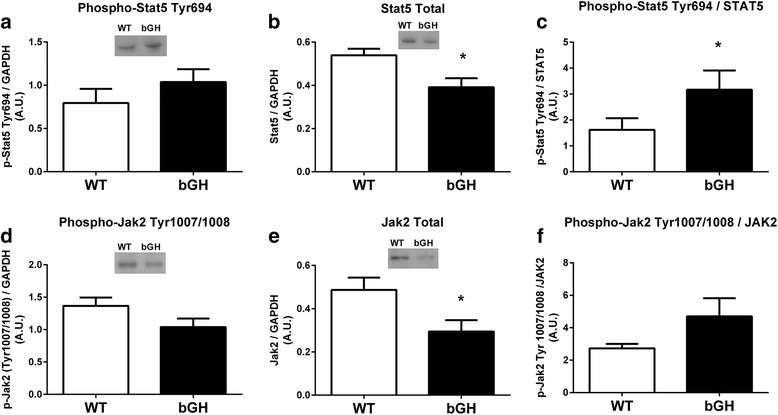
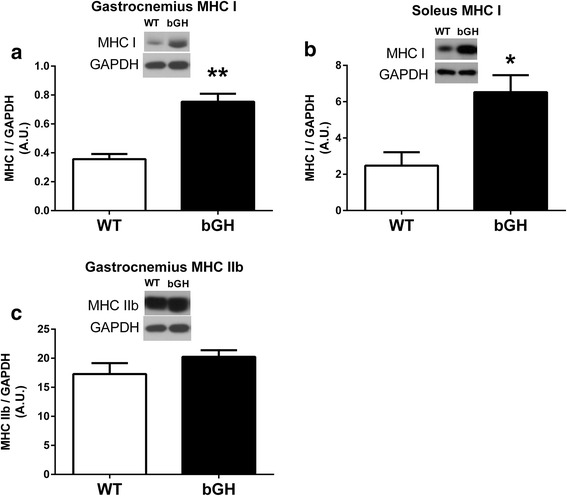
In contrast to the acute effects of growth hormone (GH) on skeletal muscle protein synthesis, long-term GH treatment appears to have negligible effects on muscle mass. Despite this knowledge, little is known regarding the chronic effects of GH on skeletal muscle protein synthesis and atrophy signaling pathways. The purpose of this study was to determine if protein synthesis pathways are attenuated and/or muscle atrophy intracellular signaling pathways are altered in the skeletal muscle of transgenic bovine GH (bGH) mice.
The gastrocnemius and soleus from 5-month-old male bGH mice (n = 9) and wild type (WT) controls (n = 9) were harvested and analyzed for proteins involved in the protein synthesis (Akt/mTOR), growth and proliferation (MAPK), and muscle atrophy (MuRF1 and myostatin) pathways.
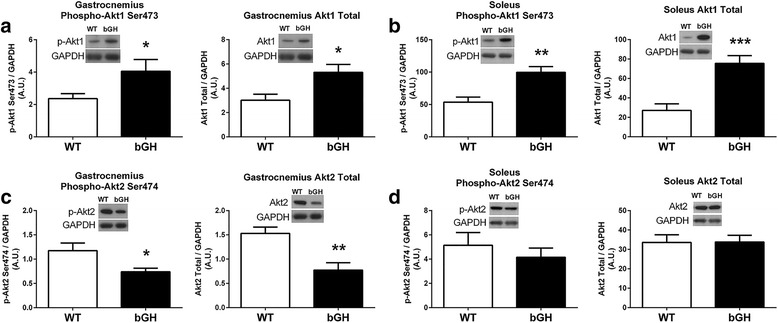
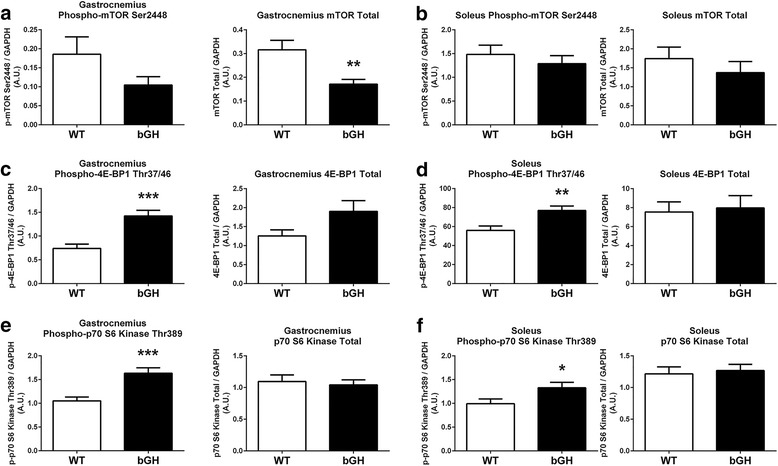
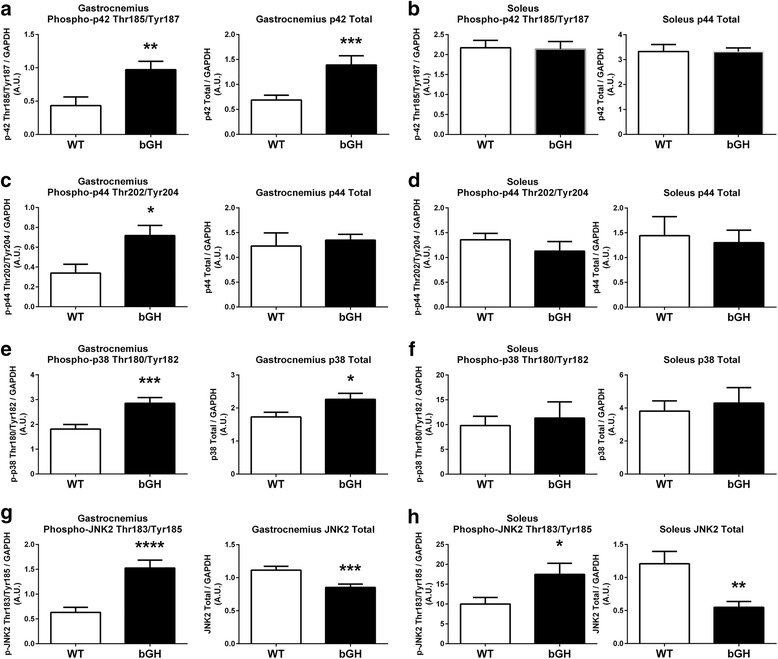
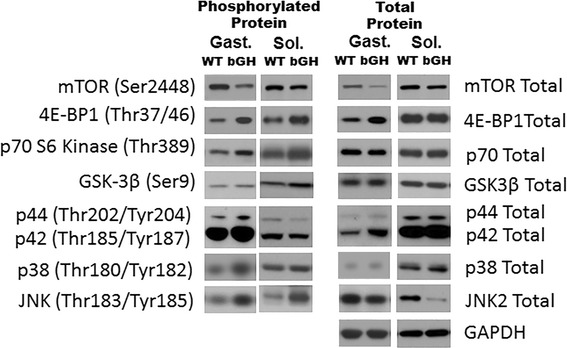
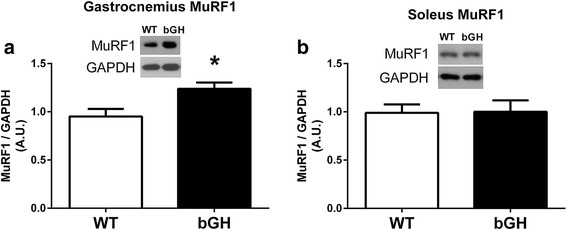
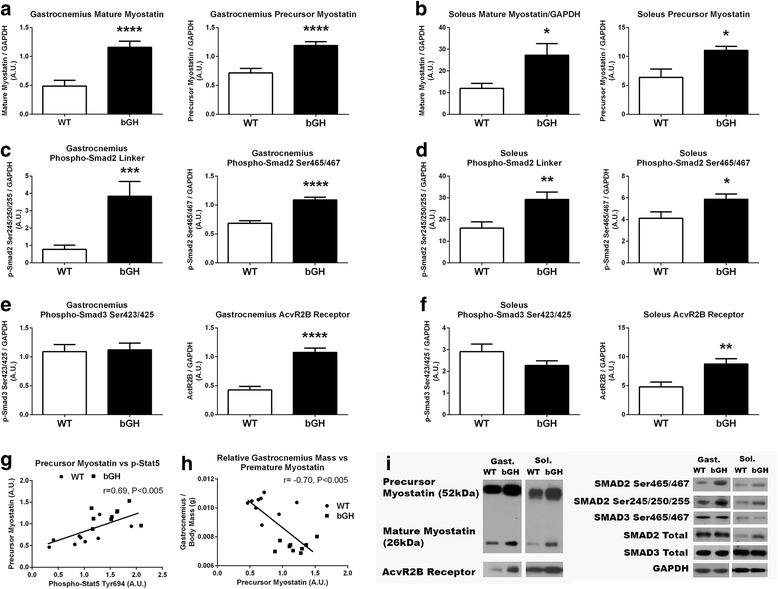
Total body mass was significantly increased in bGH mice compared to WT controls (49%, P < 0.0001). When expressed relative to total body mass, the gastrocnemius (- 28%, P < 0.0001), but not the soleus, was significantly lower in mice overexpressing GH, compared to controls. Transgenic bGH mice had elevated phosphorylation levels of protein kinase b (Akt1), 4E-binding protein 1 (4E-BP1), p70 S6 kinase, p42/44, and p38 (P < 0.05) compared to WT littermates. Mature myostatin (26 kDa), premature myostatin (52 kDa), and activin receptor type IIB (AcvR2B) protein levels were increased in bGH mice (P < 0.05), along with elevated phosphorylation levels of mothers against decapentaplegic homolog (Smad2) (59%, P < 0.0001). Mice overexpressing GH had increased MuRF1 expression (30%, P < 0.05) and insulin receptor substrate 1 (IRS1) serine phosphorylation (44%, P < 0.05) in the gastrocnemius, but not the soleus, when compared to controls.
These findings demonstrate that chronic elevations in circulating GH have a critical impact on signaling pathways involved in skeletal muscle protein synthesis and atrophy, and suggest that MuRF1, myostatin, and IRS1 serine phosphorylation may act to inhibit exaggerated glycolytic muscle growth, in environments of chronic GH/IGF-1 excess.
与生长激素 (GH) 对骨骼蛋白质合成的急性影响相反,长期 GH 治疗对肌肉质量似乎几乎没有影响。尽管有这些知识,但对于 GH 对骨骼肌肉蛋白质合成和萎缩信号通路的慢性影响知之甚少。本研究的目的是确定转基因牛 GH (bGH) 小鼠的骨骼肌中蛋白质合成途径是否减弱和/或肌肉萎缩细胞内信号通路是否改变。
从 5 月龄雄性 bGH 小鼠(n=9)和野生型(WT)对照(n=9)中采集比目鱼肌和腓肠肌,并分析参与蛋白质合成(Akt/mTOR)、生长和增殖(MAPK)以及肌肉萎缩(MuRF1 和肌肉生长抑制素)途径的蛋白质。
与 WT 对照相比,bGH 小鼠的总体重显著增加(49%,P<0.0001)。当相对于总体重表达时,与对照相比,过度表达 GH 的小鼠腓肠肌(-28%,P<0.0001)但不是比目鱼肌显著降低。转基因 bGH 小鼠的蛋白激酶 b(Akt1)、4E 结合蛋白 1(4E-BP1)、p70 S6 激酶、p42/44 和 p38 的磷酸化水平升高(P<0.05)与 WT 同窝仔相比。成熟肌肉生长抑制素(26 kDa)、早期肌肉生长抑制素(52 kDa)和激活素受体 IIB(AcvR2B)蛋白水平在 bGH 小鼠中升高(P<0.05),同时母亲对抗 decapentaplegic 同源物(Smad2)的磷酸化水平升高(59%,P<0.0001)。与对照组相比,过度表达 GH 的小鼠腓肠肌中 MuRF1 表达增加(30%,P<0.05)和胰岛素受体底物 1(IRS1)丝氨酸磷酸化增加(44%,P<0.05),但比目鱼肌没有增加。
这些发现表明,循环 GH 的慢性升高对骨骼肌肉蛋白质合成和萎缩相关信号通路有重大影响,并表明 MuRF1、肌肉生长抑制素和 IRS1 丝氨酸磷酸化可能作用于抑制慢性 GH/IGF-1 过量环境中过度的糖酵解肌肉生长。