Borrell Yaisel J, Miralles Laura, Do Huu Hoang, Mohammed-Geba Khaled, Garcia-Vazquez Eva
Department of Functional Biology, University of Oviedo, Oviedo, Spain.
Department of Aquaculture Biotechnology, Institute of Oceanography, Vietnam Academy of Science and Technology, Nha Trang, Vietnam.
PLoS One. 2017 Sep 5;12(9):e0183347. doi: 10.1371/journal.pone.0183347. eCollection 2017.
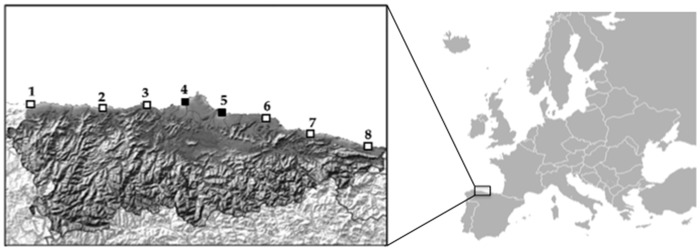
Biota monitoring in ports is increasingly needed for biosecurity reasons and safeguarding marine biodiversity from biological invasion. Present and future international biosecurity directives can be accomplished only if the biota acquired by maritime traffic in ports is controlled. Methodologies for biota inventory are diverse and now rely principally on extensive and labor-intensive sampling along with taxonomic identification by experts. In this study, we employed an extremely simplified environmental DNA (eDNA) sampling methodology from only three 1-L bottles of water per port, followed by metabarcoding (high-throughput sequencing and DNA-based species identification) using 18S rDNA and Cytochrome oxidase I as genetic barcodes. Eight Bay of Biscay ports with available inventory of fouling invertebrates were employed as a case study. Despite minimal sampling efforts, three invasive invertebrates were detected: the barnacle Austrominius modestus, the tubeworm Ficopomatus enigmaticus and the polychaete Polydora triglanda. The same species have been previously found from visual and DNA barcoding (genetic identification of individuals) surveys in the same ports. The current costs of visual surveys, conventional DNA barcoding and this simplified metabarcoding protocol were compared. The results encourage the use of metabarcoding for early biosecurity alerts.
出于生物安全原因以及保护海洋生物多样性免受生物入侵的需要,港口生物群监测变得越来越必要。只有对港口海上运输所携带的生物群进行管控,才能实现当前和未来的国际生物安全指令。生物群清查方法多种多样,目前主要依赖广泛且耗费人力的采样以及专家的分类鉴定。在本研究中,我们采用了一种极为简化的环境DNA(eDNA)采样方法,每个港口仅采集三瓶1升的水样,随后使用18S核糖体DNA和细胞色素氧化酶I作为基因条形码进行宏条形码分析(高通量测序和基于DNA的物种鉴定)。以八个有污损无脊椎动物清查记录的比斯开湾港口作为案例研究。尽管采样工作极少,但仍检测到了三种入侵性无脊椎动物:藤壶Austrominius modestus、管栖蠕虫Ficopomatus enigmaticus和多毛纲动物Polydora triglanda。此前在同一港口的目视调查和DNA条形码分析(个体的基因鉴定)中也发现了相同的物种。我们比较了目视调查、传统DNA条形码分析和这种简化宏条形码分析方案目前的成本。结果表明鼓励使用宏条形码分析来进行早期生物安全预警。